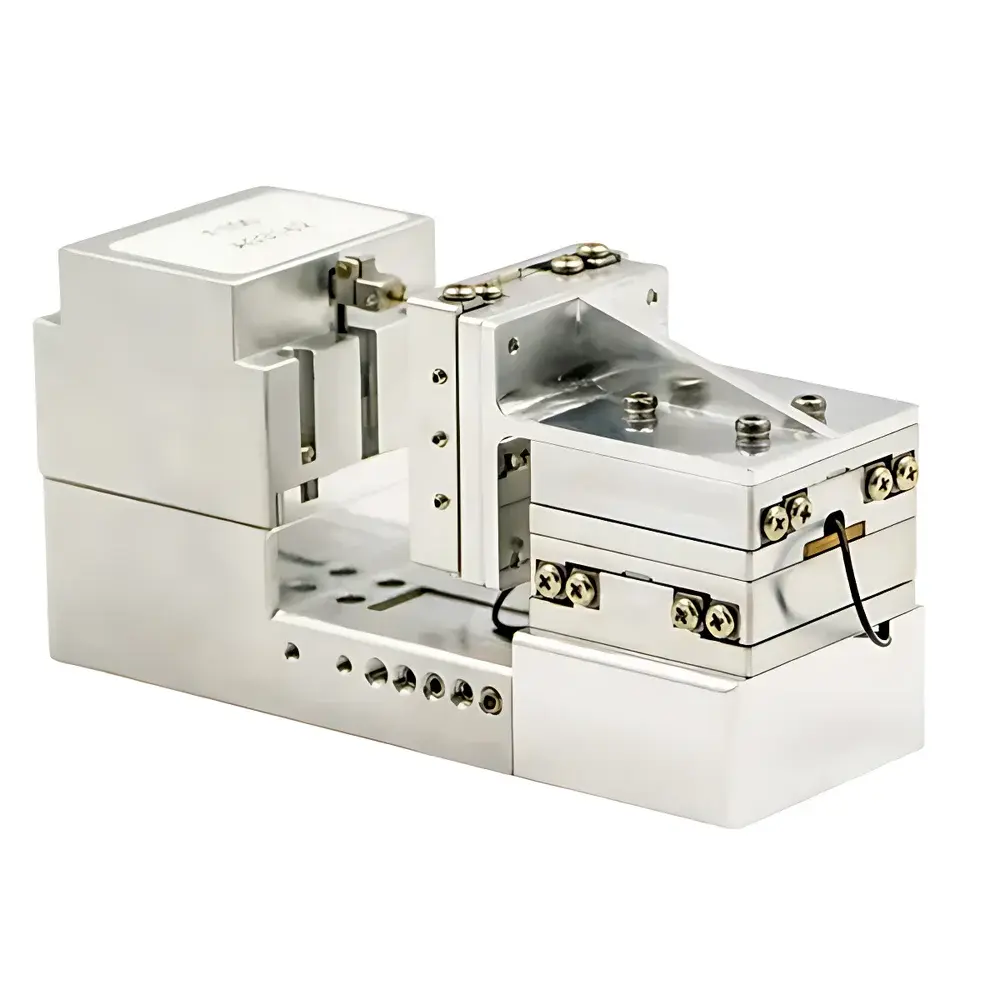
SEM Nanomechanical Testing System PicoFemto NI-100 by ZEPTOOLS
| Brand | ZEPTOOLS |
|---|---|
| Origin | Guangdong, China |
| Manufacturer Type | Original Equipment Manufacturer (OEM) |
| Country of Origin | China |
| Model | PicoFemto NI-100 |
| Pricing | Upon Request |
| Load Range | 100 mN |
| Force Resolution | 10 µN |
| Response Time | 50 ms |
| Closed-Loop XY Nanopositioning Stage | Travel ±20 µm (100 µm total), Positional Accuracy: 20 nm |
| Open-Loop XYZ Coarse Stage | XY ±10 mm, Z 10 mm, Minimum Step Size ≤1 nm |
| Dimensions (Nanoforce Stage Only) | 130 × 65 × 55 mm |
| Weight (Bare Stage) | ~300 g |
| Max Sample Size | 30 × 30 mm |
| Optional Modules | High-Temperature Heating (up to 400 °C), Electrical Biasing |
Overview
The ZEPTOOLS PicoFemto NI-100 SEM Nanomechanical Testing System is a purpose-built in situ nanomechanical characterization platform engineered for integration within scanning electron microscopes (SEMs). It operates on the principle of closed-loop piezoelectric actuation combined with high-fidelity capacitive or strain-gauge-based force transduction, enabling real-time, synchronized acquisition of mechanical response (load, displacement, stiffness) and high-resolution SEM imaging. Designed for quantitative nanoscale mechanical testing under vacuum-compatible conditions, the system supports quasi-static and dynamic loading protocols—including indentation, compression, tensile deformation, and scratch testing—while maintaining sub-20 nm positional fidelity and 10 µN force resolution. Its compact form factor (130 × 65 × 55 mm) and low mass (~300 g) minimize vibration coupling and thermal drift, ensuring stable, high-SNR video capture during prolonged in situ experiments.
Key Features
- Closed-loop nanomechanical actuation with 20 nm positional accuracy over ±20 µm range, enabling precise control of contact depth and loading trajectory during indentation or nanoindentation.
- Dual-stage architecture: integrated closed-loop fine stage (XY) and open-loop coarse stage (XYZ) with ≤1 nm step resolution, facilitating rapid sample positioning and high-precision local probing.
- Real-time force–displacement data acquisition at up to 20 Hz sampling rate, synchronized with SEM frame triggers for pixel-registered mechanical event mapping.
- Vacuum-compatible design rated for operation in standard SEM chambers (10⁻⁴ Pa or better), with feedthrough-compatible electrical interfaces for optional biasing and temperature control.
- Modular expansion interface supporting certified third-party and ZEPTOOLS-developed add-ons, including resistive heating stages (up to 400 °C), DC/AC electrical biasing modules, and optical access ports for correlative Raman or cathodoluminescence integration.
- Passive thermal stabilization architecture minimizing thermal drift (<0.5 nm/min at ambient stability), critical for multi-hour creep or relaxation measurements.
Sample Compatibility & Compliance
The PicoFemto NI-100 accommodates specimens up to 30 × 30 mm in planar dimension and compatible with standard SEM stubs and custom holders (e.g., TEM grid-based substrates, MEMS chips, thin-film stacks). All structural components are fabricated from non-magnetic, ultra-low-outgassing alloys (e.g., titanium alloy and ceramic composites) to prevent magnetic interference and maintain chamber vacuum integrity. The system conforms to ISO 14577-1:2015 (Metallic materials — Instrumented indentation test) for indentation methodology traceability and supports GLP-compliant data recording when paired with validated software configurations. Force calibration is traceable to NIST-certified reference standards via factory-applied load-cell certification reports.
Software & Data Management
Control and analysis are executed via ZEPTOOLS’ proprietary FemtoControl Suite, a Windows-based application compliant with FDA 21 CFR Part 11 requirements for electronic records and signatures (audit trail, user role management, data encryption). The software provides scriptable test sequences (Python API), real-time overlay of load–displacement curves onto live SEM frames, and automated feature tracking (e.g., crack initiation, pop-in events). Raw data is exported in HDF5 format with embedded metadata (timestamp, vacuum status, stage coordinates, calibration coefficients), ensuring FAIR (Findable, Accessible, Interoperable, Reusable) principles for long-term archival and cross-platform analysis (MATLAB, Python, Origin).
Applications
- Quantitative nanomechanical mapping of heterogeneous thin films (e.g., ALD oxides, 2D TMDs, perovskite photovoltaics) under controlled thermal or electrical bias.
- In situ fracture mechanics studies: real-time observation of crack nucleation, bridging, and deflection in brittle ceramics and metallic glasses.
- Mechanical property evolution during phase transformations—e.g., martensitic transitions in shape-memory alloys monitored via simultaneous DSC-SEM correlation.
- Nanoscale fatigue testing of MEMS/NEMS devices, including cycle-dependent modulus degradation and wear track formation.
- Cellular mechanobiology: compression and indentation of single adherent cells inside environmental SEM chambers with humidity and CO₂ control.
FAQ
Is the PicoFemto NI-100 compatible with field-emission SEMs (FE-SEMs)?
Yes—the system’s electromagnetic shielding, low-noise signal conditioning, and Faraday-cage-integrated cabling ensure stable operation in high-resolution FE-SEM environments without image distortion or signal interference.
Can force calibration be performed in-house?
Calibration requires traceable dead-weight or interferometric reference standards; ZEPTOOLS provides annual recalibration services and issues ISO/IEC 17025-accredited certificates. End users may perform verification checks using certified microforce standards.
Does the system support automated grid-based mapping?
Yes—FemtoControl Suite includes scripting tools for programmable array testing across user-defined coordinate grids, with automatic focus adjustment and stage repositioning between points.
What vacuum level is required for optimal performance?
Optimal mechanical stability is achieved at ≤10⁻⁴ Pa; however, functional operation is verified down to 10⁻² Pa for rapid prototyping or low-vacuum SEM configurations.
Are firmware updates provided post-purchase?
Yes—ZEPTOOLS delivers quarterly firmware and software updates via secure customer portal, including new test protocols, improved synchronization algorithms, and compatibility patches for newly released SEM models.