
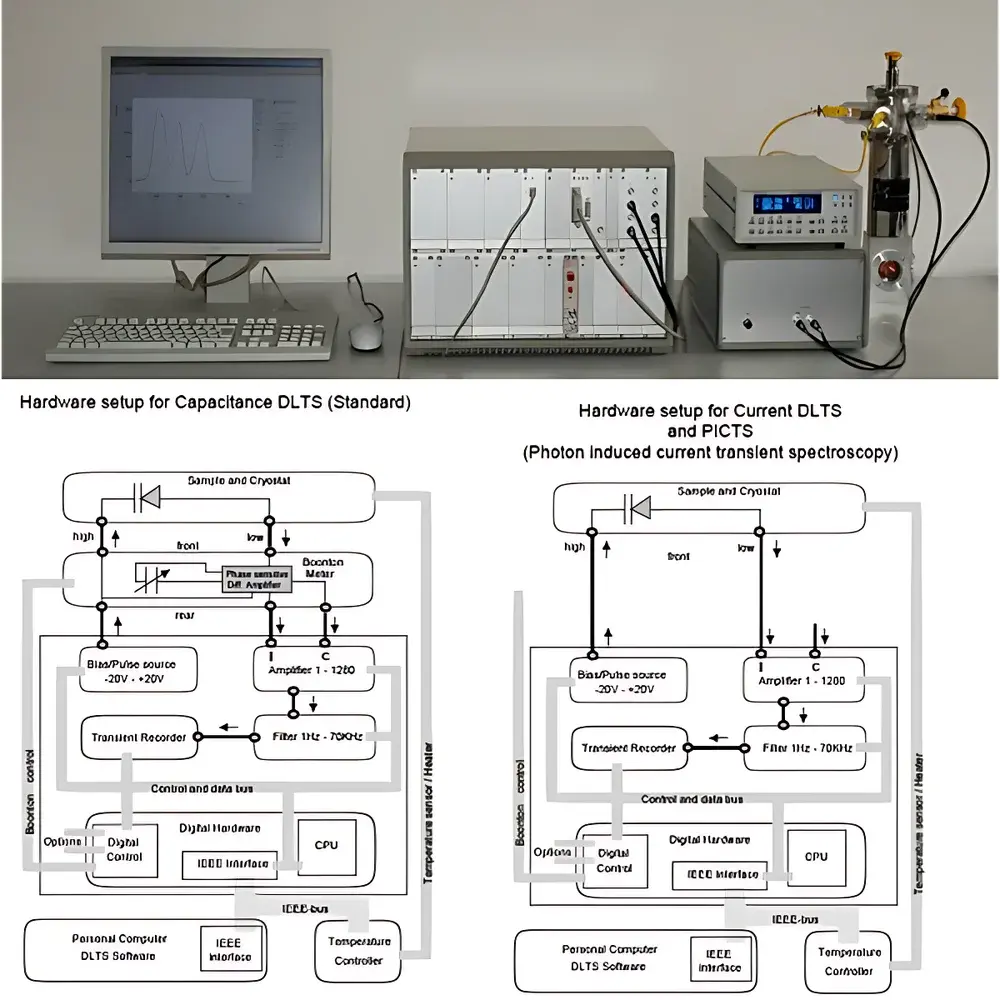
SEMETROL HERA-DLTS Deep Level Transient Spectroscopy System
| Brand | AML |
|---|---|
| Origin | USA |
| Manufacturer Type | Authorized Distributor |
| Origin Category | Imported |
| Model | SEMETROL HERA-DLTS |
| Price Range | USD 120,000 – 280,000 |
| Instrument Class | Semiconductor Defect Characterization System |
Overview
The SEMETROL HERA-DLTS is a high-precision deep level transient spectroscopy system engineered for quantitative defect characterization in semiconductor materials and devices. Based on the fundamental principle of thermally stimulated capacitance or current transients—arising from carrier emission from electrically active deep-level traps—the HERA-DLTS platform enables sub-meV energy resolution in trap level identification. First introduced by SEMETROL LLC (USA) in 1990 as the industry’s first fully digital DLTS system, it leverages modern computational architecture to execute real-time multi-exponential transient decomposition, Laplace inversion, and advanced spectral deconvolution without reliance on analog filtering. The system operates under controlled thermal ramping or isothermal conditions, supporting both cryogenic (4 K–500 K) and variable-temperature environments via integrated cryostat and temperature controller interfaces. Its core measurement fidelity stems from low-noise transimpedance amplification, high-stability bias sourcing, and synchronized digital lock-in detection—ensuring reproducible capture cross-section (σ), activation energy (ET), and trap concentration (NT) extraction per ASTM F1391 and ISO/IEC 17025-compliant workflows.
Key Features
- Automated contact integrity verification prior to transient acquisition
- Integrated capacitance compensation across wide dynamic range (10 fF–100 nF)
- Triple-terminal FET transient current measurement with gate-controlled bias sequencing
- Modular hardware architecture supporting upgrade paths for pulse timing resolution (<10 ns), sampling rate (up to 10 MS/s), and multi-channel parallel acquisition
- Native support for liquid nitrogen, closed-cycle helium, and resistive heating stages with ±0.1 K temperature stability
- Four primary DLTS operational modes: C-DLTS (capacitance), CC-DLTS (constant-capacitance), I-DLTS (current), and DD-DLTS (double-correlation)
- Extended functionality modules: Zerbst-DLTS, O-DLTS (optically excited), ITS (isothermal transient spectroscopy), PITS (photon-induced transient spectroscopy), and DLTFS (deep-level transient Fourier spectroscopy)
- 28 built-in correlation functions executable within a single temperature scan—enabling simultaneous trap profiling across multiple emission time constants
Sample Compatibility & Compliance
The HERA-DLTS accommodates standard semiconductor wafer formats (up to 200 mm diameter), discrete diodes, Schottky and p-n junctions, MOS capacitors, and III–V heterostructures. It interfaces seamlessly with probe stations (e.g., Cascade Microtech, Micromanipulator), vacuum chambers, and magnetic field accessories (up to 9 T). All signal processing routines—including Fourier transform DLTS (F-DLTS), Laplace DLTS (L-DLTS), and multi-exponential fitting—adhere to traceable calibration protocols aligned with NIST-traceable reference standards. Software audit trails, electronic signatures, and 21 CFR Part 11–compliant user access control are available via optional GxP module for GLP/GMP-regulated laboratories.
Software & Data Management
HERA-Control Suite v6.x provides full instrument orchestration, real-time transient visualization, and post-acquisition analysis using MATLAB-based scripting engine. Key capabilities include: user-defined windowing and baseline correction; automatic peak search with statistical confidence scoring (p < 0.01); Richardson plot generation for thermionic emission analysis; C/V(T) and I/V(T) sweep integration; and TSC/TSCAP data export in HDF5 and ASCII formats. Raw datasets retain full metadata (temperature ramp rate, pulse amplitude/duration, averaging cycles, lock-in parameters), ensuring full experimental reproducibility. Export modules support direct import into OriginLab, Igor Pro, and Python-based analysis pipelines (NumPy/SciPy).
Applications
- Quantitative mapping of deep-level impurity states in Si, SiC, GaN, GaAs, and CdTe photovoltaic absorbers
- Interface trap density (Dit) profiling in high-k dielectric stacks
- Defect evolution monitoring during ion implantation annealing, hydrogen passivation, or radiation damage studies
- Trap-assisted tunneling characterization in FinFET and nanowire channel devices
- Correlation of DLTS spectra with minority-carrier lifetime (τeff) measured via µ-PCD or QSSPC
- Validation of TCAD simulation parameters for trap energy distribution and capture cross-section anisotropy
FAQ
What cooling systems are compatible with the HERA-DLTS?
Liquid nitrogen dewars, closed-cycle cryocoolers (e.g., Janis ST-500, BlueFrog), and resistive heating stages with PID feedback are fully supported via IEEE-488 (GPIB) or USB-TMC interface.
Does the system support automated temperature scanning with data synchronization?
Yes—HERA-Control Suite executes linear, stepwise, or custom temperature ramps while synchronizing pulse triggering, data acquisition, and metadata logging at millisecond resolution.
Can the software perform Laplace inversion on raw transient data?
Yes—L-DLTS mode implements robust numerical inverse Laplace transform using the Jentzsch algorithm with regularization parameter optimization, yielding continuous trap energy spectra.
Is third-party probe station integration possible?
All major manual and semi-automated probe stations (Cascade, Micromanipulator, MPI) are supported via TTL trigger I/O and programmable bias source control.
How is measurement uncertainty quantified in HERA-DLTS reports?
Uncertainty propagation is calculated per GUM (JCGM 100:2008) for each extracted parameter—factoring in thermal sensor drift, capacitance meter accuracy (±0.1%), and transient noise floor (typically <50 fA RMS).





