
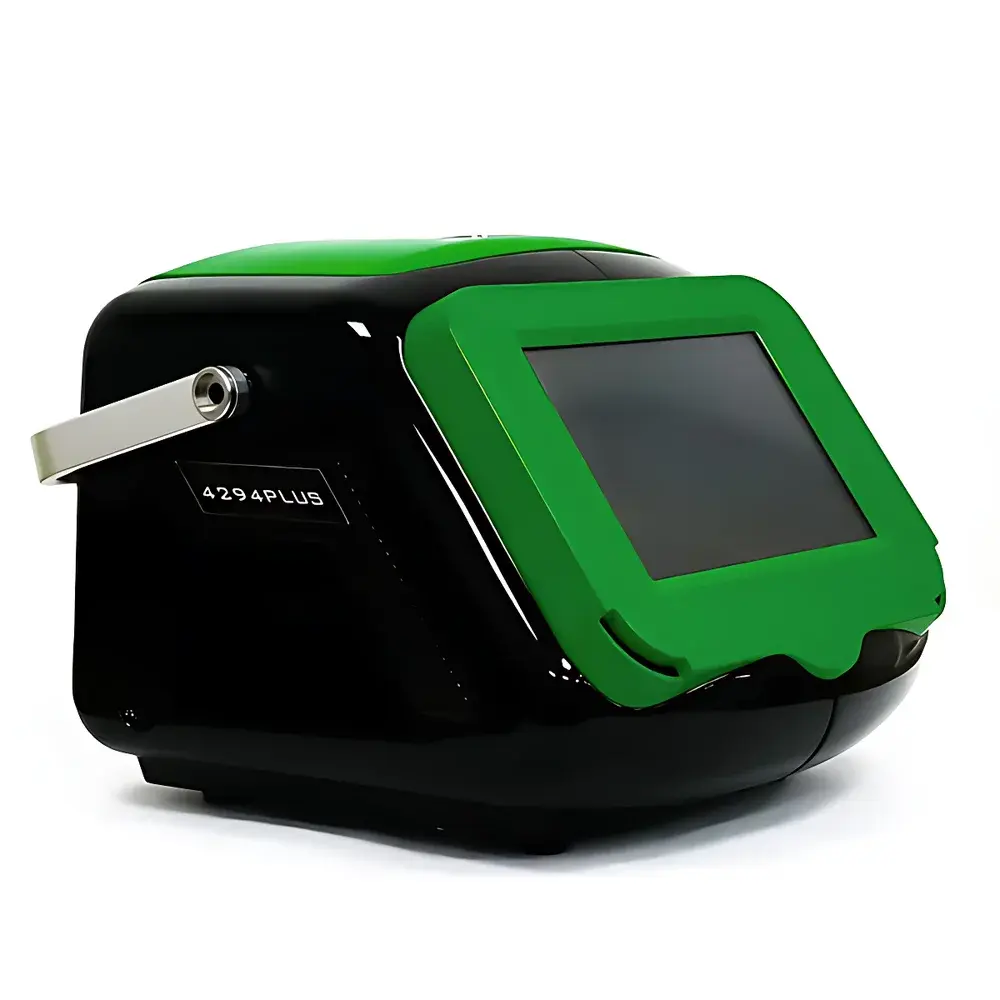
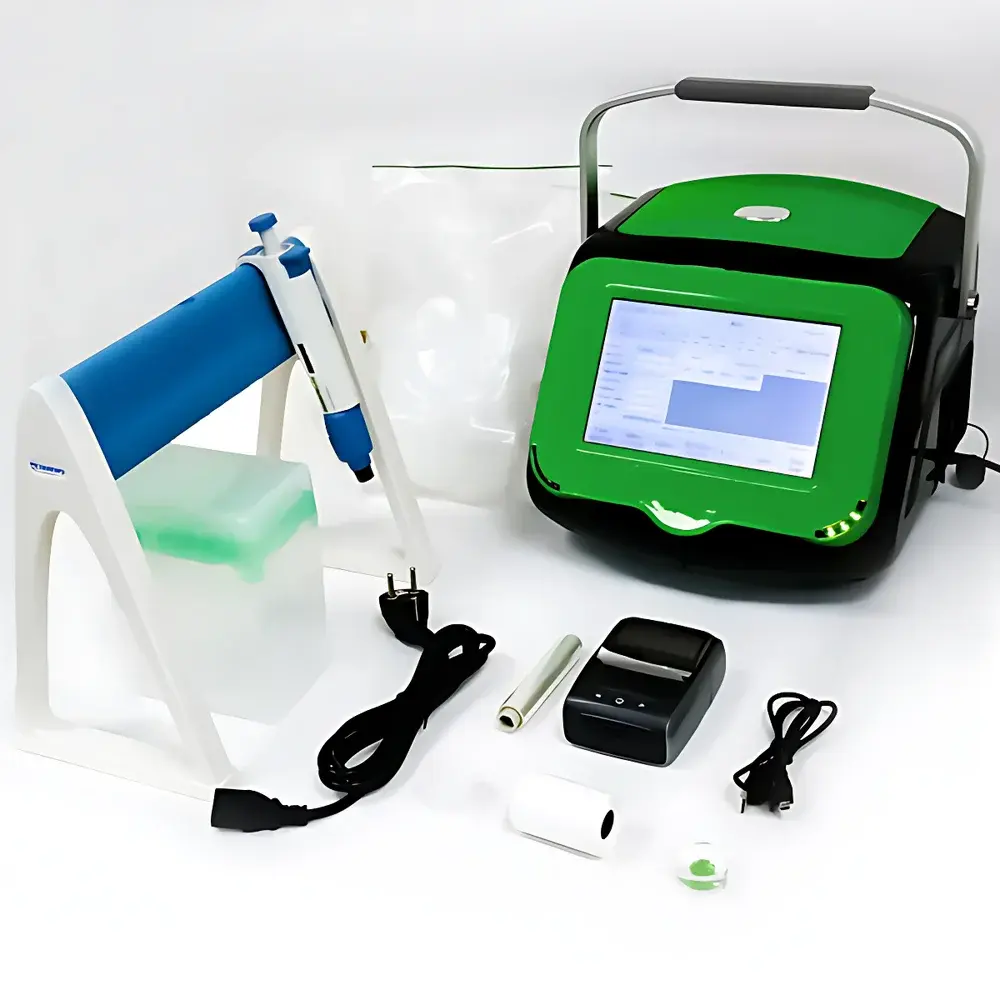
Senbe Compass 4294 Plus Portable EDXRF Sulfur and Chlorine Analyzer for Petroleum Products
| Brand | Senbe |
|---|---|
| Origin | Jiangsu, China |
| Manufacturer Type | Direct Manufacturer |
| Origin Category | Domestic |
| Model | Compass 4294 Plus |
| Pricing | Upon Request |
| Analytical Principle | Energy-Dispersive X-ray Fluorescence (EDXRF) |
| Detector | High-Resolution Peltier-Cooled Fast Silicon Drift Detector (FSDD), FWHM <130 eV (Mn Kα) |
| Max Input Count Rate | 500,000 cps |
| Vacuum Capability | Integrated Miniature Vacuum Pump |
| Measurement Time | 130–300 s (user-configurable) |
| Sample Forms | Liquids, Solids, Powders |
| Operating Temperature | −20 to 50 °C |
| Dimensions (L×W×H) | 270 × 320 × 230 mm |
| Sample Chamber Size | 170 × 110 × 17 mm |
| Weight | 10.5 kg |
| Display | 8-inch Touchscreen (1280 × 800), Windows 10 OS |
| Data Interfaces | USB, Bluetooth, Wi-Fi, GPS |
| Safety | Interlocked Radiation Shielding, Real-Time Dose Indicator |
| Calibration | Auto-startup Calibration, Factory-Preloaded Calibration Curves (Low-S: 0–100 ppm |
| High-S | 0.01–5 wt% |
| Cl | 0–100 ppm) |
| Compliance Standards | GB/T 17040–2008, GB/T 17060–1998, GB/T 380–1977, GB/T 17411–2015, SH/T 0253–1992, ASTM D4294, ISO 8754, ISO 20847, IP 336, ASTM D6445, IP 496, ASTM D7220 |
Overview
The Senbe Compass 4294 Plus is a field-deployable, benchtop-compatible energy-dispersive X-ray fluorescence (EDXRF) analyzer engineered for the simultaneous, non-destructive quantification of sulfur (S) and chlorine (Cl) in petroleum-based fuels and lubricants. It operates on fundamental EDXRF principles: primary X-rays from a 4 W, 50 kV/200 µA micro-focus X-ray tube excite characteristic fluorescent emissions from S (Kα at 2.307 keV) and Cl (Kα at 2.622 keV); these emissions are resolved by a high-resolution, Peltier-cooled fast silicon drift detector (FSDD) with spectral resolution <130 eV (FWHM at Mn Kα). The integrated vacuum chamber eliminates atmospheric absorption of low-energy S and Cl X-rays—enhancing detection sensitivity by >3× compared to ambient-air operation—and enables reliable measurement across a dynamic range from 2 ppm to 10 wt% for sulfur and up to 100 ppm for chlorine. Designed for compliance-driven environments—including marine fuel verification under China’s MARPOL Annex VI-aligned control zones and refinery QC per GB/T 17411–2015 and ASTM D4294—the Compass 4294 Plus delivers trace-level precision without consumable gases or chemical reagents.
Key Features
- Integrated vacuum system with miniature diaphragm pump—no external vacuum source required, enabling rapid (<60 s) evacuation to <10 Pa for optimal low-Z element sensitivity
- Peltier-cooled FSDD detector with high count-rate capability (up to 500,000 cps) and exceptional energy resolution (<130 eV), ensuring accurate peak deconvolution of overlapping S, Cl, and matrix elements (e.g., Ca, Fe, Ni)
- Optimized optical path design featuring dual-collimated excitation geometry and low-background beryllium window, reducing continuum background and improving signal-to-noise ratio
- Full-touch 8-inch Windows 10 interface with intuitive workflow navigation—single-tap “Start Test” initiates auto-calibration, vacuum draw, acquisition, and quantitative reporting
- Ruggedized aluminum-magnesium alloy chassis rated IP54 for dust/moisture resistance; operational in −20 to 50 °C ambient conditions
- Optional high-capacity Li-ion battery pack supporting ≥8 hours of continuous field operation without AC power
- Zero-gas-consumption operation—eliminates dependency on helium, argon, or nitrogen purge systems common in wavelength-dispersive (WDXRF) or combustion-based analyzers
Sample Compatibility & Compliance
The Compass 4294 Plus accommodates liquid fuels (gasoline, diesel, marine distillates, residual fuel oil), crude oil samples (homogenized or filtered), solid catalysts, and powdered additives. Liquid samples are introduced into standardized polypropylene cups sealed with ultrathin (6 µm) X-ray-transparent polymer film. Solid samples require minimal preparation—flat-surface placement or pelletization is sufficient. All measurements adhere to internationally recognized regulatory frameworks: ASTM D4294 (standard test method for sulfur in petroleum and petroleum products by EDXRF), ISO 8754 (petroleum products—determination of sulfur content—EDXRF method), ISO 20847 (automotive fuels—determination of chlorine content), and China’s GB/T 17040–2008 (petroleum products—determination of sulfur content—EDXRF method). Its performance has been validated against certified reference materials (CRMs) across multiple matrices, demonstrating RSD ≤2.84% for sulfur at 50 ppm and ≤2.42% for chlorine at 100 ppm—meeting GLP data integrity requirements for routine QC laboratories.
Software & Data Management
The embedded Windows 10 platform runs Senbe’s proprietary QuantStudio™ v3.2 analysis suite, compliant with FDA 21 CFR Part 11 for electronic records and signatures. Software features include audit-trail logging (user actions, calibration events, result modifications), role-based access control, and encrypted local database storage. Quantitative results export natively to Excel (.xlsx) and PDF formats—with customizable report templates including sample ID, operator, timestamp, vacuum status, measurement duration, and uncertainty estimates. Raw spectra are saved in .spe format for offline review. Bluetooth and Wi-Fi connectivity enable secure transfer to LIMS or cloud-based QA/QC dashboards. Firmware updates and method libraries are delivered via USB or over-the-air (OTA) with cryptographic signature verification.
Applications
- Marine fuel verification at bunkering terminals and port state control inspections—ensuring compliance with 0.10 wt% sulfur limit in Emission Control Areas (ECAs) per China’s 2022 Maritime Fuel Regulation
- In-line QC for refinery hydrotreating units—monitoring sulfur breakthrough in real time to optimize catalyst life and H₂ consumption
- Crude assay screening for organochloride contaminants (e.g., chlorinated paraffins, alkyl chlorides) that cause overhead corrosion in atmospheric/vacuum distillation units
- Finished product release testing for gasoline (GB 17930–2016, ≤10 ppm S), diesel (GB 19147–2016, ≤10 ppm S), and marine gas oil (ISO 8217:2017, RMG 380/RMA 10)
- Field analysis of lubricating oils and greases for wear metal and contaminant profiling (S, Cl, Ca, Zn, P)
- Research applications in alternative fuel development—including bio-diesel blends and synthetic hydrocarbons—where halogen impurity control is critical for emission system durability
FAQ
Does the Compass 4294 Plus require daily recalibration?
No. Factory-installed calibration curves are stable for ≥6 months under normal operating conditions. A quick startup self-check verifies detector gain and tube output; full recalibration is only needed after hardware service or when analyzing non-routine matrices.
Can it measure other elements besides sulfur and chlorine?
Yes. The FSDD and broad-spectrum X-ray tube support quantitative analysis of Mg, Al, Si, P, S, Cl, K, Ca, Ti, V, Cr, Mn, Fe, Ni, Cu, Zn, and Pb—subject to concentration, matrix effects, and detection limits. Multi-element methods are configurable via QuantStudio™.
Is vacuum operation mandatory for all samples?
Vacuum is required for sulfur quantification below 50 ppm and for chlorine analysis at any concentration. For high-sulfur fuels (>1 wt%), air-mode measurement is permissible but yields reduced precision and higher LODs.
How is radiation safety ensured during field use?
The instrument incorporates redundant safety interlocks: automatic beam shutdown upon chamber door opening, real-time radiation dose monitoring with LED warning indicator, and lead-shielded primary beam path. It meets IEC 61010-1 and GB 4793.1–2007 radiation safety standards for Class II analytical X-ray equipment.
What sample volume is required for liquid analysis?
Minimum fill volume is 3 mL in standard 35-mm-diameter sample cups. Surface tension and viscosity are compensated algorithmically; no internal standard addition is necessary for routine fuels.




