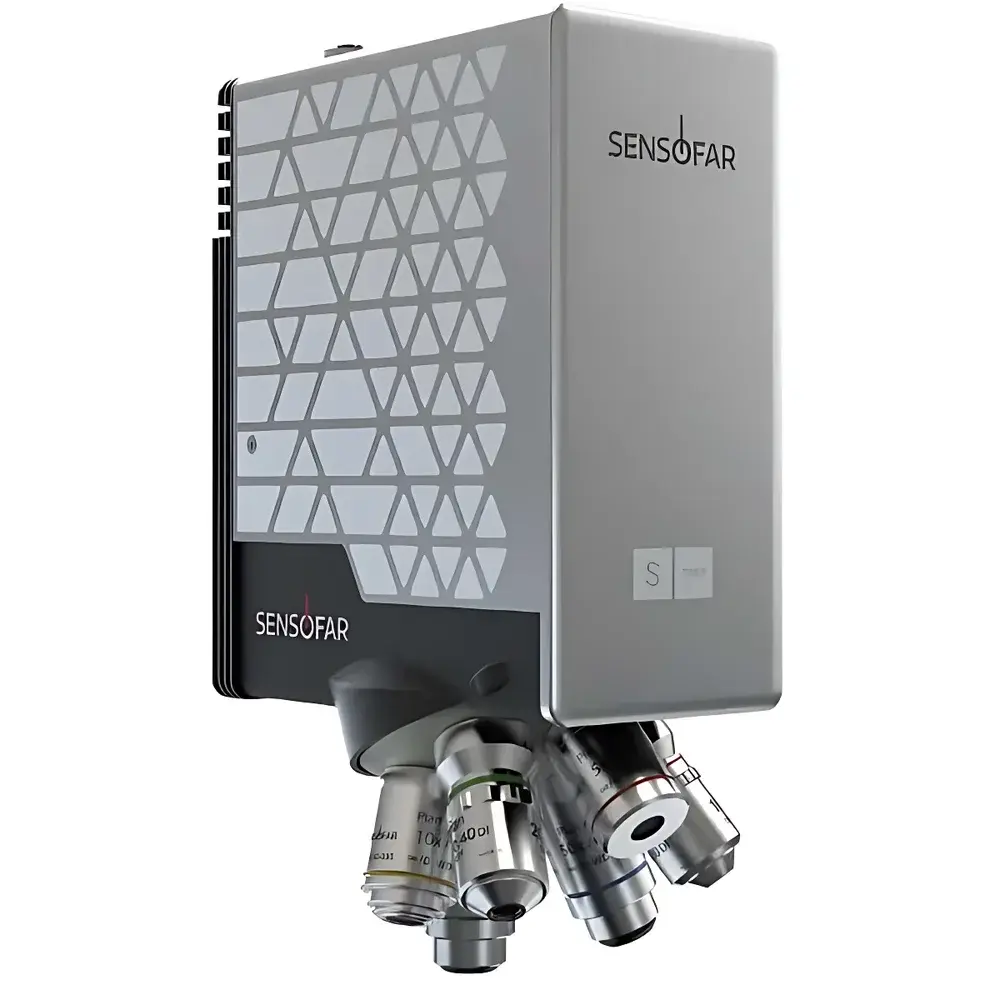
Sensofar S mart2 Integrated Confocal and White-Light Interferometry Sensor Head
| Brand | Sensofar |
|---|---|
| Origin | Spain |
| Model | S mart2 |
| Product Type | Non-contact 3D Optical Profilometer Sensor Head |
| Measurement Principle | White-Light Interferometry (WLI) with Extended PSI (ePSI), Confocal Microscopy, and AI-powered Multi-Focal Plane Synthesis (Ai-Fusion) |
Overview
The Sensofar S mart2 is an integrated, compact 3D optical profilometry sensor head engineered for high-precision surface topography and roughness characterization in industrial metrology and R&D environments. Unlike point-scanning or line-profile systems, the S mart2 delivers true area-based (areal) measurement using three complementary optical modalities—white-light interferometry (WLI), confocal microscopy, and AI-driven multi-focal plane synthesis (Ai-Fusion)—within a single, self-contained optical head. Its core measurement principle relies on spectral-domain white-light interferometry (including extended phase-shifting interferometry, ePSI), enabling sub-nanometer vertical resolution and nanometer-level repeatability across full-field acquisition. The system is designed for traceable metrology: lateral (X–Y) resolution remains uniform across the field of view, and vertical calibration is traceable to national metrology institutes including PTB (Germany), NPL (UK), and NIST (USA) via certified reference standards.
Key Features
- Integrated optical sensor head housing all critical electronics—including FPGA-based real-time processing unit, illumination control, and camera interface—eliminating external controller cabinets.
- Dual-mode optical architecture supporting WLI (for smooth to moderately rough surfaces), confocal imaging (for high-slope or reflective features), and Ai-Fusion (for robust focus stacking across complex topographies).
- Compact mechanical footprint optimized for OEM integration into automated production cells, coordinate measuring machines (CMMs), or inline inspection stations—reduced width minimizes interference with robotic arms or part handling systems.
- Plug-and-play connectivity: only two physical interfaces required—standard Gigabit Ethernet (for data and command transmission) and 24 V DC power supply—enabling rapid deployment and deterministic synchronization with host automation systems.
- Automated measurement workflow: autofocus, adaptive illumination optimization, and intelligent scan range selection are executed autonomously upon initiation; no manual parameter tuning required for routine measurements.
- Real-time surface reconstruction with hardware-accelerated phase unwrapping and noise suppression algorithms, ensuring high fidelity even on low-contrast or semi-transparent materials.
Sample Compatibility & Compliance
The S mart2 accommodates a broad spectrum of sample types—including polished metals, silicon wafers, optical lenses, MEMS devices, medical implants, and coated substrates—without contact-induced deformation or contamination. Its non-destructive optical approach complies with ISO 25178-601 (areal surface texture parameters), ISO 25178-701 (calibration of areal instruments), and ASTM E2947 (standard guide for 3D surface topography measurement). For regulated industries, the system supports audit-ready operation when paired with Sensofar’s Metrology Suite software configured under GLP/GMP-compliant workflows, including electronic signatures, change control logs, and 21 CFR Part 11–ready user access management.
Software & Data Management
The S mart2 operates exclusively with Sensofar’s Metrology Suite—a modular, Windows-based platform supporting scripting (Python API), batch processing, and customizable reporting templates compliant with ISO/IEC 17025 documentation requirements. Raw interferograms and confocal stacks are stored in vendor-neutral HDF5 format with embedded metadata (exposure time, objective ID, calibration timestamp, operator ID). Data export options include ISO-standardized .sur files, CSV-aligned height matrices, and STEP AP210 surface geometry exports for CAD comparison. Version-controlled software updates and firmware patches are distributed through Sensofar’s secure customer portal, with full revision history and validation documentation available upon request.
Applications
- Wafer-level metrology for semiconductor process control (e.g., trench depth, CMP uniformity, photoresist profile analysis).
- Optical component certification—measuring surface irregularity (PV, RMS), scratch/dig, and coating thickness on lenses, filters, and laser optics.
- Medical device quality assurance—quantifying surface finish of orthopedic implants, stent strut geometry, and microfluidic channel fidelity.
- MEMS/NEMS characterization—capturing dynamic deformation, actuator displacement, and packaging-induced warpage at sub-micron resolution.
- Automotive precision components—validating cylinder bore cross-hatch angles, gear tooth flank form, and injection-molded plastic surface texture.
- Academic surface science research—correlating topography with functional properties such as wettability, adhesion, or tribological behavior.
FAQ
Is the S mart2 suitable for in-line manufacturing environments?
Yes—the sensor head is IP52-rated for dust resistance, operates within 15–35 °C ambient temperature, and features vibration-insensitive optical design optimized for integration into robotic workcells and gantry-mounted inspection systems.
Can it measure transparent or highly reflective surfaces?
Yes—via adaptive polarization control, variable coherence length adjustment, and confocal mode selection, the S mart2 maintains measurement stability on fused silica, sapphire, gold-plated surfaces, and anti-reflective coatings.
Does it support automated pass/fail decision-making?
Yes—Metrology Suite includes rule-based tolerance evaluation engines that generate binary compliance outputs compatible with PLC handshaking or MES-level data ingestion via OPC UA or RESTful API.
What calibration services are available?
Sensofar offers factory-traceable calibration certificates (ISO/IEC 17025 accredited by ENAC) for Z-axis linearity, XY spatial calibration, and step-height verification using NIST-traceable step standards.
How is software validation handled for regulated industries?
Sensofar provides IQ/OQ documentation packages, installation qualification checklists, and performance verification protocols aligned with FDA and EU MDR expectations—available under NDA for pharmaceutical, biotech, and Class III medical device manufacturers.