
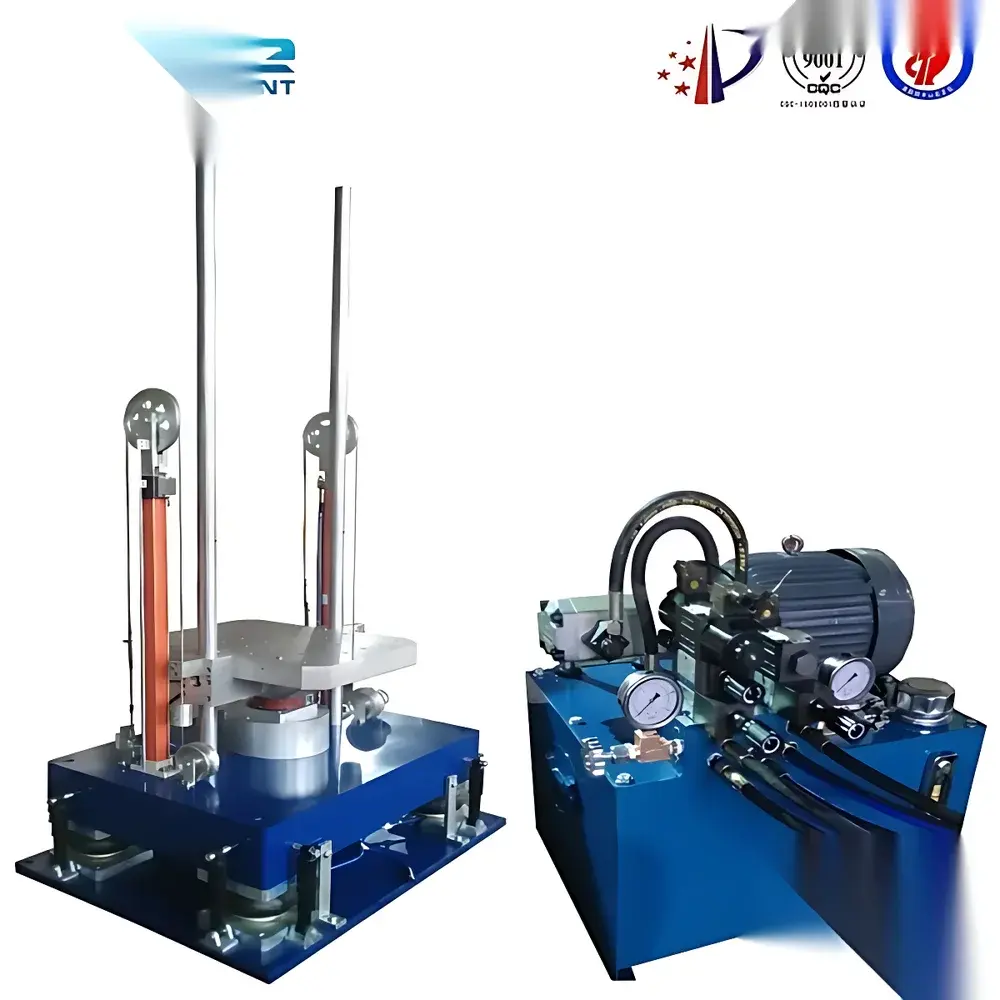
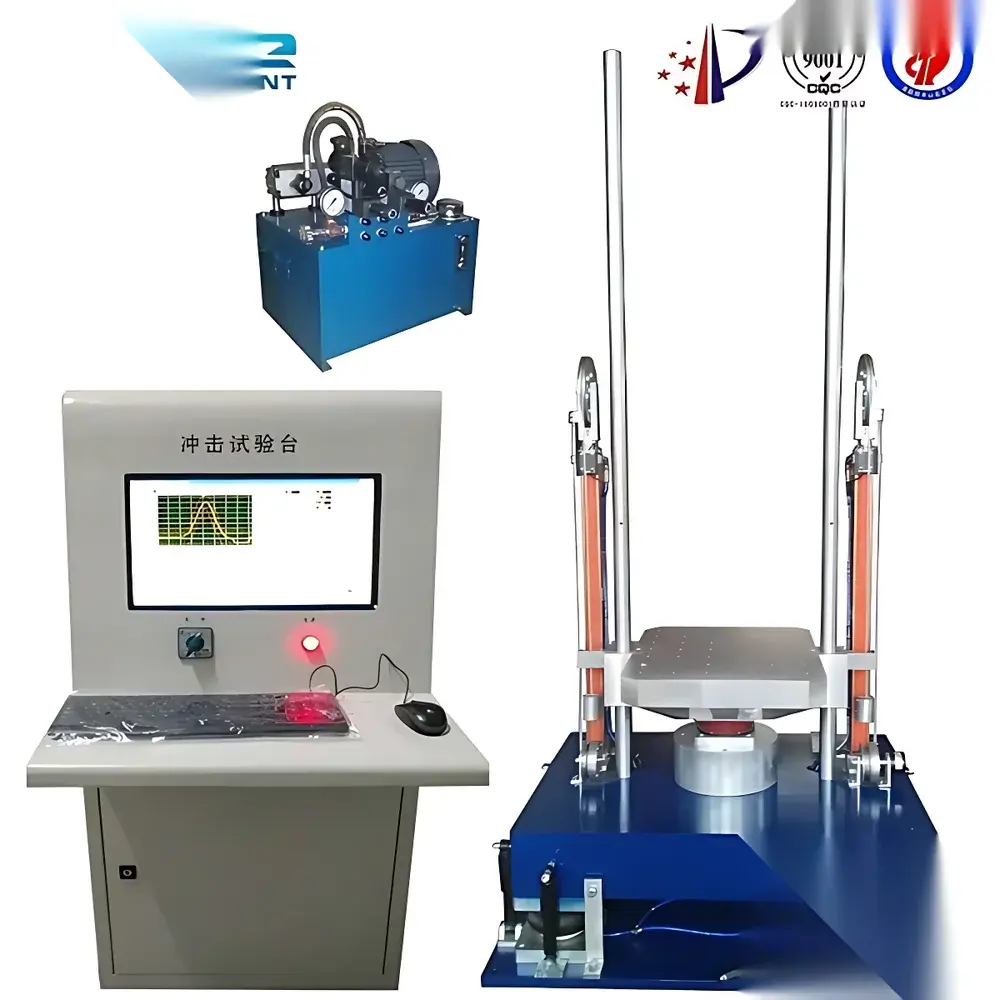
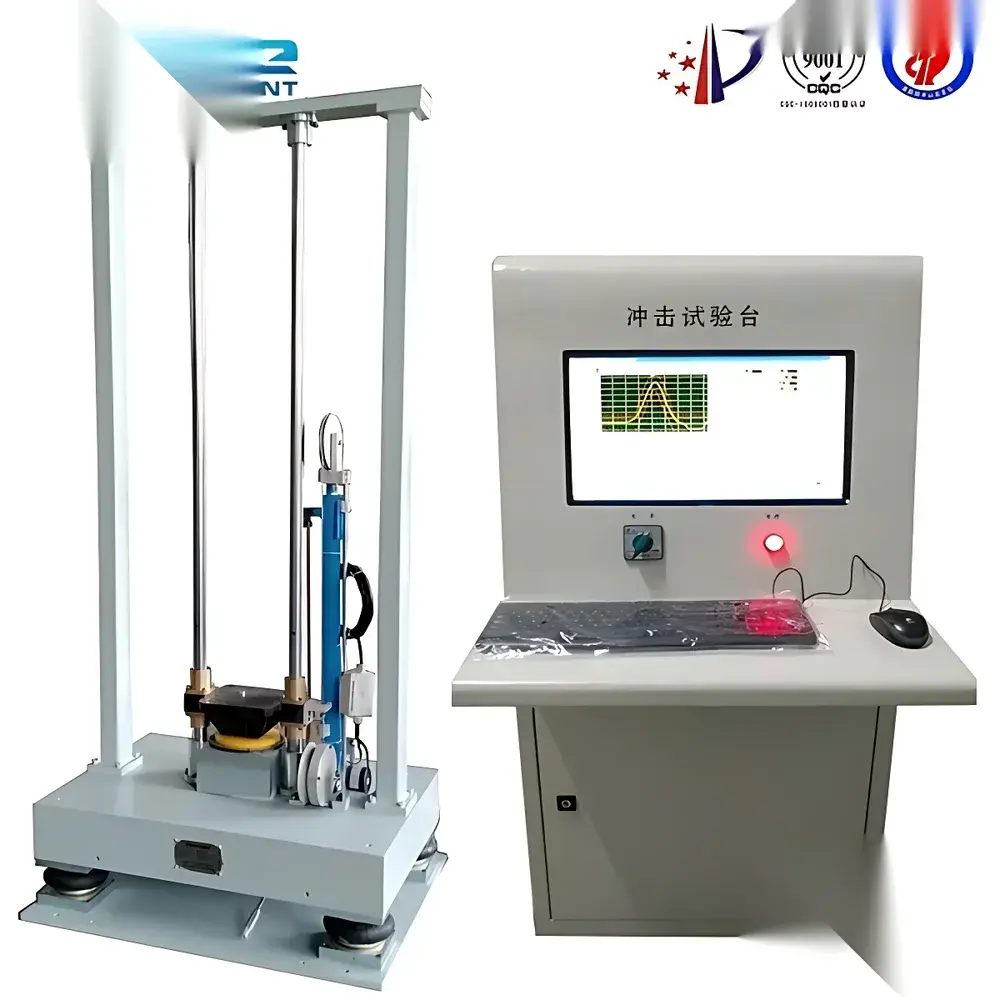
OK-S Series Electromechanical Shock Testing System
| Brand | Other Brands |
|---|---|
| Origin | Imported |
| Manufacturer Type | Authorized Distributor |
| Price | USD 16,500 (FOB) |
| Max Load Capacity | 2–300 kg |
| Table Size | 116×100 mm to 1050×1200 mm |
| Peak Acceleration Range | 150–30,000 m/s² (Half-Sine, Trapezoidal, Post-Peak Sawtooth Waveforms) |
| Pulse Duration | 0.2–30 ms |
| Control OS | Windows XP Embedded |
| Data Acquisition | Real-time FIR Digital Filtering, Auto-Gain Adjustment, Parameter Auto-Extraction (Peak Accel, Δv, Pulse Width) |
Overview
The OK-S Series Electromechanical Shock Testing System is a precision-engineered platform designed for controlled mechanical shock simulation in compliance with international environmental stress testing standards. Unlike pneumatic or drop-tower systems, this electromechanical design delivers repeatable, programmable shock pulses—half-sine, trapezoidal, and post-peak sawtooth waveforms—with deterministic control over acceleration magnitude, pulse duration, and velocity change (Δv). The system operates on a Windows XP Embedded real-time control architecture, enabling deterministic data acquisition at sub-millisecond resolution. It is engineered for laboratory-based qualification testing of electronic assemblies, aerospace components, automotive ECUs, and military-grade enclosures where waveform fidelity, traceability, and reproducibility are critical per MIL-STD-810H, IEC 60068-2-27, and GB/T 2423.5.
Key Features
- Real-time waveform generation and closed-loop control via high-fidelity servo amplifier and linear actuator architecture.
- Programmable pulse shaping: user-defined half-sine, trapezoidal, and post-peak sawtooth profiles with adjustable rise/fall symmetry.
- Integrated signal conditioning: automatic gain adjustment and FIR digital filtering with selectable cutoff frequencies to suppress aliasing and noise without phase distortion.
- On-the-fly parameter extraction: automated calculation and display of peak acceleration (g), pulse width (ms), velocity change (m/s), and zero-crossing count.
- Dual acquisition modes: single-shot trigger capture for qualification tests and continuous streaming for durability screening or failure mode analysis.
- Comprehensive data management: timestamped storage of raw time-history data, metadata (test ID, operator, standard reference), and waveform envelopes in binary and CSV formats.
- Preloaded waveform tolerance bands aligned with GB/T 2423.5–1995, GJB 150.18A–2012, GJB 360B–2009, GJB 548B–2005, and IEC 60068-2-27:2008.
Sample Compatibility & Compliance
The OK-S Series accommodates test specimens from small PCB modules (≤2 kg) up to large avionics chassis (≤300 kg), supported by interchangeable table platforms ranging from 116×100 mm to 1050×1200 mm. Mounting interfaces comply with ISO 5344:2004 mechanical interface specifications. All models meet electromagnetic compatibility (EMC) requirements per EN 61326-1:2013 for laboratory equipment. Calibration traceability follows ISO/IEC 17025:2017 guidelines, with optional NIST-traceable accelerometer verification kits available. The system supports audit-ready operation under GLP and GMP environments when paired with validated software configuration and electronic signature modules.
Software & Data Management
The embedded control software provides full waveform definition, real-time oscilloscope-style visualization, and automated pass/fail evaluation against user-selected tolerance bands. Raw acceleration time-series data are stored in IEEE 754-compliant binary format with header metadata for interoperability with MATLAB, Python (NumPy/Pandas), and commercial CAE tools. Reporting functionality exports compliant test records—including annotated shock curves, statistical summaries (min/max/mean of multiple runs), and pass/fail status—to editable Word (.docx) and PDF formats. Database schema supports SQL Server Express integration for enterprise-level test record archiving, version-controlled test method libraries, and role-based access control (RBAC) for multi-user labs.
Applications
- Qualification testing of printed circuit board assemblies (PCBAs) per IPC-J-STD-002 and JEDEC JESD22-B110.
- Environmental stress screening (ESS) of mission-critical sensors and inertial measurement units (IMUs) used in UAVs and satellite subsystems.
- Shock survivability validation of medical device enclosures under FDA guidance for Class II/III devices (21 CFR Part 820).
- Design verification of consumer electronics housings subjected to accidental drop or transport shock per IEC 60068-2-32.
- Reliability assessment of battery packs and power electronics under mechanical shock-induced solder joint fatigue.
FAQ
What shock waveforms does the OK-S Series support?
The system generates half-sine, trapezoidal, and post-peak sawtooth waveforms with fully adjustable amplitude, duration, and symmetry parameters.
Is the software compliant with FDA 21 CFR Part 11?
Yes—when deployed with optional audit trail logging, electronic signatures, and user access controls, the software meets Part 11 requirements for electronic records and signatures.
Can the system be integrated into an existing lab automation framework?
Yes—it provides TCP/IP and RS-232 communication protocols, SCPI command set, and DLL-based API for integration with LabVIEW, TestStand, or custom MES platforms.
What calibration documentation is provided with shipment?
Each unit ships with a factory calibration certificate referencing ISO/IEC 17025-accredited procedures, including accelerometer sensitivity, table flatness, and pulse repeatability metrics.
Does the system support third-party accelerometers?
Yes—the analog input channel accepts IEPE and charge-mode sensors with configurable gain and bias settings; TEDS-enabled transducers are also supported.



