
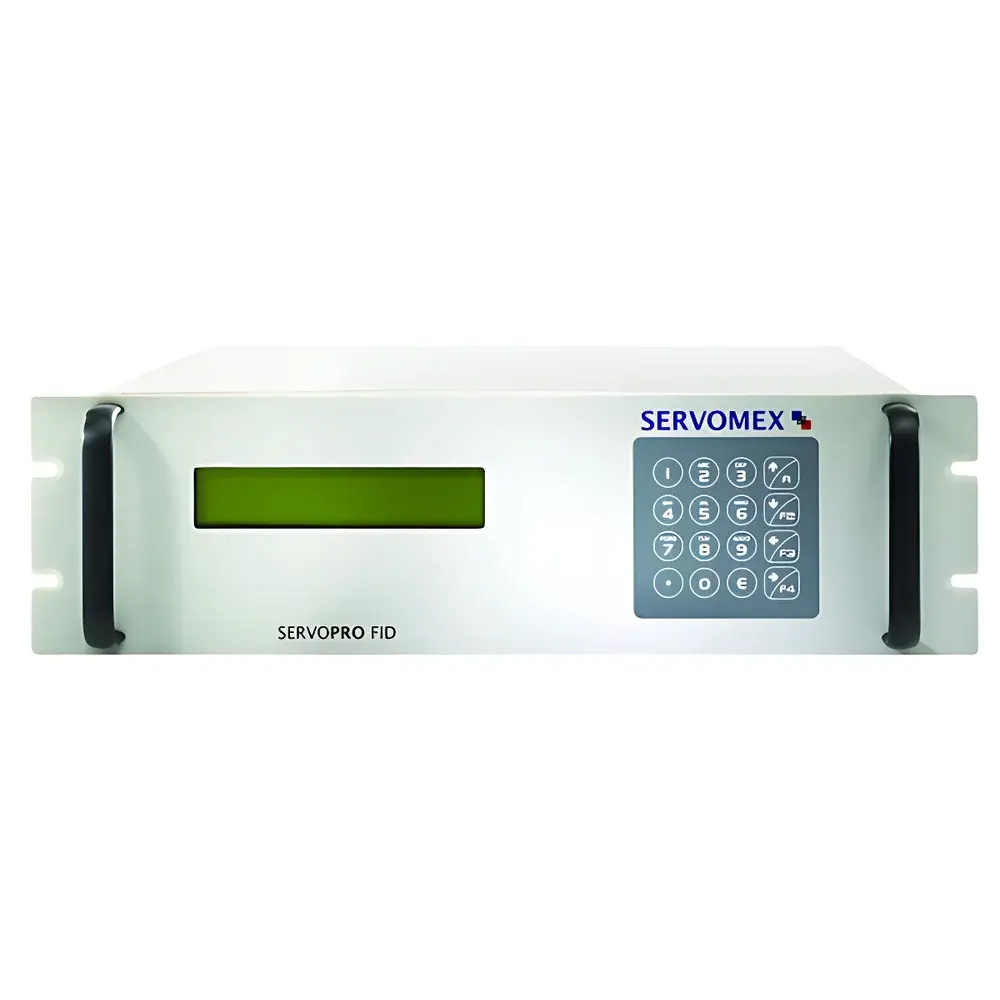
SERVOPRO FID Micro-Trace Hydrocarbon Analyzer
| Brand | SERVOMEX |
|---|---|
| Origin | United Kingdom |
| Model | SERVOPRO FID |
| Safety Compliance | IEC 61010-1:Ed2 (Electrical Safety), Low Voltage Directive, EMC Directive |
| Detection Principle | Flame Ionization Detection (FID) |
| Measurement Range | 0–10 ppm, 0–100 ppm, 0–1000 ppm (auto-ranging) |
| Sample Gases | Air, O₂, N₂, Ar, Kr, Xe (including crude krypton/xenon streams) |
| Fuel Gas Cut-off | Automatic shutoff upon flame-out detection |
| Digital Outputs | RS232 ASCII (optional), Ethernet (optional), Range-indicating digital contacts |
| Key Feature | Triple-range architecture with auto-switching, low-noise micro-trace THC quantification |
Overview
The SERVOPRO FID Micro-Trace Hydrocarbon Analyzer is a precision-engineered flame ionization detector (FID)-based instrument designed for continuous, real-time quantification of total hydrocarbons (THC) at sub-ppm to percent-level concentrations in high-purity industrial gases. Its core measurement principle relies on the controlled combustion of hydrocarbon molecules in a hydrogen–air flame, generating ions proportional to carbon content; these ions are collected and converted into a stable, linear electrical signal. This fundamental FID methodology delivers exceptional sensitivity, wide dynamic range, and long-term baseline stability—critical attributes for safety-critical applications in cryogenic air separation units (ASUs), where THC accumulation poses explosion risks below the lower flammability limit (LFL) in oxygen-rich environments. The analyzer is specifically optimized for use in ASU process streams—including liquid oxygen, gaseous oxygen, nitrogen, argon, and crude krypton/xenon fractions—where even trace organic contamination can compromise product purity, equipment integrity, or regulatory compliance.
Key Features
- Triple-range analog output architecture (0–10 ppm, 0–100 ppm, 0–1000 ppm) with fully automatic range switching to maintain optimal signal-to-noise ratio and measurement linearity across orders of magnitude.
- Integrated flame-out detection circuitry coupled with fail-safe fuel gas valve actuation: immediate mechanical cutoff of hydrogen supply upon loss of flame, preventing unburned fuel accumulation and ensuring intrinsic safety per IEC 61511 functional safety principles.
- Low-noise, temperature-stabilized FID sensor head engineered for micro-trace sensitivity and minimal drift over extended operation—validated for <100 ppb noise floor in zero-air background under controlled lab conditions.
- Rugged industrial enclosure rated for hazardous area installation (optional ATEX/IECEx certification available), compliant with IEC 61010-1:Ed2 for electrical safety, and aligned with EU Low Voltage and EMC Directives.
- Configurable digital interface suite: standard 4–20 mA analog output with HART protocol support; optional RS232 ASCII serial stream for integration into DCS/SCADA systems; optional Ethernet port supporting Modbus TCP for remote monitoring and configuration.
Sample Compatibility & Compliance
The SERVOPRO FID demonstrates robust performance across diverse gas matrices without cross-sensitivity to common inorganic interferents (e.g., CO₂, NOₓ, SO₂, H₂O vapor). It is validated for quantitative THC analysis in ultra-high-purity oxygen (≥99.5% O₂), nitrogen (≥99.999% N₂), argon (≥99.998% Ar), and noble gas streams containing up to 5% impurity load—including crude krypton and xenon recovered from ASU tail gas. All measurements adhere to ISO 8573-5:2010 for hydrocarbon contamination in compressed air and align with ASTM D1946 for hydrocarbon analysis in industrial gases. For pharmaceutical and food-grade gas production, the analyzer supports audit-ready data logging compatible with 21 CFR Part 11 requirements when paired with validated software platforms.
Software & Data Management
The analyzer operates with embedded firmware enabling local calibration verification, span adjustment, and diagnostic self-tests via front-panel keypad or remote interface. Optional SERVOPRO Insight™ software provides comprehensive data visualization, trend analysis, alarm history logging, and configurable reporting templates. All calibration events, range switches, flame status transitions, and fault codes are timestamped and stored with user-accessible audit trails. Data export formats include CSV and XML, facilitating integration into LIMS or enterprise MES systems. Firmware updates are delivered via secure HTTPS download and verified using SHA-256 checksums to ensure integrity.
Applications
- Cryogenic air separation: Continuous THC monitoring in liquid oxygen pumps, high-pressure oxygen headers, and argon purification columns to prevent hydrocarbon freeze-out and detonation hazards.
- Food-grade nitrogen and CO₂ production: Verification of hydrocarbon residuals per EN 14727 and ISO 8573-1 Class 1 purity specifications.
- Electronics-grade specialty gases: Final QC release testing for semiconductor manufacturing gases where THC ≤ 1 ppb is mandated.
- Hydrogen purity validation: Detection of methane and heavier hydrocarbons in PEM electrolyzer outlet streams prior to fuel cell integration.
- Research laboratories: Quantitative benchmarking of adsorbent breakthrough curves and catalytic oxidation efficiency in hydrocarbon removal systems.
FAQ
What is the minimum detectable THC concentration in oxygen?
The instrument achieves a method detection limit (MDL) of 0.2 ppm C₁–C₆ equivalent in oxygen matrix under standard operating conditions, confirmed per EPA Method 25A protocols.
Can the analyzer operate continuously in a 100% oxygen environment?
Yes—the FID combustion chamber and sample path components are constructed from oxygen-compatible materials (e.g., electropolished 316L SS, PTFE-free seals), and the design complies with CGA G-4.1 oxygen service guidelines.
Is third-party calibration certification available?
Certified calibration reports traceable to NIST SRM 1861 (methane in nitrogen) are provided upon request, including uncertainty budgets calculated per ISO/IEC 17025:2017 Annex A.3.
How often does the FID require maintenance?
Under typical ASU duty cycles, routine maintenance (jet cleaning, electrode inspection, hydrogen filter replacement) is recommended every 6 months; full sensor refurbishment interval exceeds 24 months with proper gas conditioning.
Does the system support remote diagnostics?
Yes—via optional Ethernet interface, users can access live diagnostics, historical alarm logs, and real-time sensor health metrics through a browser-based GUI, reducing onsite intervention frequency.





