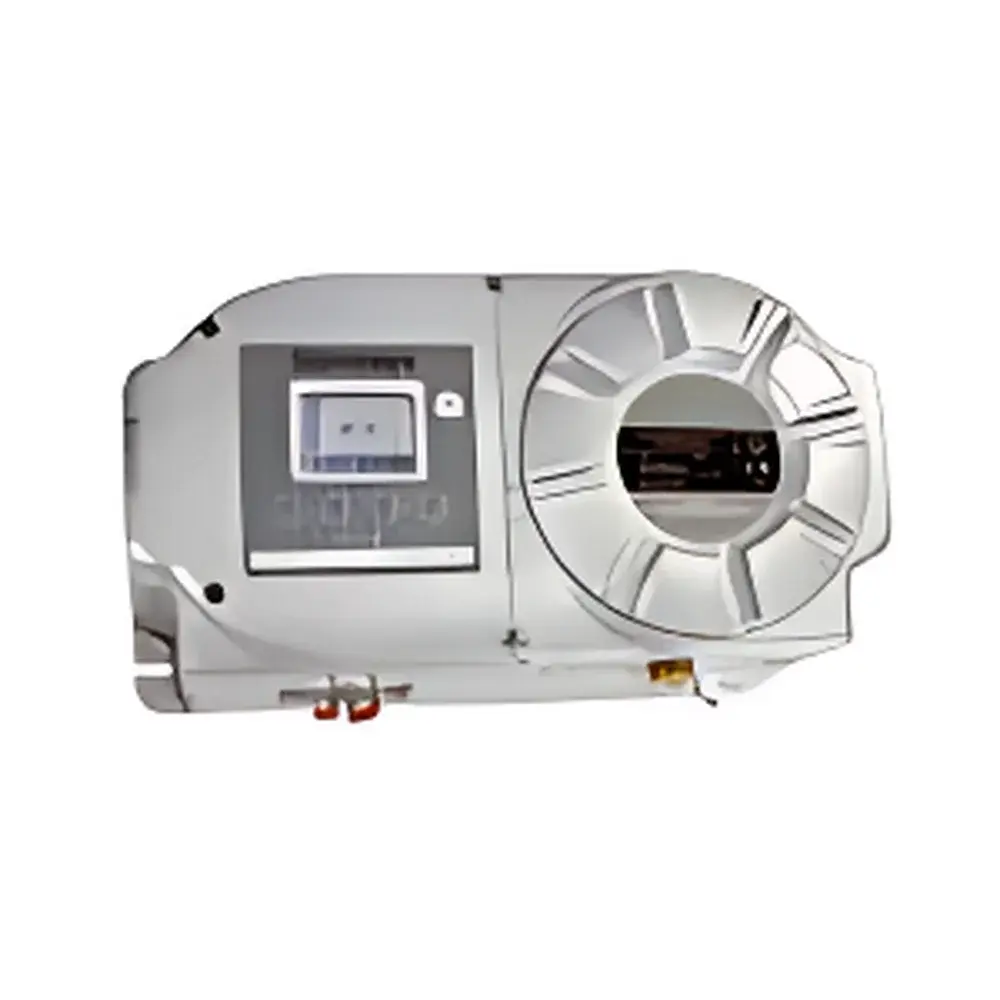
SERVOTOUGH Oxygen Analyzer Model 1900 Digital
| Brand | SERVOMEX |
|---|---|
| Origin | United Kingdom |
| Model | 1900 Digital |
| Certification | ATEX/IECEx Certified for Zone 1 Hazardous Areas |
| Measurement Principle | Paramagnetic Detection |
| Output Signal | 4–20 mA + Digital (RS-485/Modbus) |
| Power Supply | 24 VDC (intrinsically safe) |
| Operating Temperature | –20 to +50 °C |
| Enclosure Rating | IP66 |
| Compliance | EN 61000-6-2/-6-3, EN 61326-1, EN 60079-0/-11, FDA 21 CFR Part 11 (data integrity support via optional software) |
Overview
The SERVOTOUGH Oxygen Analyzer Model 1900 Digital is a certified intrinsically safe, paramagnetic oxygen analyzer engineered for continuous, high-integrity measurement in hazardous industrial environments—specifically Zone 1 (ATEX/IECEx) locations where explosive atmospheres may be present. Unlike electrochemical or zirconia-based sensors, the 1900 employs SERVOMEX’s proprietary non-consumptive paramagnetic detection cell, which exploits the unique magnetic susceptibility of molecular oxygen (O₂) in a gas mixture. This physical principle delivers inherently linear, drift-free response without chemical consumption, catalytic degradation, or reference gas dependency. The analyzer operates without purge gas or zero-span calibration gases, significantly reducing operational overhead and eliminating cross-sensitivity to CO₂, CO, hydrocarbons, or moisture—common interferents in combustion off-gas, syngas, inerting systems, and flare monitoring applications.
Key Features
- Intrinsically safe design compliant with ATEX II 1G Ex ia IIC T4 Ga and IECEx Ex ia IIC T4 Ga for direct installation in Zone 1 hazardous areas—no external purging or pressurization required.
- Non-consumptive paramagnetic sensor with solid-state, maintenance-free construction; typical measurement cell lifetime exceeds 10 years under continuous operation.
- Integrated heated sample conditioning path minimizes condensation and eliminates need for external sample coolers or chiller units—reducing pre-processing complexity and failure points.
- Onboard mass flow sensor enables real-time flow verification and automatic fault detection (e.g., blockage, leak, pump failure), enhancing process safety and diagnostic confidence.
- Internal pressure compensation algorithm dynamically corrects for ambient barometric variation or stack/backpressure fluctuations—critical for accurate O₂ quantification in flare gas, furnace exhaust, or low-pressure inerting lines.
- SIL2 certification per IEC 61508 supported by full FMEDA (Failure Modes, Effects, and Diagnostic Analysis) documentation, enabling integration into Safety Instrumented Systems (SIS) up to SIL2 integrity level.
- Extended calibration interval—typically 6–12 months—validated by internal auto-validation routines that verify optical path integrity, signal linearity, and thermal stability prior to each measurement cycle.
Sample Compatibility & Compliance
The Model 1900 is designed for direct analysis of process streams containing oxygen concentrations from 0–100% vol, with standard range options spanning 0–1%, 0–10%, 0–25%, and 0–100%. It accommodates sample temperatures up to 180 °C (with optional heated probe), dew points up to +90 °C, and particulate loadings ≤1 µm (with integrated sintered metal filter). Gas matrix compatibility includes nitrogen-, argon-, helium-, CO₂-, and hydrocarbon-rich backgrounds—provided no strong paramagnetic or diamagnetic interferents (e.g., NO, NO₂, Cl₂) are present at >100 ppm. Regulatory compliance includes EN 61000-6-2 (immunity), EN 61000-6-3 (emissions), EN 61326-1 (EMC for industrial use), and full alignment with IEC 60079-0/-11 for intrinsic safety. Full traceability and audit-ready data logging meet GLP/GMP requirements when paired with SERVOMEX’s optional PC-based configuration and validation software.
Software & Data Management
Configuration, diagnostics, and data export are managed via SERVOMEX’s Windows-based ServoSoft™ application, supporting Modbus RTU over RS-485 for seamless integration into DCS, SCADA, or MES platforms. The firmware embeds configurable alarm thresholds (high/low, rate-of-change), event logging with timestamps, and password-protected parameter access. All calibration events, sensor diagnostics, and fault logs are time-stamped and stored internally (≥10,000 records) with optional CSV export. When deployed with validated software modules, the system satisfies FDA 21 CFR Part 11 requirements—including electronic signatures, audit trails, and data integrity controls—for regulated pharmaceutical, biotech, and fine chemical manufacturing environments.
Applications
- Combustion optimization and excess air control in boilers, furnaces, and incinerators
- Inerting and blanketing monitoring in petrochemical storage tanks, reactors, and transfer lines
- Flare gas composition verification for environmental reporting (EPA Method 2C, EN 15267)
- Control of controlled-atmosphere heat treatment furnaces (e.g., carburizing, annealing)
- Quality assurance in food packaging (MAP—Modified Atmosphere Packaging) gas mix verification
- Safety-critical O₂ monitoring in hydrogen production units, electrolysis cells, and syngas purification trains
FAQ
Does the Model 1900 require zero or span gas for routine operation?
No. The paramagnetic cell is inherently stable and does not consume reactive components; therefore, no zero or span gases are required for daily operation. Optional periodic verification with certified N₂ or air may be performed for QA/QC but is not mandatory.
Can the analyzer operate in high-humidity or wet-gas streams?
Yes—when equipped with the optional heated sample line and integrated condensate trap, it handles saturated streams up to 90 °C dew point. Condensation is actively prevented upstream of the sensor chamber.
Is SIL2 certification applicable to the entire analyzer or only specific functions?
SIL2 certification covers the complete safety-related measurement chain: sensor, signal processing, output relays, and diagnostic firmware—as verified in the FMEDA report and certified by exida.
What is the typical warm-up time to achieve full measurement accuracy?
Less than 15 minutes from cold start; thermal stabilization is accelerated by intelligent heater control and internal temperature mapping.
How is data integrity ensured during power interruption or communication loss?
All critical parameters and event logs are retained in non-volatile memory; upon recovery, the device resumes operation with no data loss and timestamps all recovered entries relative to real-time clock synchronization.