
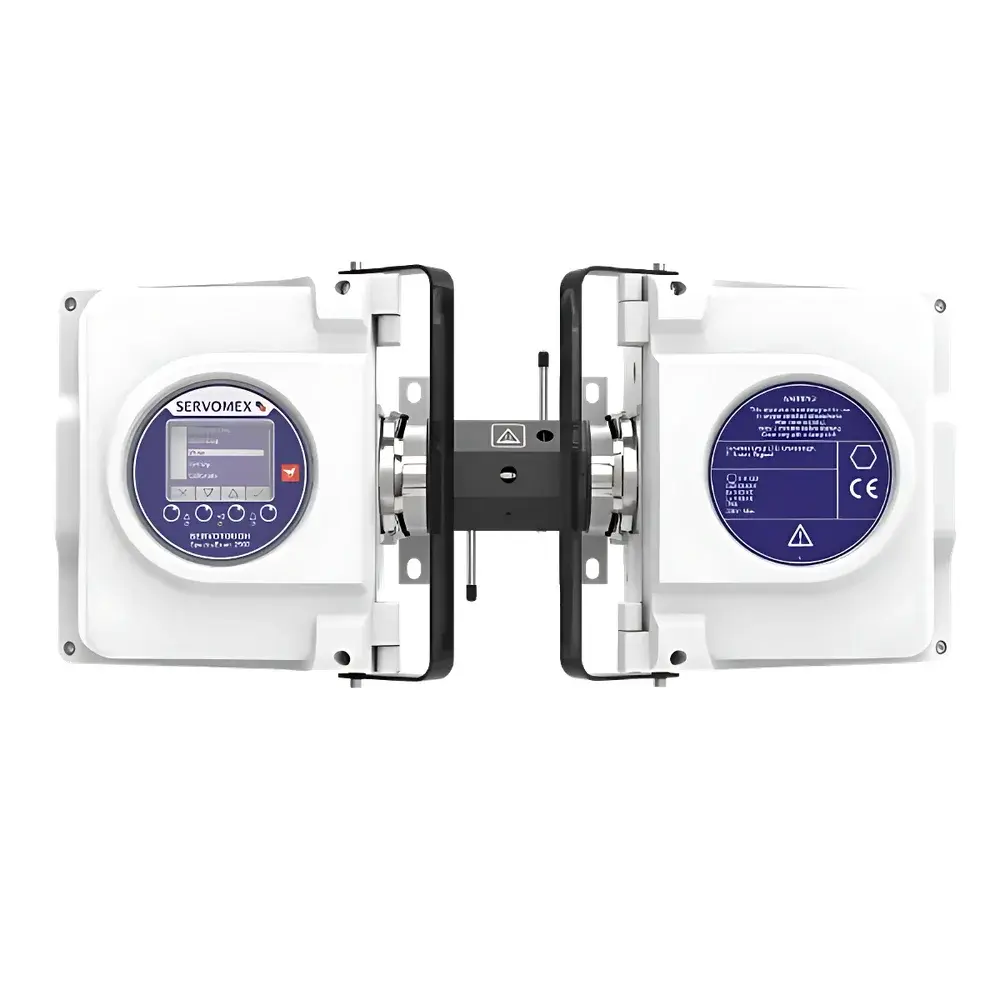
SERVOTOUGH SpectraExact 2500 NDIR Flue Gas Analyzer
| Brand | SERVOMEX |
|---|---|
| Origin | United Kingdom |
| Model | SpectraExact 2500 |
| Instrument Type | Continuous Emission Monitoring System (CEMS) |
| Measurement Principle | Single-Beam Dual-Wavelength Non-Dispersive Infrared (NDIR) with Gas Filter Correlation (GFC) Photometry |
| Accuracy | Low measurement error |
| Repeatability | High |
| Response Time | Fast |
| Stability | Excellent |
| Target Gases | Corrosive, toxic, and flammable gases (e.g., CO, CO₂, CH₄, SO₂, NO, NO₂, NH₃, HCl, HF) |
| Certifications | UKCA, CE, ATEX, UKEx, IECEx |
| Enclosure Rating | IP66 |
| Optical Path | Dedicated, field-serviceable measurement cell |
| Maintenance Profile | Non-consumable sensing technology |
Overview
The SERVOTOUGH SpectraExact 2500 is a high-integrity, industrial-grade NDIR flue gas analyzer engineered for continuous emission monitoring (CEMS) in demanding process, combustion, and stack environments. It employs a robust single-beam dual-wavelength photometric architecture combined with Gas Filter Correlation (GFC) technology to deliver selective, interference-resistant detection of multiple target gases—including CO, CO₂, CH₄, SO₂, NO, NO₂, NH₃, HCl, and HF—within corrosive, humid, or explosive sample streams. Unlike conventional broadband NDIR systems, the GFC method uses a rotating gas-filled reference cell to modulate the optical path, effectively suppressing cross-sensitivity from water vapor, dust, and background hydrocarbons. This enables stable baseline performance over extended operational cycles without frequent zero/span recalibration. Designed and manufactured in the United Kingdom, the SpectraExact 2500 meets the stringent mechanical, thermal, and electromagnetic resilience requirements of heavy-duty plant integration—supporting both extractive and in-situ configurations when paired with appropriate sampling interfaces.
Key Features
- Gas Filter Correlation (GFC) photometry for superior selectivity and long-term drift stability in complex gas matrices
- IP66-rated aluminum alloy enclosure with integrated thermal management for operation across –20 °C to +55 °C ambient conditions
- ATEX Category 1D/2G and IECEx-certified for Zone 0/1 (gas) and Zone 20/21 (dust) hazardous area installation
- Dedicated, user-accessible optical measurement cell—designed for rapid cleaning, verification, and component-level replacement without system downtime
- Fully backward-compatible hardware architecture: mounts directly onto existing 2500-series mounting frames and interfaces with legacy analog/digital I/O modules
- Intuitive 5.7-inch VGA touchscreen interface with multilingual support (English, German, French, Spanish), configurable alarm logic, and real-time trend visualization
- Non-consumable optical sensing principle—no catalytic elements, electrochemical cells, or replaceable filters required during normal service life
Sample Compatibility & Compliance
The SpectraExact 2500 is validated for use with wet, hot, and chemically aggressive sample streams typical of boiler exhausts, cement kilns, waste incinerators, and chemical synthesis off-gas lines. Its optical path design tolerates particulate loading up to 10 mg/m³ and condensate formation without signal degradation, provided upstream sample conditioning (e.g., heated probe, chiller, or permeation dryer) is implemented per EN 15267-3 and ISO 14956 guidelines. The analyzer complies with EU Directive 2014/34/EU (ATEX), UK Statutory Instrument 2016 No. 1107 (UKEx), and IEC 60079-0/10/29 for intrinsic safety and explosion protection. For regulatory reporting, it supports traceable calibration per ISO 17025-accredited procedures and integrates seamlessly into CEMS data acquisition systems compliant with EN 14181 (QAL1–QAL3) and EPA Method 10/10A.
Software & Data Management
Firmware v3.2+ provides embedded data logging (1-second resolution, 30-day buffer), Modbus TCP/RTU, Profibus DP-V1, and optional HART 7 connectivity. All configuration changes, calibration events, and alarm triggers are time-stamped and stored with user ID attribution—enabling full audit trail compliance under FDA 21 CFR Part 11 and EU Annex 11 requirements. Optional SERVOMEX Insight™ CEMS software suite delivers remote diagnostics, predictive maintenance alerts (based on optical transmission decay rate), and automated report generation aligned with national environmental agency templates (e.g., UK EA, German LAWA, Dutch RIVM). Raw spectral data export (CSV/ASCII) is supported for third-party validation and uncertainty budgeting per GUM (JCGM 100:2008).
Applications
- Regulatory-compliant continuous monitoring of SO₂, NOₓ, and CO emissions from coal-, gas-, and biomass-fired power plants
- Process optimization and safety interlock control in syngas production, ethylene cracking, and ammonia synthesis units
- Corrosion risk assessment via real-time HCl/HF monitoring in municipal solid waste (MSW) and hazardous waste incineration
- Combustion efficiency analysis using simultaneous CO/CO₂/O₂ ratio calculations in industrial boilers and thermal oxidizers
- Leak detection and fugitive emission quantification in petrochemical flare stacks and VOC abatement systems
FAQ
Does the SpectraExact 2500 require periodic optical alignment or factory recalibration?
No—its monolithic optical bench and GFC reference modulation eliminate sensitivity to mechanical drift; only annual verification against certified span gases is recommended per EN 14181 QAL2.
Can it measure gases in high-humidity or condensing sample streams?
Yes—when deployed with a heated sample line (≥180 °C) and thermoelectric chiller, the analyzer maintains accuracy even at dew points up to 95 °C, as verified per ISO 12039 Annex B.
Is firmware update capability available remotely?
Yes—secure Over-The-Air (OTA) updates via TLS 1.2-encrypted Ethernet connection are supported; all updates undergo SHA-256 signature validation prior to installation.
What is the expected service interval for the optical measurement cell?
Under typical CEMS duty cycles (continuous operation, 15% below baseline—typically exceeding 24 months between interventions.
How does the instrument handle cross-interference from methane when measuring CO in biogas applications?
The GFC architecture inherently suppresses CH₄ spectral overlap in the 4.6 µm CO band; independent CH₄ channel measurement further enables real-time compensation algorithms embedded in the firmware.
Related Products







