
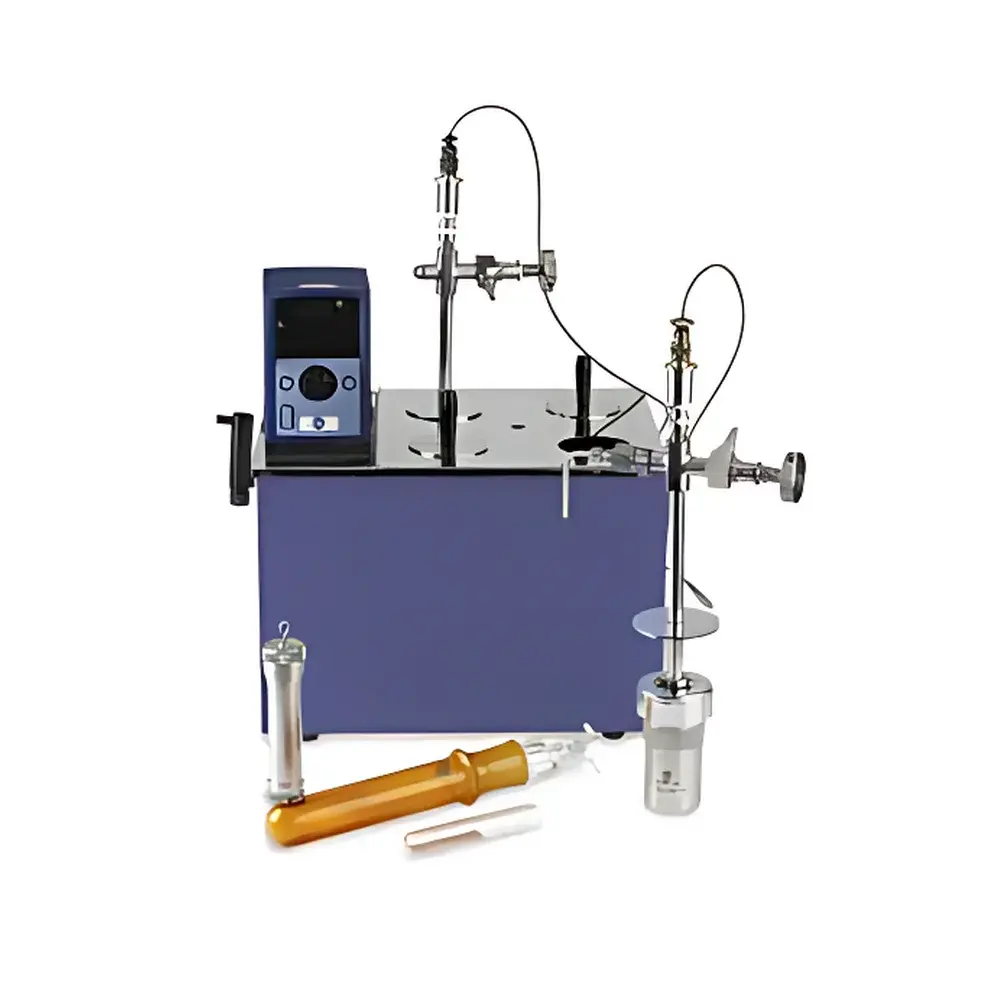
SETA Model 15550-2 Gasoline Induction Period & Copper Strip Corrosion Test Bath
| Brand | SETA |
|---|---|
| Origin | United Kingdom |
| Model | 15550-2 |
| Temperature Range | Ambient to 150 °C |
| Temperature Stability | ±0.1 °C |
| Bath Medium | Water or Oil |
| Bath Volume | 35 L |
| Power Rating | 1500 W |
| Voltage Options | 110/120 V or 220/240 V, 50/60 Hz |
| Dimensions (W×D×H) | 41 × 45 × 33 cm |
| Weight | 10 kg |
| Test Positions | 4 |
| Construction Material | Stainless Steel |
| Controller Type | Digital with Over-Temperature and Low-Level Safety Interlocks |
| Optional Accessory | Automated Pressure Monitoring Module |
Overview
The SETA Model 15550-2 is a precision-engineered thermal test bath designed for standardized evaluation of petroleum product oxidation stability and metallic corrosion behavior under controlled, accelerated aging conditions. It operates on the fundamental principle of maintaining a highly stable thermal environment—critical for reproducible induction period determination per ASTM D525 (gasoline oxidation stability) and copper strip corrosion assessment per ASTM D130 and ISO 2160. The unit complies with a comprehensive suite of international test methods including GB/T 8018, IP 40, IP 138, EN 2160, JIS K2276, and NF M07-012/013, enabling laboratories to meet regulatory, quality assurance, and R&D validation requirements across refining, fuel formulation, and lubricant development workflows. Its dual-capability architecture eliminates the need for separate dedicated baths for induction period and corrosion testing—reducing footprint, operational complexity, and cross-method calibration drift.
Key Features
- Four independent, identically conditioned test positions ensure parallel sample processing with minimized inter-position thermal variance.
- Stainless steel bath construction provides long-term resistance to chemical degradation from hydrocarbon solvents, sulfur compounds, and acidic oxidation byproducts.
- Digital PID temperature controller delivers ±0.1 °C stability over the full operating range (ambient to 150 °C), verified via traceable NIST-calibrated reference thermometers.
- Integrated safety system includes dual redundant over-temperature cutoff and low-bath-level detection—automatically de-energizing heating elements to prevent dry-run damage or thermal runaway.
- Configurable bath medium selection (water or silicone oil) allows method-specific optimization: water for lower-temperature induction period tests (e.g., ASTM D525 at 100 °C), oil for higher-temperature corrosion assessments (e.g., ASTM D4048 at 150 °C).
- Modular design supports seamless integration of the optional automated pressure monitoring module for real-time headspace pressure tracking during sealed induction period tests—enabling kinetic analysis of oxygen consumption and peroxide formation rates.
Sample Compatibility & Compliance
The SETA 15550-2 accommodates standard test vessels defined in referenced methodologies: 500-mL glass oxidation bombs (ASTM D525), 250-mL copper strip corrosion tubes (ASTM D130), and 100-mL accelerated shelf-life vials for dried pet food (FTM 791 3352). All test fixtures are compatible with ASTM E29-compliant dimensional tolerances. The instrument meets mechanical and electrical safety requirements per IEC 61010-1 and carries CE marking for use in EU-based GLP-compliant laboratories. Its operational parameters align with data integrity expectations under FDA 21 CFR Part 11 when paired with validated LIMS or electronic lab notebook (ELN) systems—supporting audit-ready temperature logging, user access control, and electronic signature workflows.
Software & Data Management
While the base unit features a stand-alone digital controller with local display and manual setpoint adjustment, it is fully compatible with third-party SCADA and laboratory informatics platforms via RS-232 or optional Ethernet interface (firmware upgrade required). Time-stamped temperature profiles, alarm events, and run duration metadata can be exported in CSV format for integration into statistical process control (SPC) dashboards. When deployed in regulated environments, the system supports ALCOA+ principles (Attributable, Legible, Contemporaneous, Original, Accurate, Complete, Consistent, Enduring, Available) through external validation of data acquisition and storage protocols—ensuring compliance with ISO/IEC 17025 accreditation requirements for petroleum testing laboratories.
Applications
- Gasoline and aviation fuel oxidation stability screening per ASTM D525 and GB/T 8018 to predict storage life and assess antioxidant package efficacy.
- Copper strip corrosion rating of gasoline, diesel, jet fuel, and biodiesel blends per ASTM D130, ISO 2160, and SH/T 0023—critical for engine deposit control and material compatibility verification.
- Accelerated shelf-life testing of dried pet food oils using FTM 791 3352 methodology to quantify lipid peroxidation kinetics.
- Research-grade thermal aging studies of lubricants, transformer oils, and synthetic esters where precise, repeatable bath temperature is essential for Arrhenius-based lifetime modeling.
- Method validation and inter-laboratory comparison exercises requiring strict adherence to IP, BS, DIN, and JIS procedural specifications.
FAQ
What standards does the SETA 15550-2 support for copper strip corrosion testing?
It fully complies with ASTM D130, ISO 2160, GB/T 5096, IP 112, IP 154, EN 2160, DIN 51811, and JIS K2513—covering both ambient and elevated temperature corrosion protocols.
Can the bath operate continuously at 150 °C using water as the medium?
No—water is suitable only up to ~95 °C at atmospheric pressure; silicone oil or other high-boiling-point heat transfer fluids must be used for sustained operation at 150 °C.
Is the unit supplied with test fixtures and copper strips?
Test vessels, copper strips, and polishing materials are available as optional accessories and are not included in the base configuration.
How is temperature uniformity verified across the four test positions?
Uniformity is validated per ASTM E2203 using calibrated platinum resistance thermometers (PRTs) placed at geometric centerpoints of each position; typical deviation is ≤±0.05 °C at steady state.
Does the digital controller support password-protected parameter locking for QA/QC environments?
Yes—the controller firmware includes configurable user levels (Operator, Supervisor, Administrator) with setpoint and alarm limit restrictions enforced via encrypted access credentials.




