
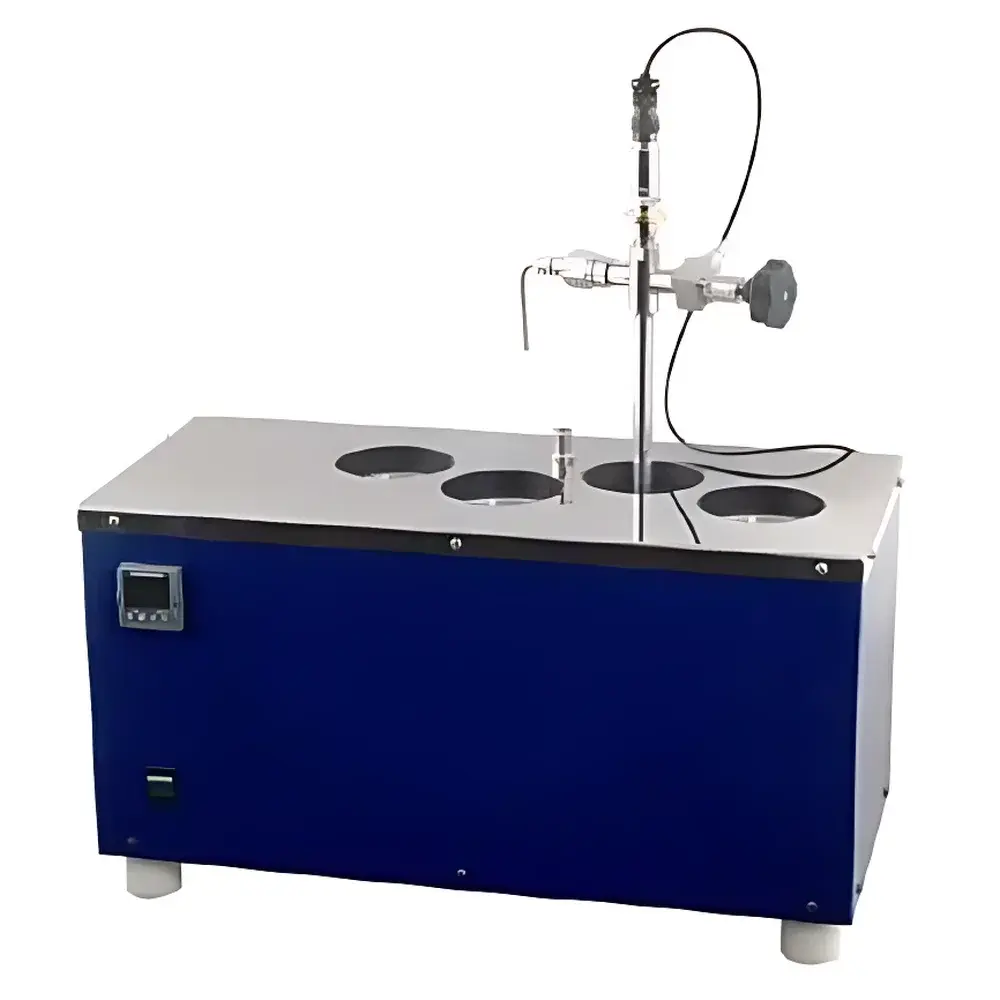
SETA Model 16670-0 Solid Bath for Gasoline Induction Period Testing
| Brand | SETA |
|---|---|
| Origin | United Kingdom |
| Model | 16670-0 |
| Heating Method | Solid (metal block) |
| Temperature Range | Ambient to 100 °C |
| Test Positions | 4 |
| Voltage | 200–240 V, 50/60 Hz |
| Power Consumption | 3 kW |
| Dimensions (W×D×H) | 30 × 60 × 28 cm |
| Weight | 65 kg |
| Compliance | ASTM D525, D873, D2274, D4310, D7462 |
Overview
The SETA Model 16670-0 Solid Bath is a precision-engineered thermal test platform designed specifically for the accelerated oxidation stability evaluation of gasoline and biodiesel blends under standardized atmospheric pressure conditions. It operates on the principle of controlled, uniform conductive heating via a solid metal block — eliminating convective variability inherent in liquid baths and ensuring exceptional temperature homogeneity across all test positions. This architecture directly supports deterministic measurement of induction period (IP), defined as the elapsed time until rapid oxygen uptake initiates, as measured by pressure drop or oxygen consumption in sealed, oxidizing sample vessels. The instrument meets the strict thermal stability and repeatability requirements of multiple international standards governing petroleum product oxidative degradation, including ASTM D525 (gasoline), D2274 (distillate fuels), D7462 (biodiesel blends), and ISO 7536.
Key Features
- Four independent, identically heated test positions within a single monolithic aluminum heating block — enabling parallel analysis while maintaining ±0.2 °C inter-position temperature uniformity at 98 °C.
- Digital PID temperature controller with real-time display, programmable setpoint retention, and user-adjustable ramp profiles for method-specific thermal conditioning.
- Integrated overtemperature protection circuitry that automatically de-energizes the heating elements if the block exceeds 105 °C — safeguarding samples, pressure vessels, and operator safety per IEC 61010-1 requirements.
- Compact footprint (30 × 60 cm base area) optimized for benchtop integration in QC laboratories with space constraints, without compromising thermal mass or stability.
- Robust construction featuring corrosion-resistant anodized aluminum housing, stainless steel internal components, and industrial-grade power terminals rated for continuous 3 kW operation.
Sample Compatibility & Compliance
The 16670-0 accommodates standard ASTM/ISO-compliant oxygen bomb assemblies (e.g., Parr-type 1362 or equivalent) used in induction period testing. Each position accepts 50 mL glass sample bottles fitted with calibrated copper or stainless steel pressure caps and oxygen inlet valves. The solid bath’s thermal inertia ensures minimal overshoot during setpoint transitions, critical for reproducible initiation of oxidation kinetics. Regulatory alignment includes full technical conformance with ASTM D525 Annex A1 (for gasoline), D7462 Section 7.2 (for B100 and B5–B20 blends), IP 40 Clause 5.3 (oxidation vessel immersion depth), and EN 7536 Annex B (temperature uniformity verification protocol). Instrument documentation supports GLP-compliant validation, including IQ/OQ templates aligned with ISO/IEC 17025 clause 5.5.2 for thermal calibration traceability to UKAS-accredited reference standards.
Software & Data Management
While the 16670-0 operates as a standalone hardware platform, it is fully compatible with third-party data acquisition systems via its analog 0–10 V temperature output and digital relay status signals (ready/overtemp). Laboratories implementing electronic record-keeping may integrate the bath into LIMS or chromatography data systems using standard RS-232 or optional RS-485 interfaces (available via SETA accessory kit 16670-COM). All thermal events — including start time, stabilization confirmation, and fault triggers — are logged with timestamped metadata, satisfying audit requirements under FDA 21 CFR Part 11 when paired with compliant software and access controls. Calibration certificates include uncertainty budgets per ISO/IEC 17025:2017 Annex A.3.
Applications
- Determination of oxidative stability of motor gasoline per GB/T 8018 and ASTM D525 — supporting refinery blending optimization and additive package qualification.
- Assessment of middle-distillate fuel stability (diesel, jet fuel) using ASTM D2274 and IP 138 protocols — critical for long-term storage and military specification compliance.
- Accelerated oxidation testing of biodiesel (B100) and blended fuels (B5–B20) per ASTM D7462 — enabling predictive shelf-life modeling and FAME oxidation inhibitor efficacy studies.
- Research-grade investigation of antioxidant synergism and metal-catalyzed degradation pathways in hydrocarbon matrices under controlled thermal stress.
- Method transfer and interlaboratory comparison studies requiring high inter-unit reproducibility across global testing networks.
FAQ
Does the 16670-0 require calibration verification before first use?
Yes. Initial verification must be performed using NIST-traceable RTDs or thermistors at three points (ambient, 50 °C, and 98 °C) per ASTM E74-22 Annex A2. A completed verification report is required for GLP compliance.
Can the bath accommodate non-standard sample vessels?
Only vessels conforming to the dimensional and thermal mass specifications in ASTM D525 Section 7.1 are supported. Deviations risk violating temperature uniformity clauses in ISO 7536 Clause 6.2.
Is routine maintenance required beyond cleaning?
Annual inspection of heater element resistance, grounding continuity, and thermal fuse integrity is recommended per IEC 62366-1 usability engineering guidelines. No lubrication or consumable replacement is necessary.
What is the maximum allowable ambient operating temperature?
The unit is rated for continuous operation in environments up to 35 °C ambient with ≥15 cm clearance on all sides for convective heat dissipation.
How does the solid bath compare to liquid-bath alternatives in terms of method equivalence?
Interlaboratory studies (ASTM WK72451) confirm statistically equivalent induction period results between solid and liquid baths when both meet ISO 7536 temperature uniformity criteria — with solid baths demonstrating superior long-term drift stability (<0.05 °C/h at 98 °C).





