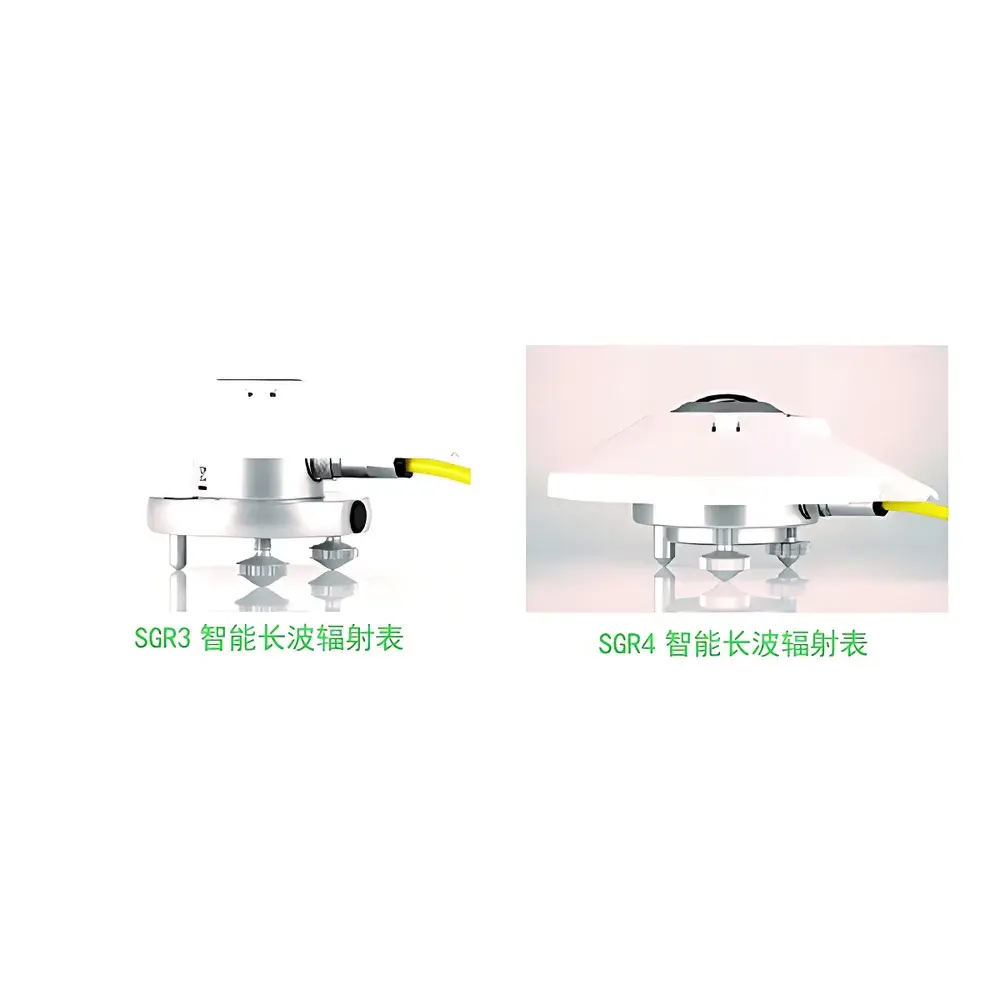
SGR3 Smart Long-Wave Radiometer
| Brand | Kipp & Zonen |
|---|---|
| Origin | Netherlands |
| Model | SGR3 |
| Spectral Range | 4.4–50 µm |
| Response Time | <18 s |
| Zero Offset (B) | <5 W/m² |
| Temperature Dependence of Sensitivity (−20 to +50 °C) | <3% |
| Operating Temperature Range | −40 to +80 °C |
| Field of View | 150° |
| Analog Output | 4–20 mA or 0–1 V per W/m² |
| Window Heating Offset | 15 W/m² |
| Power Supply | 5–30 VDC |
| Communication Interface | RS-485 Modbus® |
| Desiccant Replacement Interval | ≥10 years |
| Directional Error | <5 W/m² |
| Temperature Correction Range | −40 to +80 °C |
Overview
The SGR3 Smart Long-Wave Radiometer is a precision-grade, thermopile-based radiometric sensor engineered for continuous, high-stability measurement of downward atmospheric long-wave (infrared) radiation in meteorological and agrometeorological monitoring networks. Operating on the principle of thermal detection, the SGR3 employs a blackened thermopile detector housed behind a specially engineered silicon window with integrated solar-blind spectral filtering—effectively blocking shortwave radiation (0.3–3.0 µm) while transmitting the full terrestrial infrared band (4.4–50 µm). This spectral selectivity ensures accurate isolation of long-wave irradiance (LW↓), free from contamination by direct or diffuse solar flux. The instrument is calibrated against Kipp & Zonen’s CG4 pyrgeometer reference standard under hemispherical (180°) outdoor conditions, guaranteeing traceability to ISO 9060:2018 secondary standard requirements for radiometers used in environmental science applications.
Key Features
- Thermopile detector with temperature-compensated electronics and individual unit-specific calibration coefficients applied in real time
- Silicon optical window with proprietary solar-blind filter, eliminating need for mechanical shading or shutter mechanisms
- Integrated bubble level, leveling feet, and standardized mounting flange for rapid, repeatable field installation and re-leveling
- Wide operating voltage range (5–30 VDC) enables seamless integration into solar-powered weather stations and SCADA-based renewable energy monitoring systems
- RS-485 interface compliant with Modbus® RTU protocol, supporting direct readout of both raw analog output and digitally compensated long-wave irradiance values (W/m²)
- Low-power design with no internal heaters required for dew suppression—desiccant cartridge rated for ≥10 years under typical deployment conditions
- Enhanced directional response uniformity (<5 W/m² error across 150° field of view) and reduced zero-offset drift (B-type <5 W/m²) per WMO guidelines
Sample Compatibility & Compliance
The SGR3 is optimized for outdoor, unshaded deployment in open-field meteorological observatories, agricultural research stations, and solar farm performance monitoring sites. Its ruggedized aluminum housing (IP67-rated), corrosion-resistant anodized finish, and sealed connector system ensure long-term reliability in harsh environments—including coastal, desert, and subarctic climates. All units are factory-calibrated against primary reference standards maintained at Kipp & Zonen’s ISO/IEC 17025-accredited calibration laboratory. Calibration certificates include uncertainty budgets compliant with GUM (JCGM 100:2008) and are traceable to the World Radiometric Reference (WRR). The instrument meets the performance criteria specified in ISO 9060:2018 for secondary standard pyrgeometers and supports data quality assurance protocols aligned with WMO No. 8 (Guide to Instruments and Methods of Observation).
Software & Data Management
The SGR3 integrates natively with Kipp & Zonen’s Smart Explorer Windows™ software suite, enabling configuration of Modbus® register mapping, real-time data visualization, and automated logging of compensated long-wave irradiance, internal temperature, and diagnostic status flags. The included Modbus® Address Configuration Module allows field technicians to assign unique node IDs and adjust scaling parameters without requiring firmware updates. For enterprise-scale deployments, the SGR3 supports standard Modbus® TCP gateways and is compatible with third-party SCADA platforms (e.g., Ignition, Siemens Desigo, Campbell Scientific LoggerNet) via generic RS-485 drivers. All digital outputs include timestamped metadata and optional audit-trail logging—supporting GLP-compliant data integrity workflows where required.
Applications
- Surface energy balance modeling in climate research and land-atmosphere interaction studies
- Validation of satellite-derived long-wave radiation products (e.g., CERES, MODIS LW↓)
- Performance monitoring of concentrating solar power (CSP) plants and photovoltaic (PV) farms under varying cloud regimes
- Soil-plant-atmosphere continuum (SPAC) analysis in precision agriculture and irrigation scheduling
- Long-term trend analysis in national meteorological networks (e.g., NOAA SURFRAD, EUMETNET BSRN)
- Boundary layer turbulence studies requiring synchronized net radiation and eddy covariance inputs
FAQ
Is the SGR3 suitable for net long-wave radiation measurement?
No—the SGR3 measures only downward long-wave radiation (LW↓). For net radiation (Rnet = SW↑ + LW↑ − SW↓ − LW↓), it must be paired with an upward-facing SGR3 or a dual-dome pyrgeometer such as the CGR4.
Does the SGR3 require periodic recalibration?
Yes—Kipp & Zonen recommends recalibration every two years for scientific-grade applications or after physical impact, extreme thermal cycling, or visible window degradation. Factory recalibration maintains traceability to ISO/IEC 17025.
Can the SGR3 operate without external power for signal conditioning?
No—the 4–20 mA and 0–1 V analog outputs are actively powered; the device requires a stable 5–30 VDC supply for both sensor operation and signal amplification.
What is the significance of the “solar-blind” silicon window?
The window transmits only wavelengths >4.4 µm while attenuating >99.9% of solar radiation below 3.0 µm, eliminating spectral interference without mechanical shading—critical for maintaining diurnal continuity in LW↓ records.
How is temperature dependence corrected in real time?
Each SGR3 is supplied with unit-specific polynomial coefficients derived from multi-point thermal chamber testing (−40 to +80 °C); these are applied in firmware during analog-to-digital conversion to yield temperature-compensated W/m² values.