
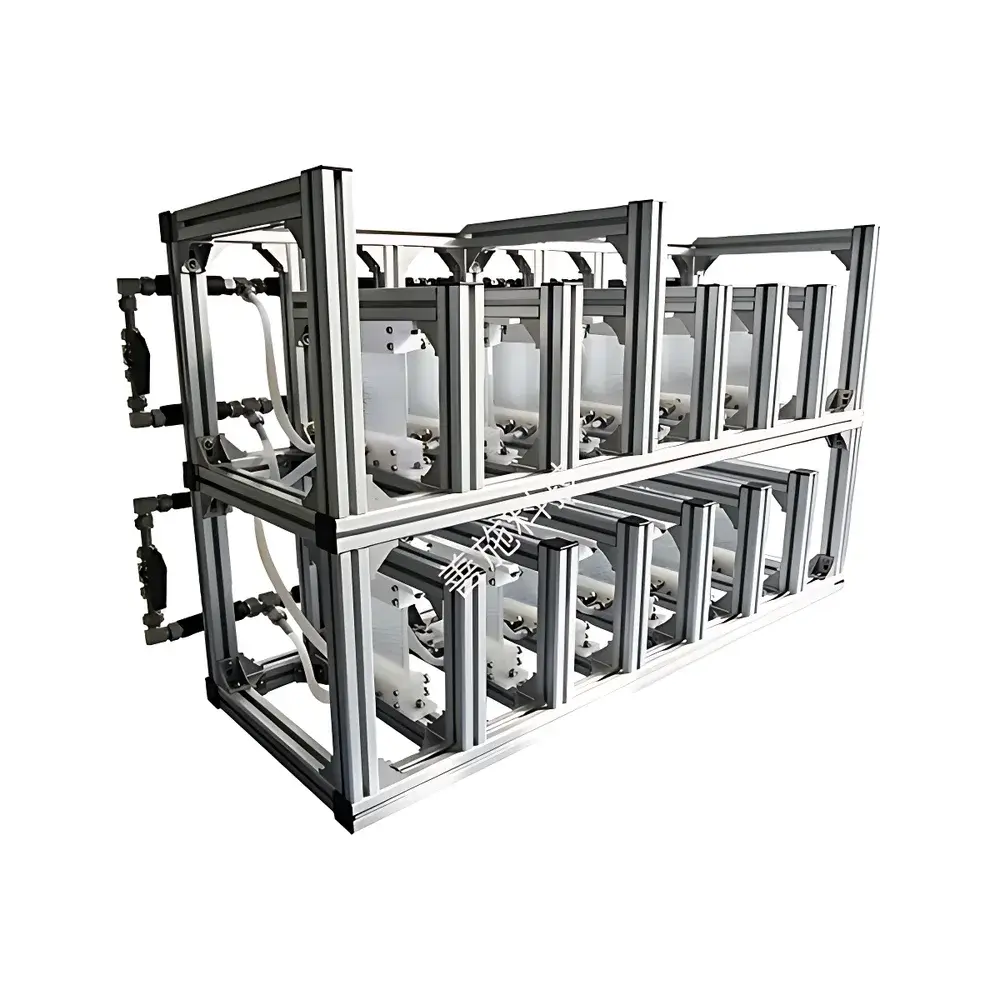
Shanghai 3S FG(9) Plate-Type Continuous-Flow Photomicroreactor
| Brand | Shanghai 3S Technology Co., Ltd |
|---|---|
| Origin | Shanghai, China |
| Manufacturer Type | OEM Manufacturer |
| Product Origin | Domestic (China) |
| Model | FG(9) |
| Pricing | Upon Request |
Overview
The Shanghai 3S FG(9) Plate-Type Continuous-Flow Photomicroreactor is an engineered platform for precise, scalable, and reproducible photochemical synthesis under controlled flow conditions. It operates on the principle of heterogeneous or homogeneous photocatalysis—where incident photons from high-stability LED arrays excite catalytic species (e.g., TiO₂, Ru(bpy)₃²⁺, or organic dyes), generating reactive intermediates such as electron–hole pairs, singlet oxygen, or radical species that drive bond-forming or bond-cleavage reactions. Unlike batch photochemistry, this system enables laminar, residence-time-defined fluid transport through precisely etched microchannels embedded in thermally conductive plate modules. The integration of optical path optimization, uniform irradiation geometry, and real-time process parameter monitoring ensures consistent photon flux delivery across the entire active reaction volume—critical for kinetic studies, quantum yield determination, and route scouting in photoredox catalysis.
Key Features
- Modular plate-stack architecture with replaceable reaction plates—enabling rapid reconfiguration for varying channel geometries (e.g., serpentine, interdigitated, or parallel microchannel layouts) and catalyst immobilization strategies.
- Integrated high-intensity, narrow-spectrum LED array (365 nm, 405 nm, 450 nm options configurable) with thermal management to maintain stable irradiance (>98% intensity stability over 10 h) and minimize wavelength drift.
- Independent control of volumetric flow rate (liquid: 0.01–10 mL/min; gas-compatible with mass flow controllers), temperature (ambient to 120 °C via Peltier or oil-jacketed heating), and backpressure (up to 20 bar) to support gas–liquid–solid triphasic reactions.
- Chemically resistant wetted materials—including borosilicate glass, quartz, PFA, and 316L stainless steel—validated for compatibility with strong oxidants, halogenated solvents, and acidic/basic media per ASTM D543 and ISO 15142-2.
- Real-time monitoring interface supporting analog/digital I/O for integration with LabVIEW, DeltaV, or third-party SCADA systems—facilitating automated start/stop, alarm thresholds, and event-triggered sampling.
Sample Compatibility & Compliance
The FG(9) accommodates a broad range of photoactive substrates and catalysts, including but not limited to aryl halides, alkenes, carbonyl compounds, and metal–organic frameworks (MOFs). It supports both suspended nanoparticulate catalysts (e.g., Pt/TiO₂ colloids) and surface-immobilized photocatalysts (e.g., g-C₃N₄ coated on microchannel walls). All fluidic components comply with ISO 8536-4 (glass syringes and tubing standards) and meet USP <661.2> extractables profiling requirements for pharmaceutical process development. The system is designed to support GLP-compliant documentation workflows, including audit-trail-enabled parameter logging aligned with FDA 21 CFR Part 11 principles when paired with validated software packages.
Software & Data Management
The reactor interfaces with Shanghai 3S’s proprietary FlowControl Suite v3.2—a Windows-based application supporting synchronized acquisition of flow rate, temperature, pressure, LED current/voltage, and optional in-line UV-Vis absorbance (via fiber-coupled spectrometer add-on). Raw data are stored in HDF5 format with embedded metadata (timestamp, operator ID, method version, calibration history). Export options include CSV, MATLAB .mat, and ISA-88-compliant S88 recipe files. Software validation documentation (IQ/OQ/PQ protocols) is available upon request for regulated environments.
Applications
- Synthesis of pharmaceutically relevant scaffolds via C–N, C–O, and C–C bond formations under visible-light photoredox conditions.
- Scale-down kinetic modeling for continuous hydrogenation, oxidation, or cycloaddition processes—supporting QbD (Quality by Design) initiatives.
- Photocatalytic degradation studies of emerging contaminants (e.g., PFAS, pharmaceutical residues) in environmental water matrices.
- High-throughput screening of photocatalyst libraries using automated reagent switching and multi-wavelength irradiation sequences.
- Production of fine chemical intermediates (e.g., chiral lactones, α-amino acids) with improved enantioselectivity via chiral photosensitizer integration.
FAQ
What light sources are compatible with the FG(9) reactor?
Standard configurations include 365 nm, 405 nm, and 450 nm high-power LEDs; custom wavelengths (310–520 nm) are available upon specification.
Can solid catalysts be used without clogging the microchannels?
Yes—the reactor supports both slurry-based operation (with inline ultrasonic dispersion module option) and fixed-bed configurations using sintered metal frits or monolithic catalyst supports.
Is the system suitable for GMP manufacturing environments?
While the base unit is intended for lab-scale R&D and pilot process development, it can be qualified for GMP use when deployed with validated software, calibrated sensors, and documented change control procedures.
How is residence time controlled and verified?
Residence time is calculated from measured flow rate and geometric channel volume; experimental verification is performed using inert tracer (e.g., acetone pulse) with in-line conductivity or UV detection.
Does the system support hazardous gas handling (e.g., O₂, Cl₂, H₂)?
Yes—when equipped with explosion-proof enclosures, gas-tight fittings, and integrated gas detectors, the FG(9) meets ATEX Category 2G and IECEx requirements for Zone 1 environments.



