
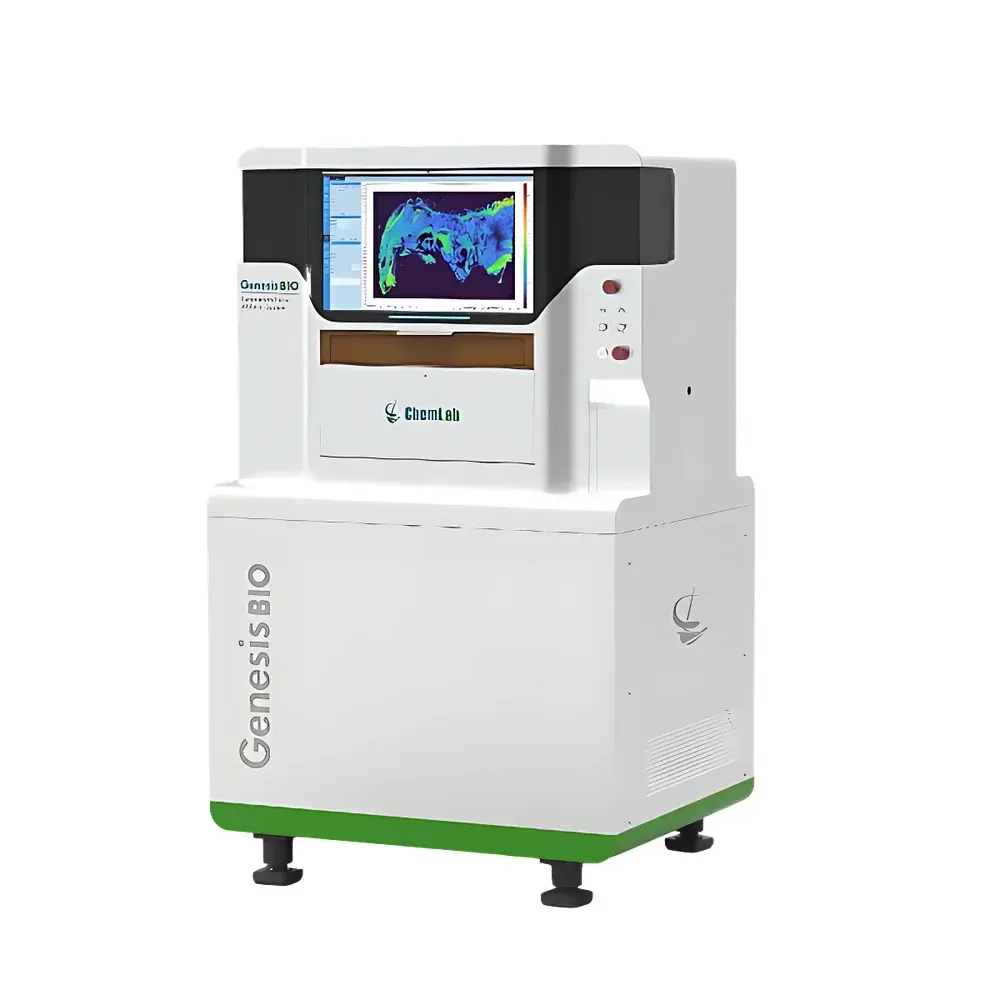
Shanghai Chemlab GenesisBIO Matrix Femtosecond Laser Ablation System
| Brand | Chemlab |
|---|---|
| Origin | Shanghai, China |
| Manufacturer Type | Original Equipment Manufacturer (OEM) |
| Country of Origin | China |
| Model | GenesisBIO |
| Price Range | USD 420,000 – 700,000 |
| Laser Wavelength | 343 nm |
| Pulse Duration | ≤260 fs |
| Spot Size Range | 1–500 µm (continuously adjustable), down to 200 nm |
| Spot Shape | Circular or rectangular (continuously selectable) |
| Repetition Rate | 1–1000 Hz |
| Fluence at Sample Surface | ≥50 J/cm² |
| Standard Objective | 10× single objective (manual turret) |
| Cooling Method | Air-cooled |
| Cryo Cell | Cryocell C40 |
| XYZ Stage Travel | 160 mm × 160 mm × 5 mm |
| Stage Resolution | ≤10 nm (X/Y/Z) |
| Maximum Stage Speed | 500 mm/s |
| Vibration Isolation | Granite optical table |
| Optical Path | Single-path architecture |
| Ablation Crater Morphology | Flat-bottomed, geometrically regular, sharp-edged |
Overview
The Shanghai Chemlab GenesisBIO Matrix Femtosecond Laser Ablation System is a purpose-built laser sampling platform engineered for high-fidelity, spatially resolved elemental imaging in life science applications. It integrates ultrafast femtosecond pulse generation with precision matrix scanning and cryogenic sample handling to enable robust coupling with inductively coupled plasma mass spectrometry (ICP-MS). Unlike conventional nanosecond laser ablation systems—where thermal diffusion dominates and compromises spatial fidelity—the GenesisBIO leverages sub-260 fs pulses at 343 nm to achieve non-thermal, photodisruptive ablation. This mechanism minimizes heat-affected zones, preserves molecular integrity in delicate biological matrices, and delivers exceptional crater uniformity and depth consistency. The system is optimized for quantitative LA-ICP-MS imaging of heterogeneous tissues—including plant vasculature, mammalian brain sections, fungal hyphae, and algal colonies—where sub-micron lateral resolution and isotopic reproducibility are critical.
Key Features
- Ultrafast laser source: Solid-state femtosecond oscillator-amplifier system with pulse duration ≤260 fs and wavelength fixed at 343 nm for optimal absorption in organic and hydrated samples.
- Matrix scanning capability: Programmable beam shaping allows seamless transition between circular and rectangular spot geometries; spot size continuously adjustable from 200 nm to 500 µm without hardware exchange.
- Nanopositioning stage: High-stiffness three-axis piezoelectric stage with 160 mm × 160 mm XY travel and 5 mm Z range; closed-loop resolution ≤10 nm and maximum velocity of 500 mm/s ensures rapid rastering while maintaining positional repeatability.
- Cryogenic sample environment: Integrated Cryocell C40 chamber maintains stable sub-zero temperatures during ablation to suppress analyte migration, minimize ice crystal artifacts, and preserve native elemental distribution in frozen-hydrated specimens.
- Optimized optical architecture: Single-path collimated beam delivery eliminates alignment drift; air-cooled laser head reduces infrastructure dependency and operational overhead compared to water-chilled alternatives.
- Thermal management design: Passive granite vibration isolation platform coupled with low-noise air cooling ensures long-term stability under continuous high-repetition-rate operation (up to 1000 Hz).
Sample Compatibility & Compliance
The GenesisBIO supports diverse sample formats including cryosectioned tissue slides (4–20 µm thickness), intact plant leaves, freeze-dried microbial colonies, and sediment cores embedded in resin or OCT compound. Its flat-bottomed, geometrically consistent craters—demonstrated on soda-lime glass standards across 10–500 µm dimensions—ensure predictable ablation yield and stoichiometric transfer to ICP-MS. The system complies with ISO/IEC 17025 requirements for calibration traceability of positioning axes and fluence measurement. When operated with validated SOPs, it supports GLP-compliant workflows for regulatory submissions involving elemental bioimaging. Data acquisition logs—including timestamped laser parameters, stage coordinates, and energy monitoring—are structured for audit readiness per FDA 21 CFR Part 11 guidelines when paired with compliant LIMS or instrument control software.
Software & Data Management
Control is managed via Chemlab’s GenesisControl Suite—a Windows-based application supporting script-driven method development, real-time fluence monitoring, and synchronized stage/laser triggering. The suite exports standardized .csv and .imzML-compatible files for downstream processing in open-source tools such as SCiLS Lab, Hypermap, or Python-based imaging pipelines (e.g., PyMCA, LAtools). All parameter sets are version-controlled and exportable as XML templates for inter-laboratory method transfer. Audit trails record user actions, parameter changes, and system events with SHA-256 hashing for integrity verification. Optional integration with Thermo Fisher, Agilent, or Nu Instruments ICP-MS platforms enables automated start/stop synchronization and metadata injection into raw data files.
Applications
- Subcellular metal mapping in neurodegenerative tissue sections (e.g., Zn/Cu/Fe distribution in hippocampal slices at 500 nm pixel resolution).
- Spatial metabolomics via hetero-element correlation (e.g., P/S/K co-localization in rice leaf vasculature over 646 × 467 µm fields).
- Trace element profiling in medicinal herbs (e.g., As/Cd/Pb quantification across 15 × 5 mm冬虫夏草 sections at 20 µm step size).
- Environmental biogeochemistry: Quantitative imaging of nutrient uptake dynamics in aquatic macrophytes (e.g., Potamogeton crispus) exposed to metal-contaminated sediments.
- Food authenticity testing: Discrimination of geographical origin via multi-isotope ratio imaging (e.g., ⁸⁷Sr/⁸⁶Sr + ²⁰⁸Pb/²⁰⁶Pb) in olive oil-infused botanical matrices.
FAQ
What is the minimum achievable spot size, and how is it verified?
The system achieves a diffraction-limited spot diameter of ≤200 nm using the 343 nm beam and high-NA optics; verified by calibrated knife-edge scanning and SEM imaging of ablation craters on certified reference materials.
Does the GenesisBIO support time-resolved ablation or dual-pulse configurations?
No—it is configured exclusively for single-pulse femtosecond ablation; dual-pulse or pump-probe modes are not implemented in this model.
Can the Cryocell C40 be retrofitted with alternative cooling media or temperature controllers?
The Cryocell C40 operates with standard liquid nitrogen supply and includes PID-regulated temperature feedback; third-party LN₂ dewars or cryo-coolers may be interfaced via analog I/O ports but require validation for thermal stability.
Is remote diagnostics or firmware update capability available?
Yes—secure SSH-enabled remote access is supported for diagnostic logging and over-the-air firmware updates, subject to customer-configured firewall policies and network authentication protocols.
How does the system handle charge accumulation on insulating samples?
A built-in low-energy electron flood gun (optional accessory) mitigates surface charging during extended ablation of polymers, resins, or dehydrated tissues; default operation assumes conductive coating or cryo-transfer protocols.
Related Products





