
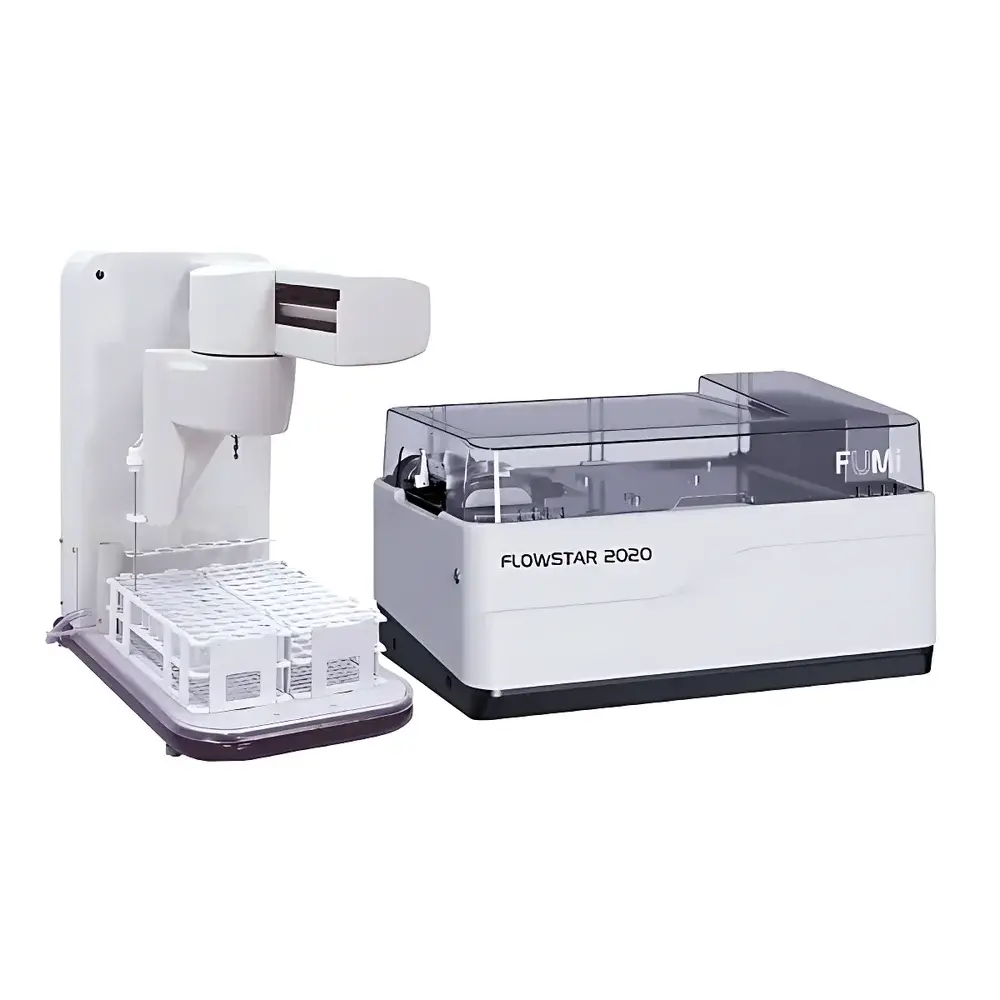
Shanghai Fumi Flowstar 2020BJ Automated Cyanide Analyzer for Food & Environmental Testing
| Brand | Shanghai Fumi |
|---|---|
| Origin | Shanghai, China |
| Model | Flowstar 2020BJ |
| Product Type | Continuous Flow Analyzer (CFA) |
| Wavelength Range | 270–1100 nm |
| Sample Cup Capacity | 100 / 180 / 270 positions (5 mL, 8 mL, or 10 mL per cup) |
| Reagent Positions | 100 / 180 / 270 |
| Flow Cell Pathlength | 10 mm, 30 mm, 50 mm |
| Light Source | LED or Krypton Lamp |
Overview
The Shanghai Fumi Flowstar 2020BJ Automated Cyanide Analyzer is a third-generation continuous flow analyzer (CFA) engineered for precise, high-throughput quantification of free and total cyanide in complex matrices—including alcoholic beverages (e.g., baijiu), drinking water, seawater, wastewater, soil extracts, plant tissues, fertilizers, tobacco, and food products. It implements segmented flow analysis (SFA) with air-segmented carrier streams to isolate reaction zones, enabling controlled residence times up to 40 minutes—critical for multi-step protocols such as on-line distillation, UV digestion, and cadmium-reduction-based colorimetric detection (ISO 6703-2, EPA Method 335.4, GB 5009.36–2023). The system integrates dual-beam, dual-wavelength photometry with selectable optical pathlengths (10/30/50 mm) and stable solid-state LED or krypton lamp illumination across 270–1100 nm, ensuring robustness against matrix-induced spectral interference. Its design eliminates manual sample pre-filtration and degassing requirements, accommodating turbid or particulate-laden samples via 2-mm internal diameter tubing and integrated dialysis membrane modules that suppress color and suspended solids interference.
Key Features
- True walk-away automation: fully programmable sequence control for sample aspiration, reagent addition, air segmentation, heating, digestion, reduction, and detection—no manual intervention required.
- Cadmium-ring reduction module replaces traditional packed-cadmium columns, delivering higher reproducibility, longer service life, and reduced maintenance downtime.
- On-board high-pressure autoclave digestion unit enables ISO-compliant total cyanide determination (per ISO 11237 and HJ 665–2013), including simultaneous total phosphorus analysis using identical thermal/chemical protocols.
- Dual-wavelength, dual-beam spectrophotometer with selectable pathlength cells (10 mm, 30 mm, 50 mm) and drift-compensated LED/krypton light sources ensures linearity over 4+ orders of magnitude.
- Modular reagent rack configuration supports 100/180/270 reagent positions; sample carousel accommodates 100/180/270 vials (5–10 mL each), compatible with standard 12.5 mm or 16 mm tubes.
- Low reagent consumption (<1.2 mL per test on average) and minimal sample volume requirement (≤1 mL), reducing operational cost and hazardous waste generation.
- Robust fluidic architecture: corrosion-resistant PTFE/PFA tubing, solenoid-valve–controlled air injection, oil-free compressed air supply, and self-diagnostic pressure monitoring.
Sample Compatibility & Compliance
The Flowstar 2020BJ is validated for direct analysis of undiluted or minimally diluted baijiu (Chinese distilled spirits), groundwater, effluent, soil leachates, and digested plant/fertilizer extracts. It meets method performance criteria outlined in GB 5009.36–2023 (National Food Safety Standard for Determination of Cyanide in Foods), GB 5750.5–2023 (Standard Methods for Drinking Water), SL/T 788–2019 (Water Quality Monitoring for Irrigation), CJ/T 141–2018 (Urban Water Supply Quality), HY/T 141–2011 (Seawater Analysis), and HJ 665–2013 / HJ 667–2013 / HJ 670–2013 (China’s Environmental Monitoring Technical Specifications). It also supports AOAC Official Method 971.23, EPA Methods 335.4 and 335.2, and ISO 6703-1/2 for free and total cyanide. Instrument compliance includes GLP-aligned audit trails, user-level access control, and electronic signature readiness per FDA 21 CFR Part 11 when paired with certified LIMS integration.
Software & Data Management
Controlled via Windows-based FlowStar Suite v4.x software, the system provides method editor with drag-and-drop protocol builder, real-time chromatogram visualization, peak height/area dual-integration algorithms, and automatic baseline correction. All analytical parameters—including flow rates, segment timing, temperature setpoints, wavelength selection, and calibration curve models—are stored with versioning and timestamped metadata. Raw data files (.fsd) are exportable in CSV, ASCII, and ASTM E1382-compliant formats. Audit trail logs record operator actions, method changes, calibration events, and instrument status alerts—retained for ≥18 months with optional encrypted backup to network drives. Software supports IQ/OQ documentation templates aligned with ISO/IEC 17025 laboratory accreditation requirements.
Applications
The Flowstar 2020BJ supports over 150 standardized and custom-developed CFA methods beyond cyanide, including nitrate/nitrite, ammonia, phosphate, silica, sulfate, chloride, fluoride, orthophosphate, total Kjeldahl nitrogen (TKN), and phenolic compounds. In baijiu quality control, it delivers trace-level cyanide detection (sub-µg/L LOD) without matrix interference from ethanol, esters, or fusel oils. For environmental labs, it enables unattended batch processing of 30+ samples per hour with <2% RSD across heterogeneous wastewater streams. Its dialysis-compatible manifold allows direct analysis of raw sludge filtrates and sediment pore waters, while UV-digestion capability extends applicability to organically bound cyanide species in industrial effluents.
FAQ
Does the Flowstar 2020BJ comply with GB 5009.36–2023 for baijiu testing?
Yes—the system implements the full distillation–cadmium reduction–colorimetry workflow specified in Clause 8.2 of GB 5009.36–2023, including automated distillate collection, pH-controlled reduction, and 540 nm endpoint measurement.
Can it measure both free and total cyanide in a single run?
No—free and total cyanide require separate analytical protocols: free cyanide uses direct distillation at pH 4.0; total cyanide requires pre-digestion under alkaline conditions with UV irradiation or high-pressure autoclaving. Both are supported but executed in distinct method sequences.
Is filtration or degassing of samples required prior to analysis?
No—integrated dialysis membranes and air-segmented flow eliminate the need for offline filtration or vacuum degassing, even for turbid or gaseous samples.
What is the typical detection limit for cyanide in baijiu?
Under optimized conditions (50 mm flow cell, 40-min distillation, peak-area integration), the method detection limit (MDL) is ≤0.2 µg/L with ≤1.8% RSD (n=10) at 5 µg/L spike level.
How is instrument validation performed for regulatory submissions?
The system supports full IQ/OQ/PQ execution per ISO/IEC 17025 Annex A, including linearity (5–500 µg/L), accuracy (recovery 96–103%), precision (RSD <2.5%), and carryover assessment (<0.05%). Validation reports are auto-generated within FlowStar Suite.






