
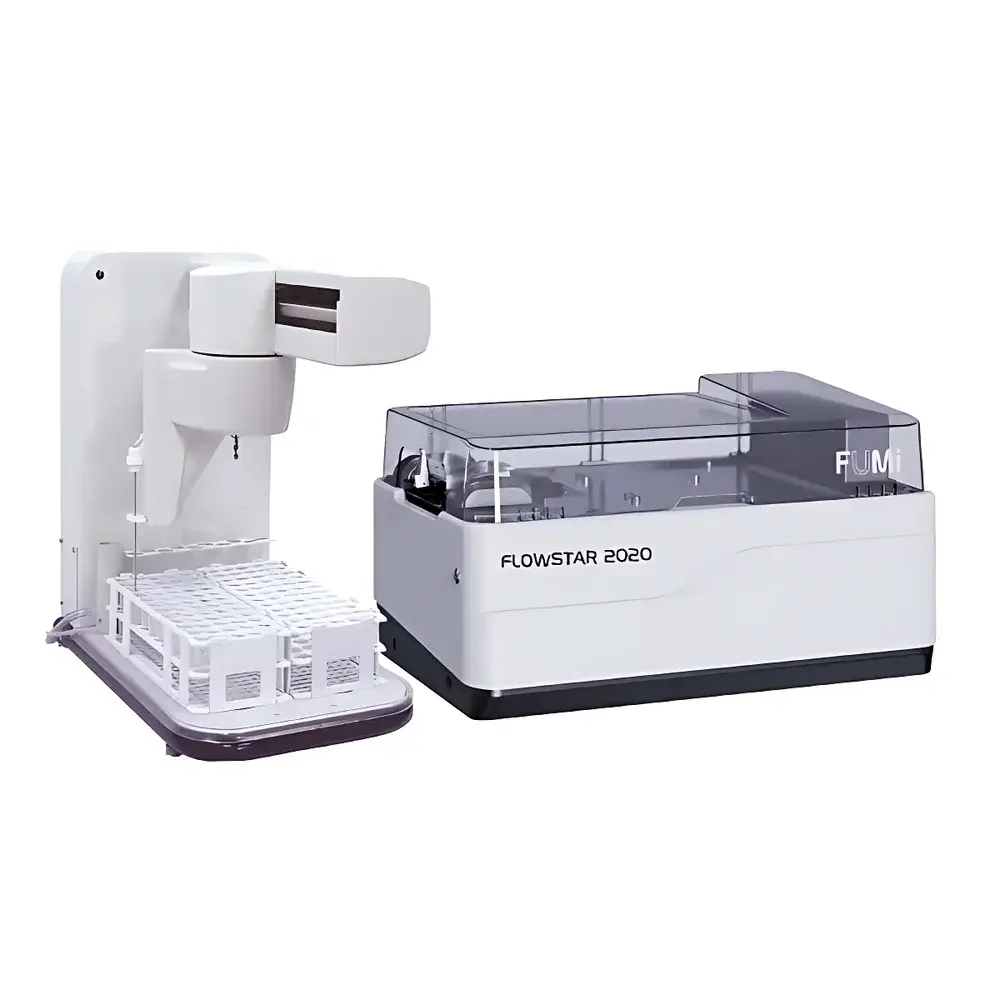
Shanghai Fumi Flowstar 2020YC Tobacco-Specific Continuous Flow Analyzer
| Brand | Shanghai Fumi |
|---|---|
| Origin | Shanghai, China |
| Model | Flowstar 2020YC |
| Product Type | Continuous Flow Analyzer (CFA) |
| Wavelength Range | 270–1100 nm |
| Sample Capacity | 100 / 180 / 270 positions (vials of 5, 8, or 10 mL) |
| Reagent Positions | 100 / 180 / 270 |
| Flow Cell Pathlength | 10 mm, 30 mm, 50 mm |
| Light Source | LED or Krypton Lamp |
Overview
The Shanghai Fumi Flowstar 2020YC Tobacco-Specific Continuous Flow Analyzer is a fully automated, third-generation continuous flow analysis (CFA) system engineered for high-precision, high-throughput determination of key chemical parameters in tobacco and related agricultural, environmental, and industrial matrices. Based on segmented flow analysis (SFA) principles—where discrete sample and reagent segments are separated by precisely injected air bubbles—the instrument enables controlled reaction kinetics, extended incubation times (up to 40 minutes), and robust interference mitigation. Its design integrates dual-beam, dual-wavelength photometry with selectable optical pathlengths (10–50 mm), enabling accurate quantification across wide concentration ranges without manual dilution. The system supports standardized colorimetric, enzymatic, and spectrophotometric methods compliant with YC/T 159–162 (China Tobacco Industry Standards), as well as international protocols including ISO 6439 (total cyanide), ISO 11261 (total phosphorus), EPA 365.3, APHA 4500-P, and AOAC Official Methods. Unlike conventional flow injection analyzers (FIA), the Flowstar 2020YC employs true continuous segmentation, allowing complex on-line operations such as steam distillation, dialysis, UV digestion, and cadmium-reduction-based nitrate/nitrite conversion—all executed automatically without operator intervention.
Key Features
- True segmented flow architecture with programmable air-segment injection via solenoid valves—eliminates need for degassing or pre-filtration of samples or reagents
- Dual-beam, dual-wavelength photometer with interchangeable LED or krypton lamp sources and selectable flow cell pathlengths (10 mm, 30 mm, 50 mm) for optimized sensitivity and dynamic range
- Modular reagent and sample carousels accommodating up to 270 positions each (5/8/10 mL vial formats), supporting unattended operation for >12 hours
- Integrated on-line dialysis unit to remove matrix interferences from colored or turbid samples (e.g., tobacco extracts, soil digests, wastewater)
- On-board UV digestion module compliant with ISO 11261 for total phosphorus and EPA Method 365.3 for total cyanide
- Cadmium-ring reduction system replacing traditional cadmium columns—improving longevity, reproducibility, and reducing maintenance frequency
- High-pressure autoclave-style digestion for refractory organic-bound analytes (e.g., protein-bound nitrogen, starch hydrolysis)
- Peak-height and peak-area dual quantification algorithms with baseline correction and drift compensation
- 2 mm internal diameter tubing—enhanced tolerance for particulate-laden samples (e.g., plant homogenates, sediment suspensions, fertilizer slurries)
Sample Compatibility & Compliance
The Flowstar 2020YC is validated for direct analysis of raw and processed tobacco leaf, stem, and by-product materials—including cured, fermented, and reconstituted sheet—without pre-dilution in most cases. It accommodates aqueous extracts, acid digests, enzymatic hydrolysates, and distillates from diverse sample types: surface water, groundwater, wastewater, seawater, soil leachates, plant tissues, fertilizers, food products, and industrial effluents. All method implementations adhere to regulatory data integrity requirements: audit trails, electronic signatures, and user-access controls align with FDA 21 CFR Part 11 and GLP/GMP documentation frameworks. Method validation reports include precision (RSD < 2.5% for n ≥ 6), detection limits (sub-ppb to low-ppm depending on analyte and pathlength), and recovery studies per ISO/IEC 17025 guidelines. Certified reference materials (CRMs) from NIST, LGC, and CNAS are routinely used for calibration verification.
Software & Data Management
The proprietary FlowControl™ software provides intuitive method development, real-time system monitoring, and automated report generation in PDF and CSV formats. Each analysis run records full metadata: instrument status logs, valve actuation timestamps, photometer voltage traces, temperature profiles, and reagent consumption metrics. Raw chromatograms and processed peak tables are stored in a relational database with version-controlled method files. Exported datasets comply with LIMS integration standards (ASTM E1467, HL7) and support direct import into statistical packages (e.g., JMP, R, Python pandas). Software validation documentation includes IQ/OQ/PQ protocols and change control records meeting ISO 9001 and ISO/IEC 17025 requirements.
Applications
The system supports over 150 validated analytical procedures—including but not limited to: water-soluble sugars (glucose, fructose, sucrose) via anthrone or phenol-sulfuric acid assays; total alkaloids (nicotine, nornicotine) by bromocresol green titration; total nitrogen by Kjeldahl or combustion-based CFA adaptation; chloride by mercuric thiocyanate; starch by amyloglucosidase hydrolysis; ammonia by indophenol blue; total protein by Lowry or biuret; orthophosphate and total phosphorus by molybdenum blue; and cyanide by pyridine-barbituric acid. Applications extend beyond tobacco QC to environmental monitoring (HJ 665, HJ 667, HJ 670), drinking water safety (GB 5750), marine analysis (HY/T 141), and agricultural testing (SL/T 788, CJ/T 141).
FAQ
Does the Flowstar 2020YC require sample filtration or degassing prior to analysis?
No—its segmented flow design and 2 mm ID tubing tolerate suspended solids and dissolved gases; samples and reagents are loaded directly.
Can the system perform online distillation for ammonia or cyanide analysis?
Yes—integrated steam distillation modules operate under programmable temperature and pressure control, compliant with ISO 5664 and ISO 6439.
Is method transfer from manual wet chemistry possible?
Yes—pre-validated tobacco industry methods (YC/T 159–162) and EPA/ISO protocols are pre-loaded; custom method development tools support kinetic optimization and calibration curve fitting.
What maintenance intervals are recommended for routine operation?
Valve manifolds and pump tubing are rated for ≥10,000 cycles; photometer lamp life exceeds 5,000 hours; dialysis membranes are replaced every 3 months under continuous use.
How is data security and traceability ensured?
All user actions, method changes, and result modifications are time-stamped and logged with operator ID; electronic signatures and role-based access control meet 21 CFR Part 11 requirements.




