
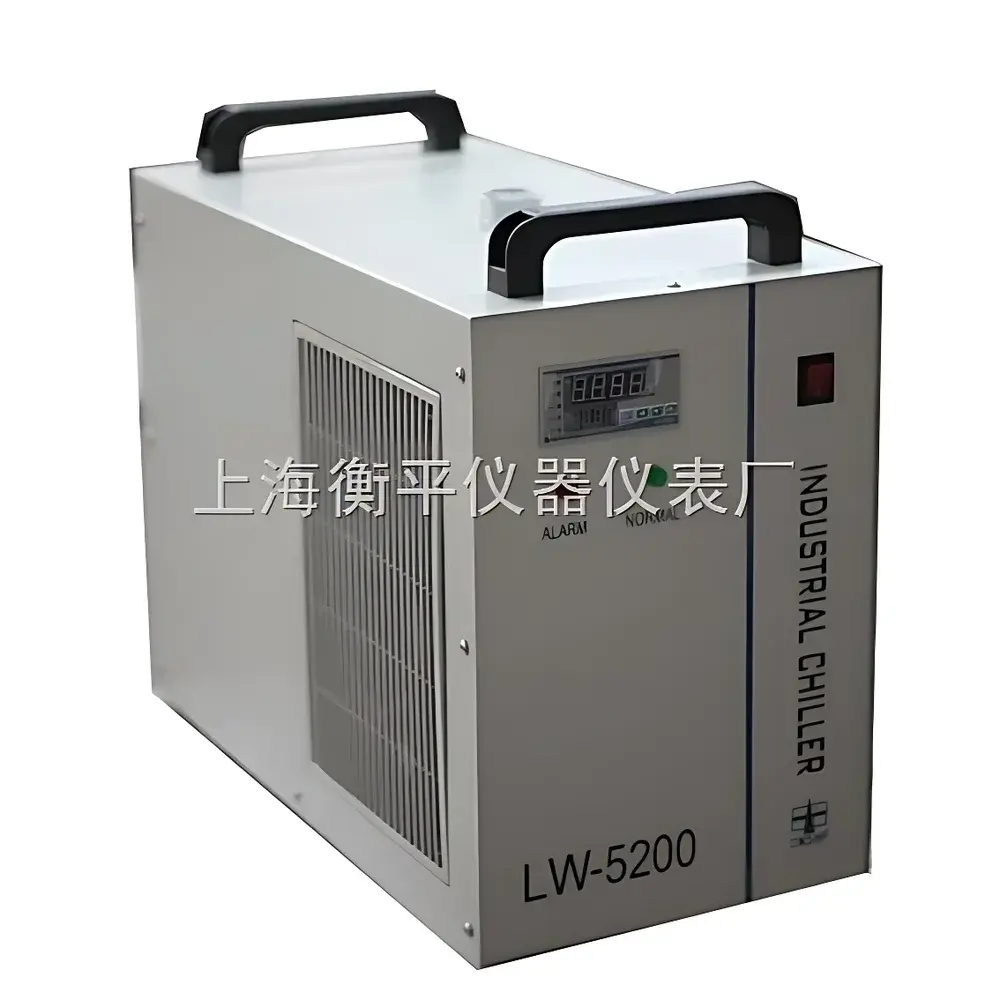
Shanghai Hengping LW-5200 Integrated Air-Cooled Circulating Chiller
| Brand | Hengping |
|---|---|
| Origin | Shanghai, China |
| Model | LW-5200 |
| Cooling Type | Air-cooled |
| Temperature Range | 5–40 °C |
| Temperature Stability | ±0.1 °C |
| Refrigeration Capacity | 1400 W |
| Pump Pressure | 2.0 bar |
| Flow Rates | 10 / 13 / 16 L/min (model-dependent) |
| Reservoir Volume | 6 L |
| Power Supply | 220 V, 50 Hz |
| Compressor Power | 0.52 kW (0.7 HP) |
| Refrigerant | R-134a |
| Max. Head | 10–19 m |
| Net Weight | 30 kg |
| Dimensions (L×W×H) | 550 × 280 × 430 mm |
Overview
The Shanghai Hengping LW-5200 is an integrated, air-cooled circulating chiller engineered for precise thermal management in laboratory and light industrial applications. Designed to maintain stable coolant temperatures across extended operating cycles, it employs a hermetic scroll or rotary compressor with R-134a refrigerant — a non-ozone-depleting, low-global-warming-potential (GWP) hydrofluorocarbon widely accepted under current EU F-Gas Regulation (EU No. 517/2014) and EPA SNAP program guidelines. The unit operates on a closed-loop thermosyphon-assisted vapor-compression cycle, delivering consistent cooling performance at setpoints between 5 °C and 40 °C. Its compact footprint (550 × 280 × 430 mm) and integrated pump-reservoir architecture eliminate external plumbing complexity, making it suitable for benchtop integration with lasers, spectrometers, plasma sources, and analytical instrumentation requiring stable heat extraction.
Key Features
- Stable temperature control with ±0.1 °C fluctuation over time — achieved via PID-controlled electronic expansion valve (EEV) modulation and dual-sensor feedback (inlet/outlet)
- Three flow-rate variants (10 / 13 / 16 L/min) matched to application-specific thermal load profiles; maximum head up to 19 m supports multi-instrument daisy-chaining
- Dual-mode temperature regulation: selectable constant-setpoint or differential (ΔT) control for process-coupled cooling loops
- Comprehensive hardware safety suite: compressor overcurrent protection, flow-loss alarm (via turbine flow sensor), high/low temperature cutoff, and 3-minute compressor restart delay to prevent short-cycling
- Corrosion-resistant 6 L stainless steel reservoir with level indicator, anti-spill fill port, and drain valve compliant with ISO 13850 emergency stop interface standards
- Front-panel LED display with real-time monitoring of outlet temperature, flow status, and fault codes — supports user-defined alarm thresholds per IEC 61000-6-2 EMC immunity requirements
Sample Compatibility & Compliance
The LW-5200 is compatible with deionized water, 20–30% ethylene glycol/water mixtures, and other non-corrosive, low-conductivity coolants meeting ASTM D1384 specifications for cooling system fluids. It meets CE marking requirements under the Low Voltage Directive (2014/35/EU) and Electromagnetic Compatibility Directive (2014/30/EU). All electrical components conform to IP20 ingress protection rating per IEC 60529. While not certified to UL 61010-1 or CSA C22.2 No. 61010-1 out-of-the-box, the unit’s design adheres to core safety principles referenced in those standards, including reinforced insulation, double-pole switching, and thermal cutouts. Documentation includes full RoHS 2 (2011/65/EU) compliance statements and REACH SVHC screening reports.
Software & Data Management
The LW-5200 operates as a standalone analog/digital hybrid controller with no embedded firmware update capability or remote connectivity. However, its analog 0–5 V or 4–20 mA output signal (optional upon request) enables integration into centralized SCADA or LabVIEW-based monitoring systems. For laboratories operating under GLP or GMP frameworks, the unit supports audit-ready manual logbooks — temperature stability data can be recorded externally using calibrated NIST-traceable thermistors placed at the outlet port. All alarm events trigger visual indicators and latching relay outputs (dry contact), facilitating connection to building management systems (BMS) for automated incident escalation per ISO/IEC 17025 clause 7.9.
Applications
- Cooling of CO₂ glass tube lasers (up to 130 W output) and RF metal tube lasers (up to 30 W), where thermal lensing must be minimized to preserve beam quality (M² < 1.3)
- Thermal stabilization of CNC spindle motors (up to 8 kW) during high-duty-cycle machining, preventing bearing creep and dimensional drift per ISO 230-3 thermal displacement testing protocols
- Active cooling of diode-pumped solid-state (DPSS) lasers and semiconductor laser modules (50–75 W), maintaining junction temperature within ±0.5 °C to ensure wavelength stability (±0.05 nm) and power repeatability
- Supporting electrophoresis systems, gel documentation units, and vacuum pump condensers requiring continuous sub-ambient heat rejection without refrigerant leakage risk
- Backup cooling for HPLC column ovens and mass spectrometer ion sources where secondary thermal control enhances method robustness under variable ambient conditions
FAQ
What is the minimum allowable coolant conductivity for safe operation?
Deionized water with conductivity ≤ 5 µS/cm is recommended. Glycol mixtures must remain below 100 µS/cm to avoid accelerated corrosion of copper tubing and pump impellers.
Can the LW-5200 be used in unheated environments below 5 °C?
No. Ambient operating range is strictly 10–35 °C per IEC 60068-2-1. Sub-10 °C ambient conditions risk refrigerant migration, oil slugging, and condensation-induced electrical faults.
Is the reservoir equipped with a level switch for automated refill signaling?
No. A visual sight gauge and manual low-level warning are provided; integration with external level sensors requires third-party relay interface.
Does the unit comply with FDA 21 CFR Part 11 for electronic records?
Not natively — it lacks audit trail generation, electronic signatures, or password-protected parameter modification. Data must be manually transcribed for regulated workflows.
What maintenance intervals are specified for long-term reliability?
Compressor oil inspection every 24 months; refrigerant charge verification every 36 months; pump impeller cleaning and seal inspection annually — all documented per ISO 55001 asset management principles.



