
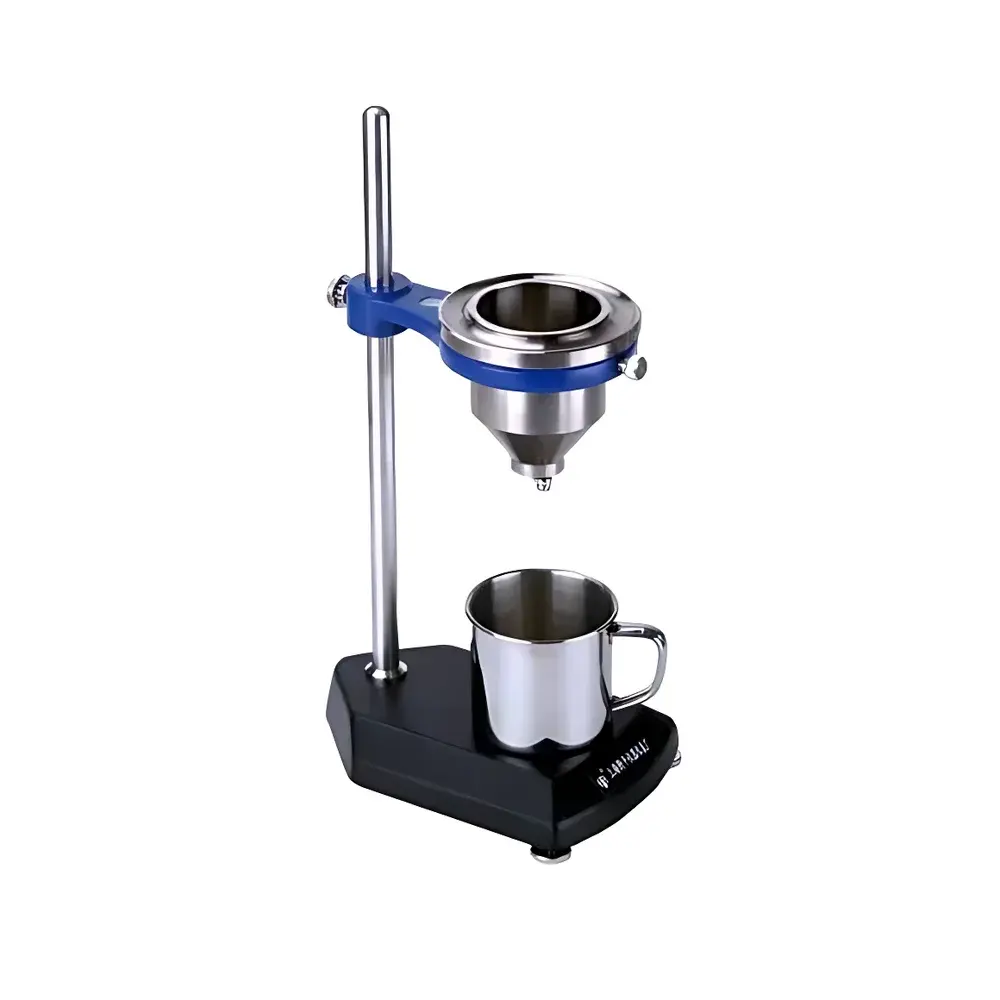
Shanghai Hengping NDJ-5 Coating-4 (Ford Cup #4) Efflux Viscometer
| Brand | Hengping |
|---|---|
| Origin | Shanghai, China |
| Model | NDJ-5 |
| Instrument Type | Portable Efflux Viscometer |
| Viscosity Range | 30–100 seconds (efflux time, per ISO 2431 / ASTM D1200) |
| Applicable Fluids | Paints, varnishes, coatings, inks, adhesives, food suspensions, cosmetic emulsions, and other Newtonian or near-Newtonian liquids |
| Compliance | ISO 2431, ASTM D1200, GB/T 1723–1993 |
Overview
The Shanghai Hengping NDJ-5 Coating-4 Efflux Viscometer is a precision-engineered gravity-driven flow instrument designed for rapid, standardized measurement of kinematic viscosity in low-to-medium viscosity liquids—primarily architectural and industrial coatings, lacquers, and related formulations. Unlike rotational viscometers that measure dynamic viscosity via torque resistance, the NDJ-5 operates on the efflux principle: it quantifies the time required for a fixed volume of liquid to drain through a calibrated orifice under gravity, directly yielding efflux time in seconds. This value correlates to kinematic viscosity (mm²/s or cSt) via empirical calibration curves traceable to ISO 2431 and ASTM D1200. The device is optimized for routine quality control in production labs, R&D facilities, and on-site inspection where portability, speed, and repeatability are critical. Its robust brass body, precision-ground stainless steel orifice (4 mm diameter), and temperature-stable design ensure consistent performance across ambient laboratory conditions (15–30 °C), with minimal operator dependency when used per standardized wetting and draining protocols.
Key Features
- Portable, hand-held design with integrated stand and level-adjusting feet for stable placement on any flat surface
- Calibrated orifice conforming to Ford Cup #4 geometry (ISO 2431 Annex A, ASTM D1200 Type 4)
- Brass main body with chrome-plated finish for corrosion resistance and long-term dimensional stability
- Clear acrylic reservoir cap with fill line indicator for precise 100 mL sample volume dosing
- No external power supply or electronics required—fully mechanical operation ensures intrinsic reliability
- Direct efflux time readout (30–100 s) with ±0.2 s repeatability under controlled temperature and procedure adherence
Sample Compatibility & Compliance
The NDJ-5 is validated for use with low-viscosity, non-thixotropic, and minimally shear-thinning fluids whose flow behavior approximates Newtonian response within the efflux timeframe window. Typical applications include solvent-borne and water-borne architectural paints, clear varnishes, printing inks, wood stains, and certain polymer dispersions. It is not suitable for highly thixotropic systems (e.g., textured coatings), high-solids pastes, or non-Newtonian fluids exhibiting significant time-dependent recovery (e.g., some acrylic gels or bentonite suspensions). Regulatory alignment includes full compatibility with ISO 2431:2015 (Paints and varnishes — Determination of flow time using flow cups), ASTM D1200–22 (Standard Test Method for Kinematic Viscosity of Transparent and Opaque Liquids by the Ford Viscosimeter), and China’s national standard GB/T 1723–1993 (Determination of viscosity of paint, varnish and similar products). Data generated supports GLP-compliant batch release documentation when paired with documented calibration records and environmental logs.
Software & Data Management
As a purely mechanical efflux viscometer, the NDJ-5 does not incorporate embedded firmware, digital interfaces, or proprietary software. Efflux time measurements are recorded manually using a certified stopwatch traceable to NIST or equivalent national metrology institutes. For laboratories operating under FDA 21 CFR Part 11 or ISO/IEC 17025 requirements, users may integrate NDJ-5 data into validated LIMS or ELN platforms via structured manual entry, accompanied by operator ID, ambient temperature/humidity, instrument calibration certificate number, and sample identification. Calibration verification is performed quarterly using reference oils of known kinematic viscosity (e.g., Cannon-Manning Series), with results logged in accordance with internal SOPs governing efflux cup maintenance and traceability.
Applications
- Routine QC screening of incoming raw materials (e.g., resin solutions, pigment dispersions) prior to formulation
- In-process viscosity checks during paint manufacturing to ensure consistency before filtration and packaging
- Final product release testing against specification limits (e.g., “38–42 s @ 25 °C”) per customer technical data sheets
- Comparative evaluation of solvent blends or rheology modifiers during formulation development
- Field-based audits at contractor sites to verify coating viscosity compliance prior to spray or roller application
- Educational use in polymer science and coatings technology courses for teaching fundamental viscosity concepts
FAQ
What is the difference between NDJ-5 and rotational viscometers like Brookfield models?
The NDJ-5 measures efflux time (seconds) under gravity, correlating to kinematic viscosity; rotational viscometers apply controlled shear and report dynamic viscosity (mPa·s) across adjustable shear rates. They serve complementary roles—NDJ-5 for fast pass/fail QC, rotational units for full flow curve analysis.
Can the NDJ-5 be used for non-coating materials such as food syrups or pharmaceutical suspensions?
Only if the material flows freely through the 4-mm orifice within 30–100 s and exhibits negligible particle settling or stringiness during drainage. Viscous or particulate-laden systems require rotational or capillary methods.
How often must the orifice be cleaned and calibrated?
The orifice must be cleaned with compatible solvents (e.g., acetone, xylene) after every test series and inspected microscopically for burrs or deposits weekly. Calibration verification with reference oils is recommended every 90 days or after physical impact.
Does the NDJ-5 comply with ISO/IEC 17025 accreditation requirements?
Yes—provided the laboratory maintains documented procedures for operator training, environmental monitoring, calibration traceability, and uncertainty estimation per ISO/IEC 17025 Clause 6.4 and 6.5.
Is temperature control built into the NDJ-5?
No—the instrument relies on ambient temperature stabilization. Users must conduct tests in a temperature-controlled room (±0.5 °C) and record actual bath or air temperature alongside each measurement per ISO 2431 Section 6.2.
Related Products



