
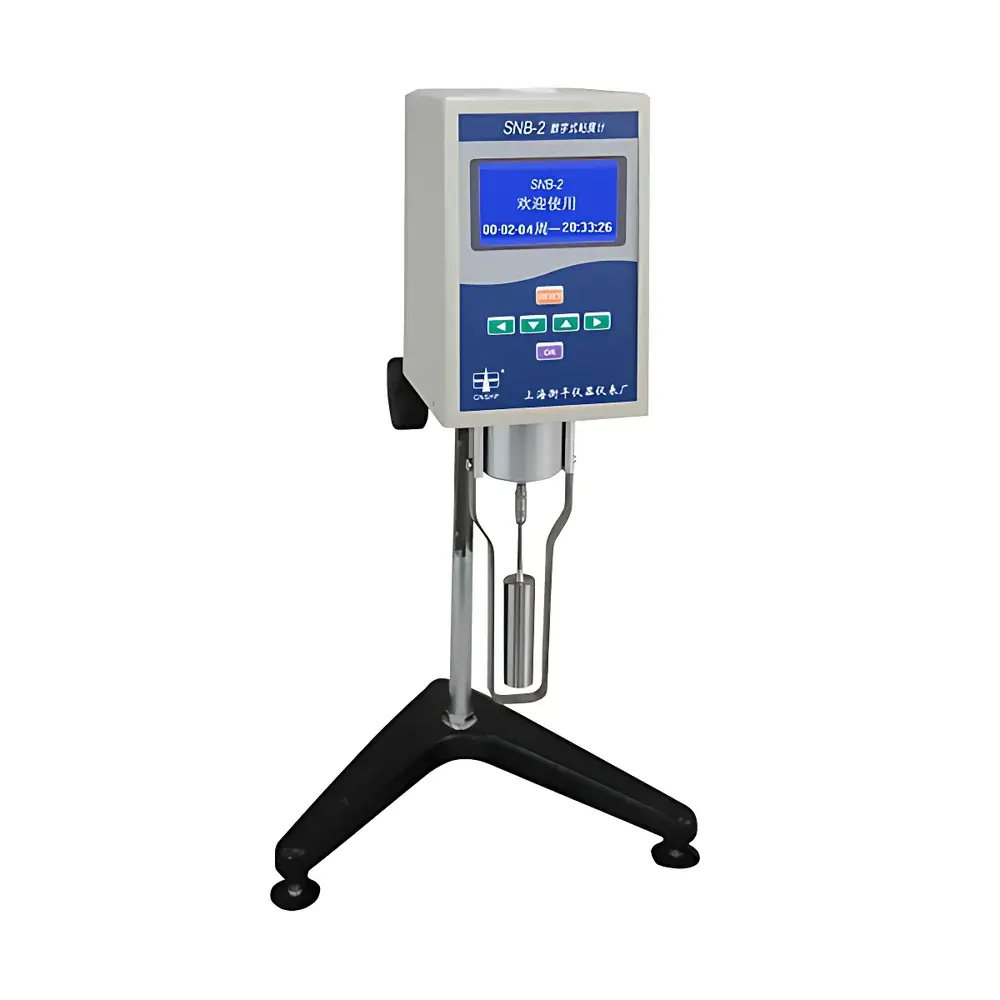
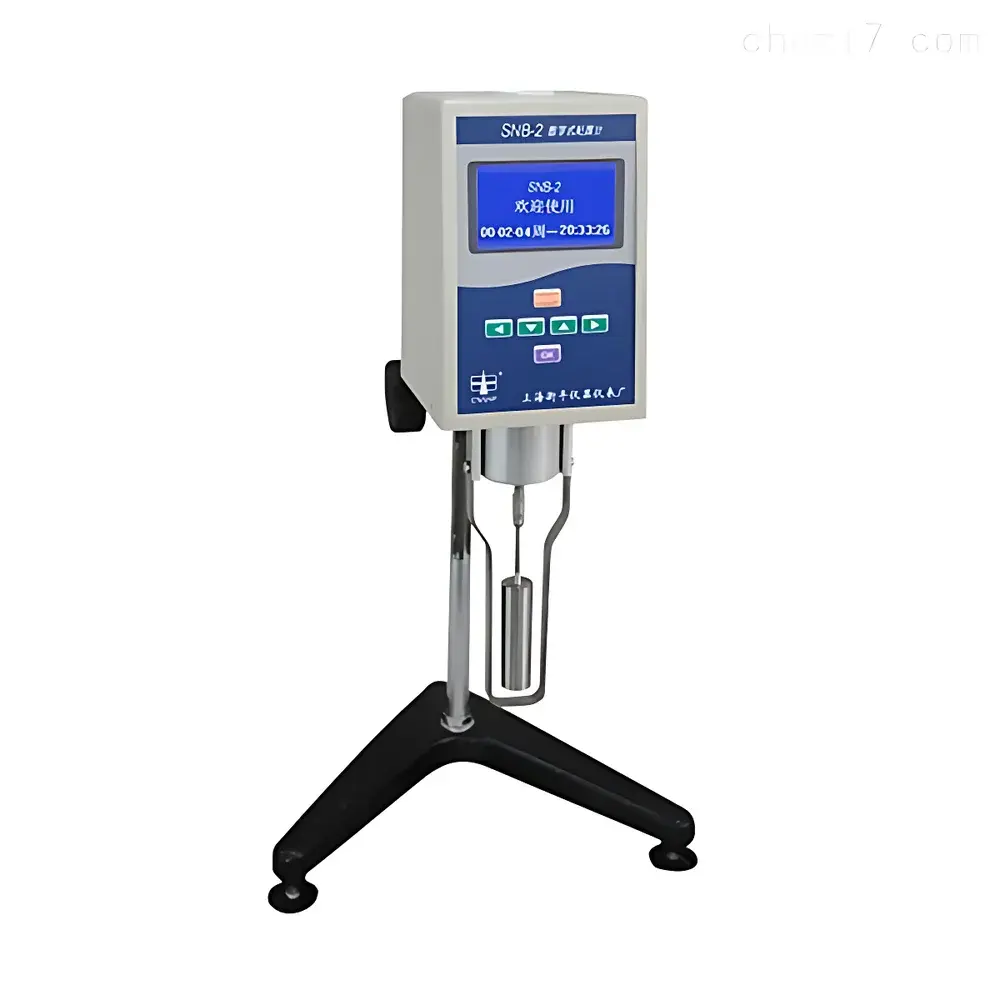
Shanghai Hengping SNB-2 Digital Rotational Viscometer
| Brand | Hengping |
|---|---|
| Origin | Shanghai, China |
| Model | SNB-2 |
| Instrument Type | Rotational Viscometer |
| Viscosity Range | 1–2×10⁶ mPa·s |
| Rotors | Standard #1–#4 (Optional #0 for 0.1–10 mPa·s) |
| Speed Settings | 0.3, 0.6, 1.5, 3, 6, 12, 30, 60 rpm |
| Accuracy | ±2% (for Newtonian fluids) |
| Power Supply | AC 220 V ±10%, 50 Hz ±10% |
| Operating Temperature | 5–35 °C, RH ≤80% |
| Dimensions | 280 × 320 × 390 mm |
| Net Weight | 4.5 kg |
| Interfaces | RS-232, temperature sensor port, printer port |
| Auto-ranging | Yes (auto-selects rotor & speed) |
| Display | Backlit LED |
Overview
The Shanghai Hengping SNB-2 Digital Rotational Viscometer is a precision-engineered instrument designed for routine and quality control viscosity measurements of both Newtonian and non-Newtonian fluids. Based on the principle of rotational viscometry—where torque required to rotate a spindle (rotor) immersed in a sample at controlled shear rates is measured—the SNB-2 delivers reliable apparent viscosity data across a broad dynamic range (1–2×10⁶ mPa·s). Its microprocessor-based control system ensures consistent rotational speed stability and accurate torque transduction, making it suitable for laboratories requiring repeatable, operator-independent results under ambient conditions. The device complies with fundamental metrological practices aligned with ISO 2555 and ASTM D2196 for rotational viscosity testing, supporting traceable calibration protocols when used with certified standard oils.
Key Features
- Digital LED display with blue backlight for high-contrast readability in varied lighting conditions
- Eight programmable rotational speeds (0.3–60 rpm), enabling flexible shear rate selection for rheological profiling
- Auto-ranging function: automatically identifies optimal rotor and speed combination based on measured torque
- Integrated RS-232 serial interface for bidirectional communication with Windows-based PCs; compatible with basic terminal emulation or custom data logging software
- Dedicated temperature sensor port supports real-time sample temperature monitoring (sensor sold separately), critical for temperature-dependent viscosity evaluation per ASTM D445 guidelines
- Printer interface enables direct hardcopy output of measurement records—including time stamp, rotor ID, speed, viscosity value, and temperature (if sensed)
- Robust mechanical architecture with precision-machined aluminum housing and low-inertia spindle drive system
- Standard set includes four DIN-standard spindles (#1–#4); optional #0 spindle extends low-viscosity capability down to 0.1 mPa·s
Sample Compatibility & Compliance
The SNB-2 accommodates a wide variety of liquid and semi-liquid samples common in industrial R&D and QC environments—including solvent-based coatings, polymer melts, edible oils, pharmaceutical suspensions, cosmetic emulsions, and detergent formulations. Its geometry conforms to standard coaxial cylinder (Couette) flow assumptions for Newtonian fluids, while providing empirically validated apparent viscosity values for shear-thinning or thixotropic materials when operated under defined test protocols. Though not certified for GLP or GMP-regulated environments out-of-the-box, the instrument supports audit-ready documentation when paired with validated PC software and calibrated reference standards. All electrical components meet CE-marking safety requirements for laboratory equipment (IEC 61010-1).
Software & Data Management
The SNB-2 does not include embedded firmware-based data storage; instead, it relies on external host systems for persistent recordkeeping. When connected via RS-232 and configured with appropriate terminal software (e.g., Tera Term, PuTTY), users can capture ASCII-formatted output streams containing timestamped viscosity readings, rotor identification, rotational speed, and optional temperature input. For regulated environments, third-party software packages may be deployed to enforce 21 CFR Part 11-compliant electronic signatures, audit trails, and user access controls—provided the host system and validation documentation are independently qualified. Raw data export is supported in CSV-compatible plain-text format for downstream statistical analysis in Excel or MATLAB.
Applications
- Quality assurance of lubricants, transformer oils, and hydraulic fluids per ISO 3104
- Batch release testing of paints, varnishes, and architectural coatings (ASTM D1084)
- Routine monitoring of food-grade syrups, sauces, and dairy products during production
- Stability assessment of pharmaceutical suspensions and topical gels
- Evaluation of cleaning agent formulations for consumer and industrial use
- Teaching labs for undergraduate instruction in fluid mechanics and material science
FAQ
What viscosity standards are recommended for calibration verification?
Certified mineral oil standards (e.g., Cannon N47, N100, N500) traceable to NIST or equivalent national metrology institutes are advised for periodic accuracy checks.
Can the SNB-2 measure yield stress?
No—it is not equipped with controlled-stress capability or ramped-speed programming; yield point estimation requires extrapolation from multiple fixed-speed measurements and is not ISO-compliant.
Is temperature control integrated into the instrument?
No—temperature regulation requires an external water bath or Peltier-controlled sample holder; the built-in port only accepts passive RTD or thermistor probes for monitoring.
How often should rotor calibration be performed?
Annual verification against reference geometries is recommended; visual inspection for wear or bending should occur before each use.
Does the SNB-2 support continuous real-time viscosity logging?
Yes—when interfaced with a PC running polling-capable software, readings can be acquired at user-defined intervals (minimum ~1 second) and logged synchronously with timestamps.



