
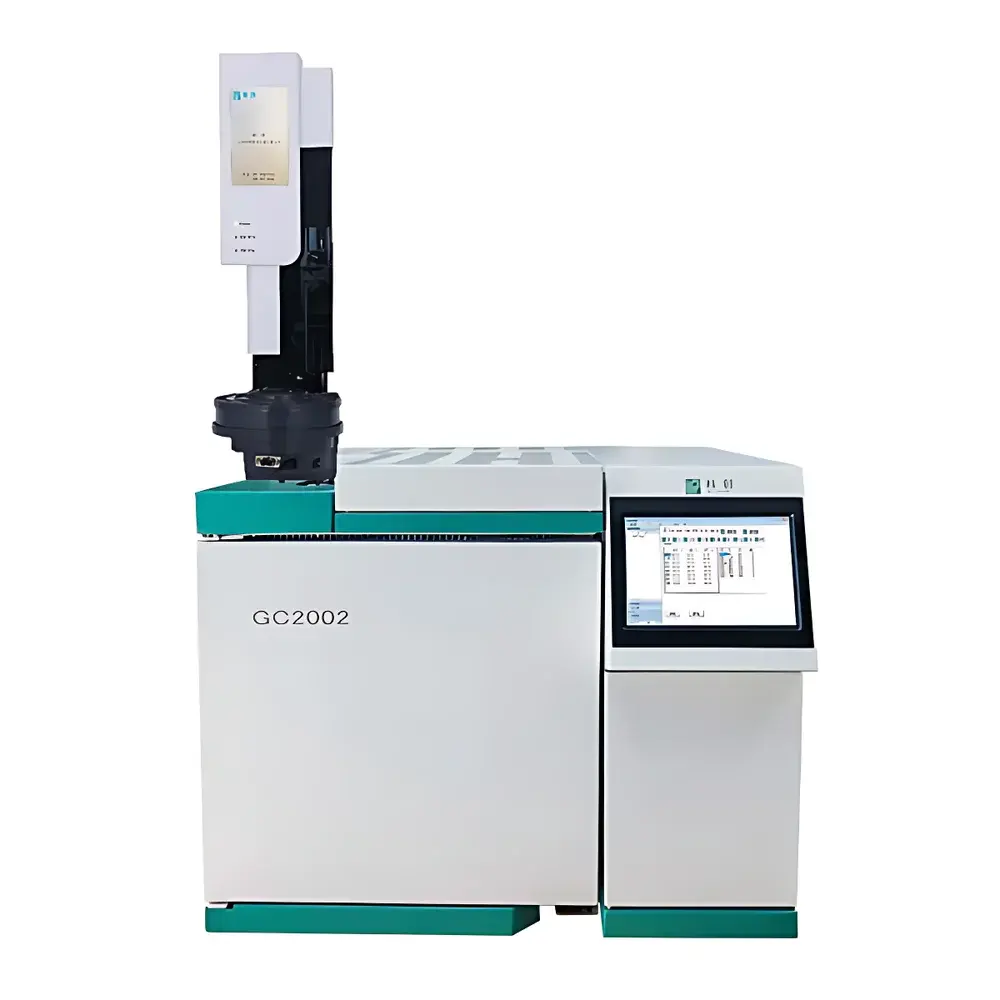
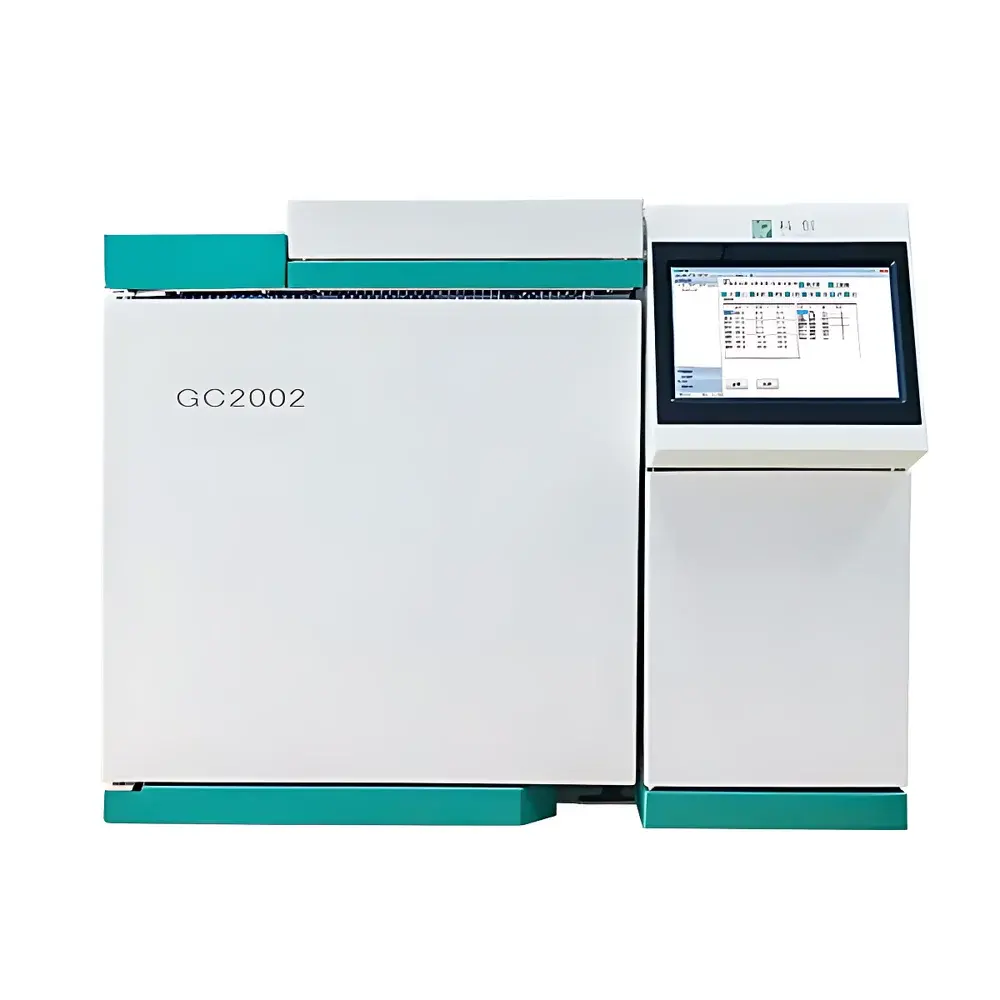
Shanghai Kechuang GC2002 Intelligent Color Touchscreen Gas Chromatograph
| Brand | Kechuang |
|---|---|
| Origin | Shanghai, China |
| Manufacturer Type | Direct Manufacturer |
| Product Category | Domestic |
| Model | GC2002 |
| Instrument Type | Laboratory Gas Chromatograph |
| Application Scope | General-Purpose |
| Oven Temperature Range | Ambient + 5 °C to 400 °C |
| Oven Ramp Rate | 0.1–40 °C/min |
| Oven Cool-Down Rate | 400 °C to 50 °C in ≤4 min (with auto back-door) |
| Carrier Gas Flow Range & Control | 0–100 mL/min |
| Carrier Gas Pressure Range & Control | 0–250 kPa |
| Injector Maximum Operating Temperature | 400 °C |
| Injector Pressure Setting Range | 0–500 kPa |
| Injector Total Flow Setting Range | 0–1200 mL/min |
| Temperature Control Accuracy/Stability | ≤±0.5 % |
| Temperature Display Resolution | 0.1 °C |
| Programmable Temperature Steps | 8-stage |
| Programmed Ramp Reproducibility | ≤±0.5 % |
| Column Oven Internal Dimensions | 160 × 304 × 278 mm (D × W × H) |
| Mainframe Dimensions | 585 × 650 × 506 mm (L × W × H) |
| Weight | ~53 kg |
| Power Consumption | ~3000 W |
Overview
The Shanghai Kechuang GC2002 Intelligent Color Touchscreen Gas Chromatograph is a fully microprocessor-controlled, general-purpose laboratory gas chromatograph engineered for precision, operational reliability, and seamless integration into modern analytical workflows. Based on classical gas chromatographic separation principles—where volatile and semi-volatile analytes are partitioned between a mobile gas phase (carrier gas) and a stationary liquid or polymer phase coated on the inner wall of a capillary column—the GC2002 delivers high-resolution separation under precisely regulated thermal conditions. Its modular architecture supports both packed and capillary column configurations, and it is designed for routine QC/QA analysis, environmental monitoring, petrochemical profiling, pharmaceutical impurity testing, and food safety screening across academic, industrial, and regulatory laboratories.
Key Features
- 8.0-inch high-resolution color touchscreen interface with intuitive graphical user interface (GUI), enabling direct method setup, real-time chromatogram viewing, and system status monitoring without external PCs.
- Integrated dual-mode control architecture: local operation via touchscreen and remote network-based control via RJ45 Ethernet interface—supporting up to 253 instruments per network segment for centralized lab management.
- Seven independent temperature-controlled zones—including oven, up to four detector modules, and multiple inlet ports—each with programmable setpoints, ramp rates, and hold times.
- Eight external event timing channels for precise synchronization of autosampler triggers, valve actuations, detector signal gating, and auxiliary device coordination.
- Automated column oven cooling via motorized back-door mechanism, achieving rapid cooldown from 300 °C to 50 °C in under 5 minutes—enhancing throughput in multi-method sequences.
- Embedded chromatography data system (CDS) with intelligent peak detection, baseline correction, retention time alignment, and multi-channel chromatogram overlay/comparison functions.
- Comprehensive hardware diagnostics: real-time fault logging with location-specific error codes, automatic thermal shutdown upon exceedance of any temperature limit, and audible/visual alarm activation.
Sample Compatibility & Compliance
The GC2002 accommodates a broad range of sample introduction techniques—including split/splitless capillary injection, on-column injection, packed-column injection, gas sampling valves, thermal desorption units, headspace autosamplers, pyrolysis modules, and nickel-catalyzed methanation for CO/CO2 quantification. Its design conforms to foundational instrumentation requirements outlined in ASTM D3606, ISO 10156, USP , and ICH Q2(R2) guidelines for method validation. While not pre-certified for 21 CFR Part 11, the system supports audit-trail-enabled data acquisition when paired with validated third-party CDS software compliant with GLP/GMP environments.
Software & Data Management
The onboard firmware includes a native chromatographic data workstation capable of automated integration, calibration curve generation (linear, quadratic, or polynomial), limit-of-detection estimation, and report export in PDF, CSV, and XML formats. Raw data files adhere to open-standard formats compatible with third-party processing tools (e.g., OpenChrom, Chromeleon). Remote data transmission is supported via TCP/IP protocols, allowing secure transfer to LIMS or enterprise analytics platforms. All method parameters, sequence logs, and audit trails are timestamped and stored internally with write-protected archival options.
Applications
- Residual solvent analysis in pharmaceutical intermediates per ICH Q3C guidelines.
- VOC profiling in ambient air, indoor air, and soil headspace extracts (EPA Method TO-17, ASTM D5503).
- Fatty acid methyl ester (FAME) composition in biodiesel feedstocks (EN 14103).
- Hydrocarbon group-type analysis (PIONA) in gasoline and naphtha fractions (ASTM D5134, D6730).
- Monomer purity assessment in polymer manufacturing (e.g., vinyl chloride, styrene, acrylonitrile).
- Flavor and fragrance compound identification in beverages and essential oils using retention index libraries.
FAQ
Does the GC2002 support compliance with FDA 21 CFR Part 11?
The instrument’s embedded software does not include electronic signature or role-based access controls out-of-the-box; however, full Part 11 compliance can be achieved using validated external CDS software deployed on a controlled network environment.
What detector types are compatible with the GC2002?
It supports simultaneous installation of up to four detectors, including FID, TCD, ECD, NPD, and FPD—each with independent temperature and gas flow control.
Can the GC2002 operate unattended overnight?
Yes—equipped with 8-stage programmable temperature control, event-driven sequencing, and thermal safety interlocks, it is suitable for extended unattended runs when configured with appropriate autosampling and gas supply redundancy.
Is column oven temperature stability verified per ISO 8573-1?
While not certified to ISO 8573-1 (which governs compressed air quality), the oven’s thermal stability (≤±0.5 % over 24 h at constant setpoint) meets typical ISO/IEC 17025 metrological requirements for chromatographic temperature control systems.
What is the maximum allowable carrier gas pressure for capillary columns?
The inlet pressure control module supports up to 500 kPa—sufficient for high-resolution narrow-bore columns operating at elevated linear velocities, provided column specifications and detector compatibility are verified prior to use.
Related Products






