
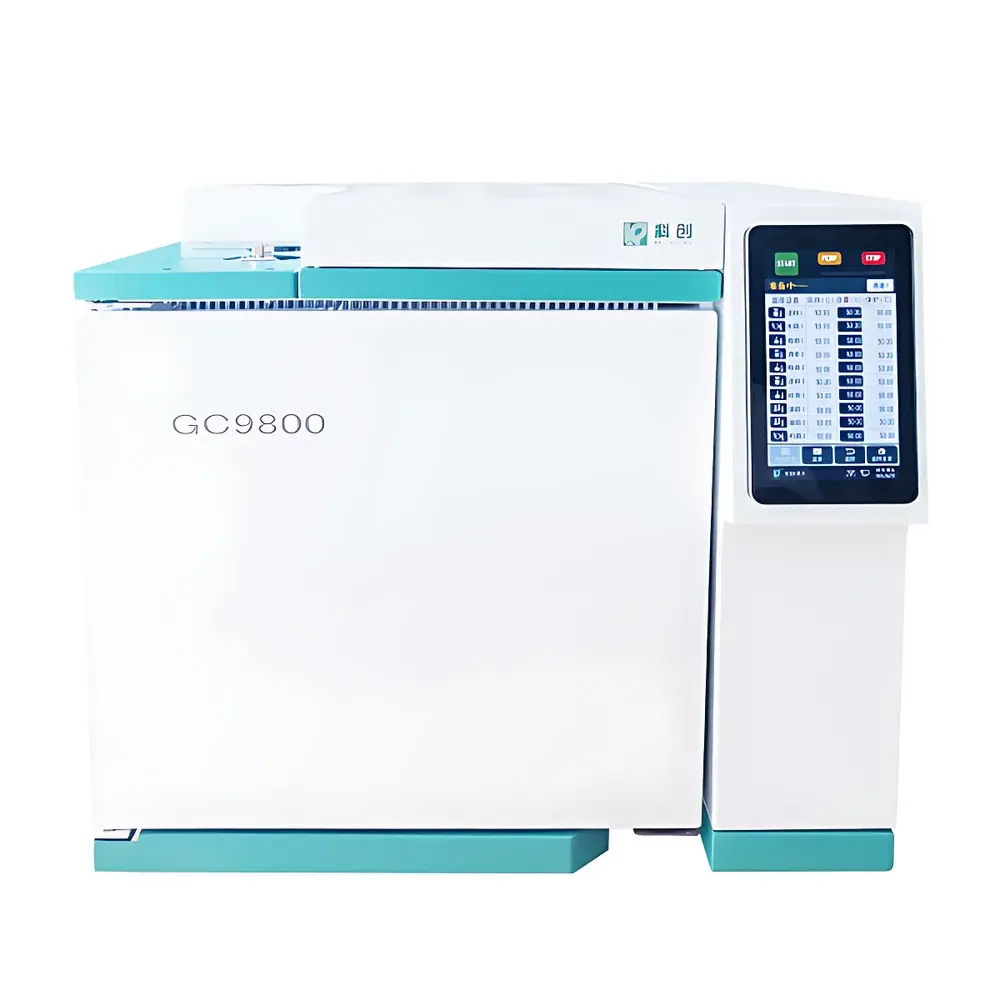
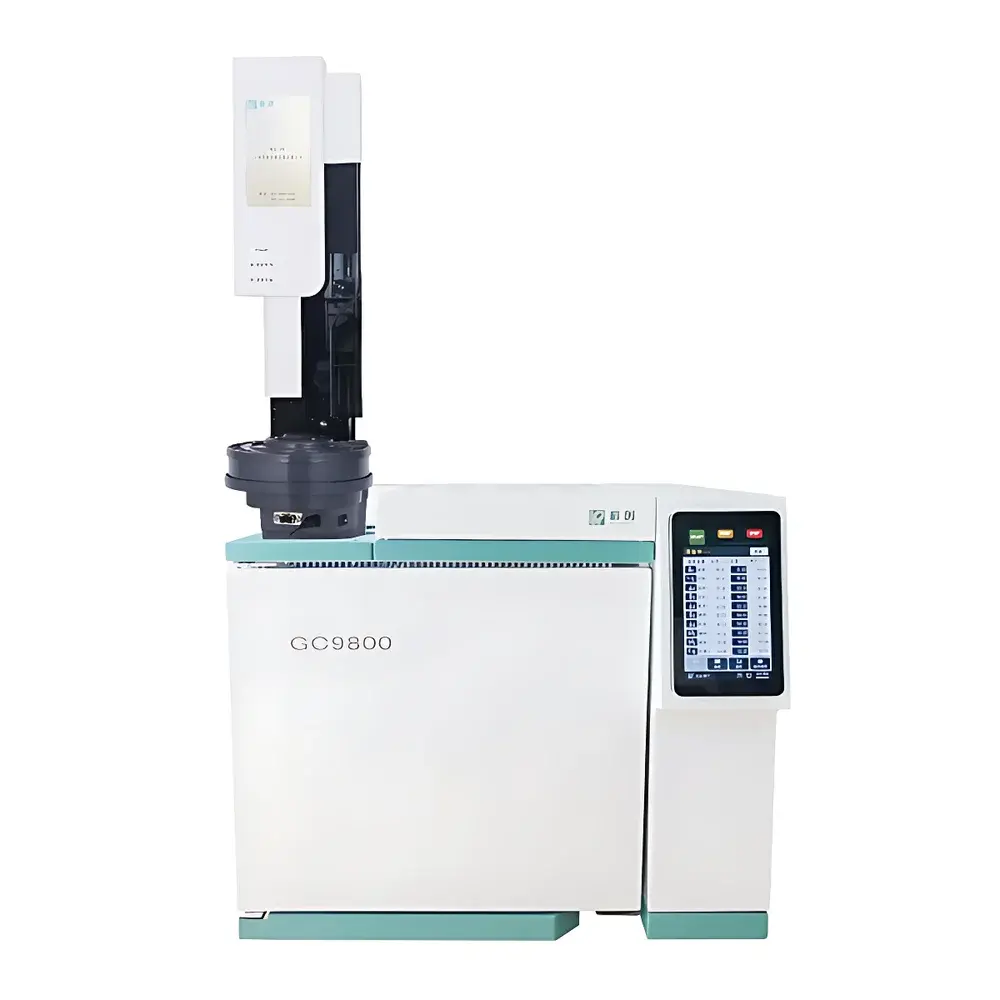
Shanghai Kechuang GC9800 Gas Chromatograph
| Brand | Kechuang |
|---|---|
| Origin | Shanghai, China |
| Manufacturer Type | Direct Manufacturer |
| Regional Classification | Domestic (China) |
| Model | GC9800 |
| Instrument Type | Laboratory Gas Chromatograph |
| Application Scope | General-Purpose |
| Oven Temperature Range | 0–450 °C |
| Maximum Ramp Rate | 0–120 °C/min |
| Cooling Rate | ≤4 min (column oven from 350 °C to 50 °C) |
| Carrier Gas Flow Range & Control | 0–1000 mL/min |
| Carrier Gas Pressure Range & Control | 0–0.6 MPa |
| Injector Maximum Operating Temperature | 450 °C |
| Injector Pressure Setting Range | 0–0.6 MPa |
| Injector Total Flow Setting Range | 0–1000 mL/min |
| Temperature Control Precision | ±0.01 °C |
| EPC/EFC Pressure Accuracy | 0.001 psi |
| EPC/EFC Flow Accuracy | 0.001 mL/min |
| Retention Time RSD | <0.008% |
| Peak Area RSD | <1.0% |
| Maximum Programmed Temperature Steps | 16 (expandable to unlimited) |
| Detector Signal Linearity | FID 10⁷, TCD 10⁵, ECD 10⁴, FPD 10⁴ |
Overview
The Shanghai Kechuang GC9800 Gas Chromatograph is a high-performance, general-purpose laboratory gas chromatograph engineered for precision separation, identification, and quantification of volatile and semi-volatile organic compounds. Built on a robust modular architecture, the GC9800 employs capillary or packed column chromatography with carrier gas-driven solute partitioning across a stationary phase under precisely controlled thermal gradients. Its dual-oven design supports independent temperature programming for primary and auxiliary columns—enabling advanced applications such as heart-cutting, backflushing, or parallel column analysis. The system operates on fundamental principles of retention time dependence on compound volatility, polarity, and interaction thermodynamics with the stationary phase, ensuring reproducible elution profiles compliant with ASTM D3606, ISO 10301, and USP . Designed for continuous operation in regulated environments, the GC9800 integrates hardware-level fault diagnostics, real-time thermal monitoring, and fail-safe overtemperature protection—critical for unattended overnight runs and GLP-compliant laboratories.
Key Features
- 10-channel independent temperature control system, including dual programmable column ovens with 0.01 °C setpoint resolution and ±0.01 °C stability over 30 min.
- Electronic Pressure and Flow Control (EPC/EFC) with 0.001 psi pressure accuracy and 0.001 mL/min flow accuracy across up to 24 independently managed gas channels.
- 7-inch industrial-grade resistive touchscreen interface with embedded baseline visualization, real-time chromatogram display, and local instrument parameter configuration.
- RJ45 Ethernet interface supporting TCP/IP-based remote control and data acquisition; compatible with up to 253 instruments per network segment via centralized workstation software.
- Integrated mass spectrometry (MS) interface port compliant with standard GC-MS coupling protocols (e.g., Agilent 5977/7010, Thermo ISQ series), facilitating seamless hyphenated analysis workflows.
- 16-stage (expandable to unlimited) oven temperature programming with ramp rates up to 120 °C/min and cooling recovery ≤4 min (350 °C → 50 °C) using motorized auto-backdoor mechanism.
- Eight external event time programs for automated valve switching, detector modulation, or auxiliary device triggering during sequence execution.
- Self-diagnostic firmware that continuously monitors heater status, sensor integrity, gas line integrity, and power supply conditions—reporting fault codes with descriptive location and severity.
Sample Compatibility & Compliance
The GC9800 accommodates liquid, gaseous, and solid samples (via headspace or thermal desorption) across a broad polarity and volatility range. It supports capillary columns (0.1–0.53 mm ID, up to 60 m length) and packed columns (2–4 mm ID). Compatible carrier gases include helium, hydrogen, nitrogen, and argon—with EPC/EFC enabling method transfer between gases without recalibration. The system meets mechanical and electrical safety requirements per IEC 61010-1 and electromagnetic compatibility per CISPR 11 Class B. All temperature and pressure control modules are traceable to NIST-certified standards. Data acquisition and instrument control logs satisfy FDA 21 CFR Part 11 audit trail requirements when used with validated chromatography data systems (CDS), including electronic signatures, user access tiers, and immutable record retention.
Software & Data Management
The GC9800 ships with Kechuang Chromatography Workstation (KCWS) v4.x—a Windows-based CDS supporting bidirectional instrument control, real-time signal acquisition, peak integration, calibration curve generation (linear, quadratic, weighted), and report export in PDF, CSV, and XML formats. KCWS implements full reverse control: users configure oven ramps, detector parameters, and EPC/EFC profiles directly from the software interface. Multi-detector time-programming allows dynamic switching between FID, TCD, ECD, or FPD signals within a single run—eliminating manual hardware reconfiguration. Audit trails record all parameter changes, integration events, and user logins with timestamps and operator IDs. Raw data files (.kcd) are stored in a structured directory hierarchy with SHA-256 checksums for integrity verification. Optional LIMS integration via ASTM E1384-compliant HL7 messaging enables automated sample assignment and result dissemination.
Applications
The GC9800 serves diverse analytical domains requiring regulatory-grade repeatability and sensitivity. In environmental testing, it quantifies VOCs in air (EPA TO-17), pesticides in soil (EPA 8081B), and hydrocarbons in water (EPA 8015M). In petrochemical labs, it performs detailed hydrocarbon analysis (DHA) per ASTM D5134 and simulates distillation curves (ASTM D2887). Pharmaceutical QC workflows leverage its FID and ECD configurations for residual solvent testing (ICH Q2(R2)), impurity profiling (USP ), and extractables/leachables screening. Food safety applications include fatty acid methyl ester (FAME) profiling (AOAC 996.06), flavor compound identification, and mycotoxin detection. Its wide linear dynamic range (10⁷ for FID) and sub-pg detection limits (ECD: ≤10 fg/mL γ-HCH) support both routine screening and low-abundance target analysis.
FAQ
Does the GC9800 support compliance with FDA 21 CFR Part 11?
Yes—when operated with validated KCWS software and configured with role-based user accounts, electronic signatures, and enabled audit trail logging, the system fulfills electronic record and signature requirements.
Can the GC9800 be integrated into an existing LIMS environment?
Yes—via ASTM E1384-compliant HL7 message exchange or direct database polling using ODBC/JDBC drivers provided with KCWS.
What is the maximum number of temperature program steps supported?
The instrument supports 16 pre-programmed steps out-of-the-box, with firmware-upgradable capability for unlimited step editing via KCWS.
Is hydrogen carrier gas safe to use with the GC9800’s EPC system?
Yes—the EPC module includes hydrogen-specific safety logic, automatic leak detection algorithms, and flow-limiting valves compliant with ISO 10156 and CGA G-1.1.
How does the GC9800 ensure retention time stability across ambient temperature fluctuations?
The column oven features dual-sensor thermal feedback, active ambient compensation, and insulation rated for <0.1 °C drift per 10 °C ambient change—validated per ISO 8573-1 Class 4.




