
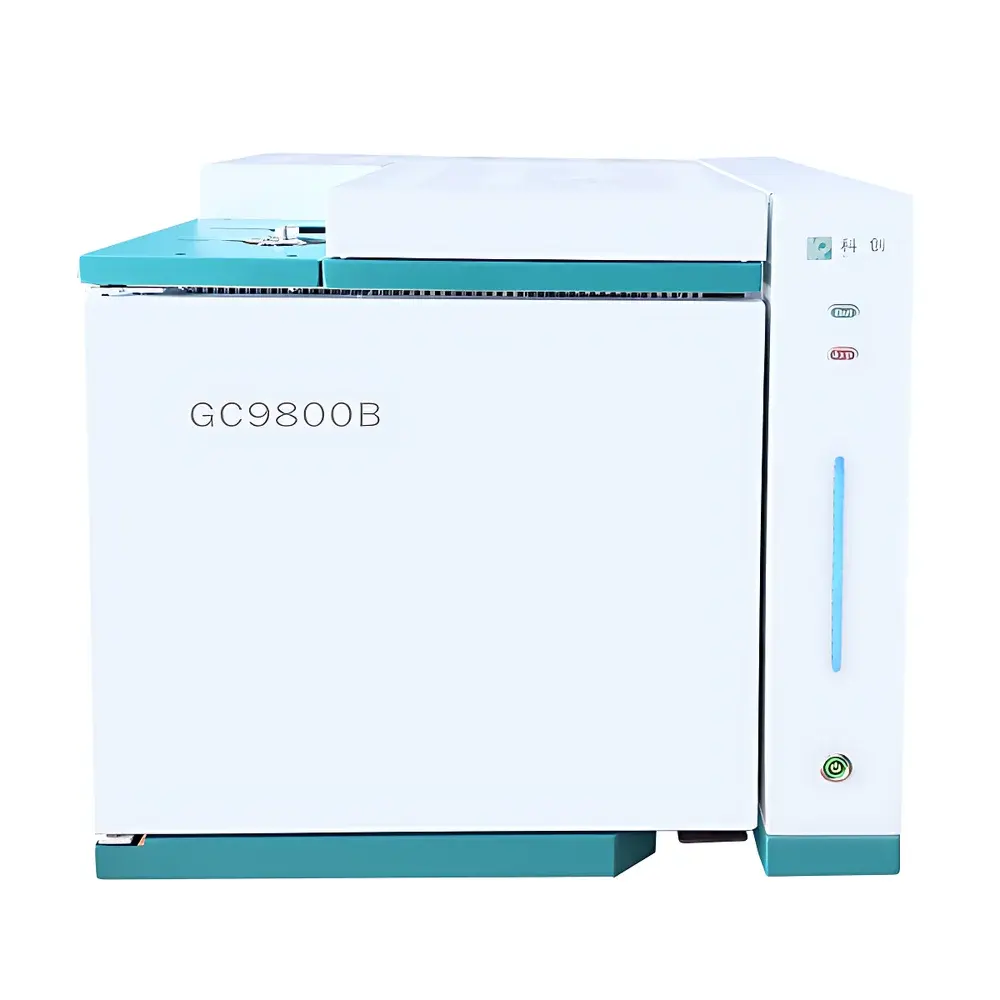
Shanghai Kechuang GC9800B Gas Chromatograph
| [Brand | Kechuang |
|---|---|
| Origin | Shanghai, China |
| Manufacturer Type | Original Equipment Manufacturer (OEM) |
| Model | GC9800B |
| Detection Modes | TCD, FID, ECD, FPD |
| Temperature Control Range | Ambient +3°C to 450°C |
| Column Oven Programmable Ramp | Up to 16 stages (expandable to unlimited) |
| EPC/EFC Precision | ±0.001 psi (pressure), ±0.001 mL/min (flow) |
| Retention Time RSD | <0.008% |
| Peak Area RSD | <1.0% |
| Dimensions (W×H×D) | 530 × 510 × 535 mm |
| Weight | ≤50 kg |
| Power Supply | 220 V ±10%, 50 Hz ±5%] |
Overview
The Shanghai Kechuang GC9800B Gas Chromatograph is a high-performance, microprocessor-controlled analytical instrument engineered for precision separation and quantitative analysis of volatile and semi-volatile organic compounds. Based on the fundamental principle of differential partitioning between a mobile gas phase (carrier gas) and a stationary liquid or polymer phase coated inside fused-silica capillary columns, the GC9800B delivers robust chromatographic resolution across diverse sample matrices. Its architecture integrates dual independently programmable column ovens—each capable of precise temperature ramping with 0.01°C display resolution and ±0.1% thermal stability—enabling complex multi-step temperature programs essential for method development in environmental, petrochemical, pharmaceutical, and food safety laboratories. The system supports universal carrier gases (N₂, H₂, He, Ar) and features real-time environmental compensation, maintaining column oven temperature deviation <0.1°C under ambient fluctuations of ±10°C—a critical capability for GLP-compliant routine analysis in non-climate-controlled lab environments.
Key Features
- Dual independent column ovens with full programmability: up to 16 heating/cooling ramps per oven (expandable to unlimited via firmware), maximum ramp rate >120°C/min, and rapid cooldown (<5 min from 350°C to 50°C) enabled by motorized auto-backdoor.
- Advanced Electronic Pressure and Flow Control (EPC/EFC) system: 24-channel independent control capability; pressure accuracy ±0.001 psi; flow accuracy ±0.001 mL/min; repeatability (RSD) ≤0.1%; supports constant-pressure, constant-flow, and multi-stage programmed pressure/flow profiles (up to 8 stages).
- Integrated RJ45 Ethernet interface: digital signal transmission directly to host PC; embedded chromatography workstation firmware on main control board; remote operation and real-time data streaming supported for up to 253 instruments on a single network segment.
- Comprehensive self-diagnostic suite: real-time fault localization with on-screen error code display; hardware-level over-temperature cutoff for all 10 temperature zones; automatic shutdown if any zone exceeds user-defined limits.
- Multi-detector time-programmable signal routing: software-configurable acquisition windows allow dynamic assignment of detector signals (TCD/FID/ECD/FPD) to shared or dedicated data channels—enabling synchronized multi-detection without hardware reconfiguration.
- Wide-range detector electronics: standard wide-linear amplifier prevents solvent peak saturation; optimized baseline stability (e.g., FID noise ≤10 µV, TCD drift ≤30 µV/30 min) meets ISO 17025 validation requirements for routine QC workflows.
Sample Compatibility & Compliance
The GC9800B accommodates a broad spectrum of sample introduction methods—including split/splitless injection, on-column, PTV, and headspace—compatible with standard 0.1–0.53 mm ID capillary columns and packed columns. Its modular detector design permits simultaneous or sequential use of TCD (detection limit ≥6000 mV·mL/mg for benzene), FID (≤3.0×10⁻¹² g/s for n-hexadecane), ECD (≤10 fg/mL for γ-HCH), and FPD (≤1 pg/s for phosphorus), satisfying multi-residue screening needs per EPA Method 8081B, 8270, and ISO 11843-2. The instrument’s hardware and firmware architecture support audit-trail-enabled data acquisition, electronic signatures, and secure user access levels—aligning with FDA 21 CFR Part 11 readiness when deployed with compliant chromatography data systems (CDS). All thermal and pneumatic control modules are calibrated traceable to NIST standards, and operational parameters comply with IEC 61010-1 for laboratory electrical safety.
Software & Data Management
The embedded GC workstation provides full bidirectional instrument control—including oven programming, detector parameter tuning, EPC/EFC configuration, and event timing—and supports ASTM E1947-compliant peak integration algorithms (tangent skim, valley-to-valley, exponential curve fit). Raw data files (.cdf or .dx format) include complete metadata: acquisition timestamp, operator ID, method version, calibration history, and environmental logs. Networked deployment enables centralized data archiving, role-based review workflows, and automated report generation (PDF/Excel) with configurable templates aligned to ISO/IEC 17025 clause 7.8. Data integrity safeguards include write-once-read-many (WORM) storage options, immutable audit trails for all method and result modifications, and optional integration with LIMS platforms via HL7 or RESTful API.
Applications
The GC9800B serves as a primary analytical platform for regulated and research applications requiring high reproducibility and method flexibility. Typical use cases include residual solvent analysis in APIs (ICH Q3C), pesticide residue quantification in agricultural commodities (AOAC 2007.01), hydrocarbon profiling in gasoline (ASTM D6730), volatile organic compound (VOC) monitoring in indoor air (EPA TO-17), and fatty acid methyl ester (FAME) composition in biodiesel (EN 14103). Its dual-oven capability facilitates heart-cutting 2D-GC configurations when paired with appropriate modulators, while its low detection limits and wide linear dynamic range (e.g., FID: 10⁷) support both trace-level environmental monitoring and high-concentration process stream analysis.
FAQ
Does the GC9800B support compliance with FDA 21 CFR Part 11?
Yes—the instrument’s firmware and bundled workstation support electronic signatures, audit trails, and role-based access control when configured with validated CDS software and appropriate IT infrastructure.
Can multiple detectors be operated simultaneously with independent signal processing?
Yes—time-programmable detector switching allows concurrent acquisition from two or more detectors, with signal routing dynamically assigned per analysis segment.
What is the maximum number of GC9800B units controllable from a single PC?
Up to 253 instruments can be managed concurrently over standard Ethernet using the embedded TCP/IP stack and centralized workstation software.
Is the column oven cooling performance verified under ISO 8573-1 conditions?
Cool-down time (<5 min from 350°C to 50°C) is measured per internal engineering protocol under ambient 25°C/50% RH; actual performance may vary with room HVAC capacity and column dimensions.
Are calibration certificates provided with shipment?
Factory calibration reports (traceable to NIST SRMs) are included; field recalibration services and IQ/OQ/PQ documentation packages are available upon request.
Related Products




