
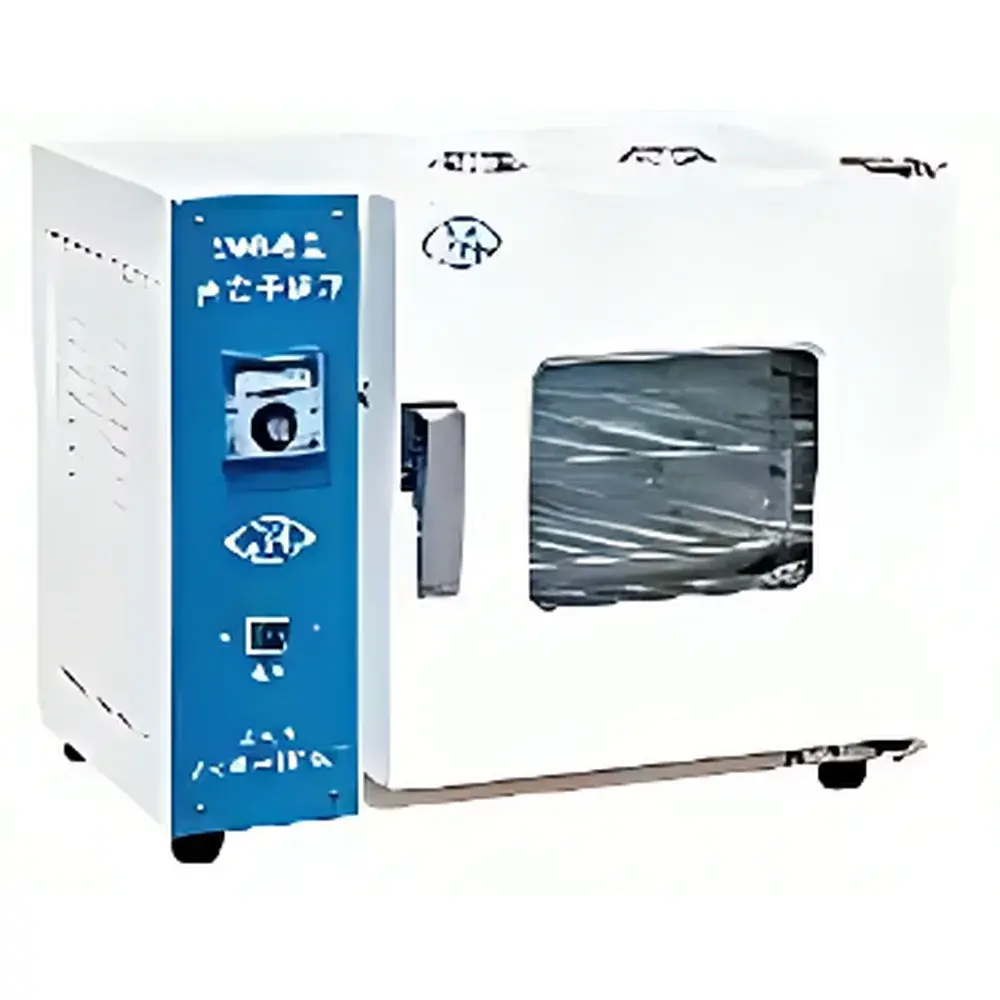
Shanghai-made 202-EBS Series Electrically Heated Constant-Temperature Drying Ovens (Models: 202-0EBS, 202-1EBS, 202-2EBS, 202-3EBS)
| Origin | Shanghai, China |
|---|---|
| Manufacturer Type | Authorized Distributor |
| Product Origin | Domestic (China) |
| Models | 202-0EBS / 202-1EBS / 202-2EBS / 202-3EBS |
| Power Ratings | 1600 W / 1800 W / 2500 W / 4000 W |
| Internal Chamber Dimensions (W×D×H) | 350×350×350 mm / 350×450×450 mm / 450×550×550 mm / 500×600×750 mm |
| External Dimensions (W×D×H) | 515×640×555 mm / 515×740×655 mm / 615×840×755 mm / 665×890×955 mm |
| Voltage | 220 V AC |
| Interior Material | Stainless Steel (AISI 304) |
| Exterior Finish | Electrostatic Powder Coating |
Overview
The 202-EBS Series Electrically Heated Constant-Temperature Drying Ovens are precision-engineered laboratory-grade thermal processing units designed for consistent, repeatable drying, baking, sterilization, wax melting, and curing applications. Based on resistive heating architecture with forced-air convection (natural or optional fan-assisted airflow), these ovens maintain uniform temperature distribution across the working chamber—critical for adherence to standardized protocols in quality control, pharmaceutical stability testing, and materials science workflows. Each model complies with fundamental safety and performance expectations aligned with IEC 61010-1 (Safety Requirements for Electrical Equipment for Measurement, Control, and Laboratory Use) and supports routine validation under GLP and GMP environments when operated with documented calibration and procedural controls.
Key Features
- Electrostatically powder-coated steel exterior for corrosion resistance, mechanical durability, and long-term aesthetic integrity.
- Tempered glass observation window integrated into the double-layer insulated door, enabling real-time visual monitoring without thermal disruption or door opening.
- Stainless steel (AISI 304) interior chamber—non-porous, non-reactive, and compatible with repeated cleaning, solvent exposure, and high-temperature operation up to 300 °C (model-dependent).
- Modular temperature control system supporting interchangeable digital PID controllers with adjustable proportional band, integral time, and derivative action—enabling fine-tuned response to thermal load variations.
- Over-temperature protection circuitry with independent mechanical backup thermostat prevents uncontrolled thermal excursion and satisfies basic functional safety requirements.
- Robust structural design includes reinforced corner joints, balanced door hinges with silicone gasket sealing, and stable leveling feet for vibration-free operation on standard lab benches or mobile carts.
Sample Compatibility & Compliance
The 202-EBS Series accommodates a broad range of sample formats—including Petri dishes, weighing boats, glassware, metal trays, polymer substrates, and biological tissue cassettes—without compromising thermal homogeneity. Chamber volume options (from 42.9 L to 225 L) allow scalability from benchtop R&D to production-line batch processing. All models meet essential electromagnetic compatibility (EMC) criteria per EN 61326-1 and are suitable for use in ISO/IEC 17025-accredited laboratories when paired with traceable thermometer calibration (e.g., NIST-traceable RTD or thermocouple probes). While not inherently compliant with FDA 21 CFR Part 11, the ovens support integration into validated systems via external data loggers with audit trail capabilities and user-access controls.
Software & Data Management
These ovens operate as standalone instruments with analog or digital front-panel interfaces; no embedded firmware or proprietary software is included. However, they are fully compatible with third-party data acquisition platforms (e.g., LabVIEW, WinCC, or custom Python-based logging solutions) via optional 4–20 mA or 0–10 V analog output signals (available upon request with controller upgrade). Temperature setpoint, actual chamber reading, and alarm status can be externally recorded at configurable intervals—enabling full traceability for SOP-driven processes, equipment qualification (IQ/OQ/PQ), and regulatory submissions. Optional RS-485 Modbus RTU interface modules facilitate integration into centralized building management or manufacturing execution systems (MES).
Applications
- Drying moisture-sensitive powders, granules, and filter papers in environmental and geochemical analysis.
- Baking ceramic precursors, thin-film substrates, and electrode coatings in materials research labs.
- Sterilizing reusable glassware and stainless-steel tools in microbiology and cell culture facilities (validated cycles require additional documentation and biological indicators).
- Curing adhesives, encapsulants, and composite laminates during prototyping and small-batch manufacturing.
- Melting and holding paraffin wax and embedding media in histopathology workflows.
- Accelerated aging studies per ASTM D573 and ISO 188 for rubber and polymer degradation assessment.
FAQ
What is the maximum operating temperature for the 202-EBS series?
Standard configuration supports up to 300 °C. Higher-temperature variants (e.g., 400 °C) are available upon special order with upgraded insulation and heating elements.
Is fan-forced convection standard or optional?
Natural convection is standard. Forced-air circulation (with adjustable speed) is an optional retrofit for improved temperature uniformity and reduced process cycle times.
Can these ovens be used for sterilization of medical devices?
They may be employed for dry-heat sterilization per ISO 15883-5 only when fully validated for specific load configurations, dwell times, and bioburden levels—and must be supported by temperature mapping, biological indicator testing, and documented change control procedures.
Do the 202-EBS models include calibration certificates?
Factory calibration is performed using reference-grade thermometers. A UKAS- or CNAS-accredited calibration certificate is available as an add-on service at time of order.
What maintenance is required to ensure long-term accuracy and safety?
Biannual verification of temperature uniformity and controller accuracy is recommended. Routine inspection of door gaskets, ventilation grilles, and heating element continuity should be conducted per internal maintenance SOPs aligned with ISO/IEC 17025 Clause 6.4.



