
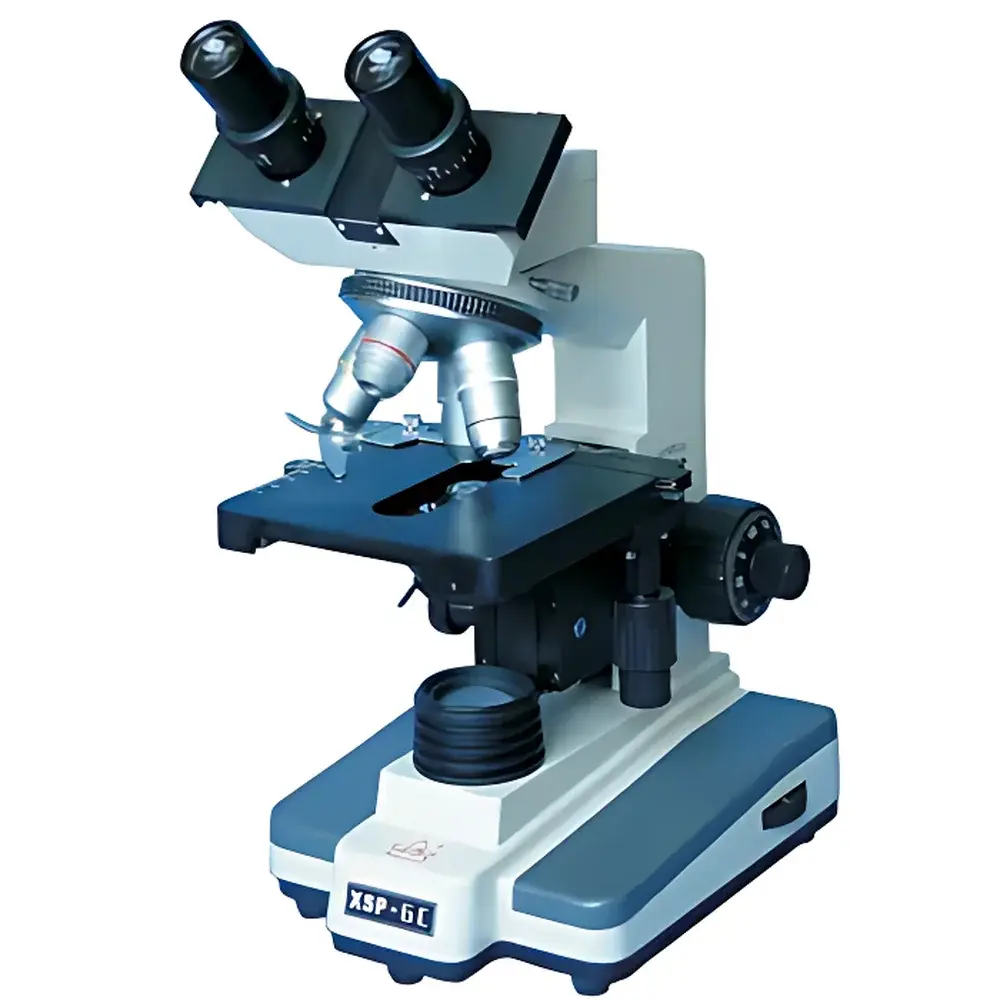
Shanghai Optical XSP-6C Upright Biological Microscope
| Brand | Shanghai Optical |
|---|---|
| Origin | Shanghai, China |
| Model | XSP-6C |
| Microscope Type | Upright Biological Microscope |
| Eyepiece Configuration | Binocular |
| Objective Lenses | Four (4×, 10×, 40×, 100× oil) |
| Maximum Total Magnification | 1600× |
| Illumination | Built-in 6V/20W Halogen Lamp |
| Köhler Illumination System | Yes |
| Condenser | Adjustable Abbe Condenser with Iris Diaphragm |
| Nosepiece | Inclined Revolving Turret |
| Focusing Mechanism | Coaxial Coarse & Fine Focus (2 mm coarse travel, 0.002 mm fine increment) |
Overview
The Shanghai Optical XSP-6C is a precision-engineered upright biological microscope designed for routine laboratory use in academic teaching, clinical cytology, and basic life science research. It operates on conventional brightfield optical principles, utilizing transmitted white-light illumination through fixed or stained biological specimens mounted on standard glass slides. The instrument adheres to the 160 mm mechanical tube length standard common to classical optical microscopes, ensuring compatibility with widely available accessories and objective lenses calibrated to this specification. Its robust all-metal frame, combined with a stable base and geared focusing system, delivers consistent mechanical performance and long-term optical alignment stability—critical for repetitive daily use in shared lab environments.
Key Features
- Binocular observation head with 30° inclination and interpupillary adjustment (55–75 mm), reducing operator fatigue during extended viewing sessions.
- Four-objective turret accommodating standard DIN 4×, 10×, 40×, and 100× oil immersion objectives, enabling magnifications from 40× to 1600× when paired with 10× wide-field eyepieces.
- Inclined revolving nosepiece ensures smooth, backlash-free objective switching while maintaining precise parfocality across all magnifications.
- Köhler illumination system with built-in 6V/20W halogen lamp provides uniform, glare-free field illumination—essential for quantitative photomicrography and consistent contrast assessment.
- Adjustable Abbe condenser (NA 1.25) with centering screws and iris diaphragm allows optimal numerical aperture matching for each objective, maximizing resolution and depth of field control.
- Coaxial focusing mechanism featuring dual-scale coarse focus (2 mm travel per revolution) and ultra-fine focus (0.002 mm per division), facilitating precise Z-axis positioning for layered specimen analysis.
Sample Compatibility & Compliance
The XSP-6C accommodates standard 1″ × 3″ (25 × 75 mm) glass microscope slides and No. 1.5 cover slips (0.17 mm thickness). It supports unstained live specimens (e.g., protozoa, algae, blood smears) under brightfield, as well as routinely stained preparations (e.g., H&E, Gram, Giemsa). While not certified for ISO 13485 or FDA 510(k) regulatory pathways, its optical design conforms to fundamental requirements outlined in ISO 8578:2017 (Microscopes — Requirements for binocular microscopes) and ASTM E2892-22 (Standard Practice for Calibration of Microscope Magnification). The halogen illumination meets IEC 61000-3-2 harmonic emission limits for laboratory equipment.
Software & Data Management
The XSP-6C is a standalone optical instrument without integrated digital imaging hardware. However, it features a standardized trinocular port (optional accessory) compatible with C-mount adapters for third-party CMOS/CCD cameras (e.g., AmScope MU series, OMAX 10MP units). When coupled with validated acquisition software—such as NIS-Elements (Nikon), ZEN Blue (Zeiss), or open-source MicroManager—users can capture, annotate, measure, and export TIFF/PNG images compliant with FAIR data principles. Audit trails, user access logs, and image metadata embedding are supported via external software configurations aligned with GLP-compliant documentation workflows.
Applications
- Undergraduate and graduate-level histology and microbiology laboratories
- Peripheral blood film examination and differential white cell counts
- Basic plant anatomy studies (e.g., root tip mitosis, leaf stomata observation)
- Quality control of culture purity in non-GMP fermentation monitoring
- Preparatory microscopy for fluorescence or phase contrast upgrades (via optional filter cubes or annuli)
- Field-deployable diagnostics in resource-limited settings where electrical grid stability permits halogen lamp operation
FAQ
Is the XSP-6C suitable for fluorescence microscopy?
No—it lacks excitation filters, dichroic mirrors, and high-sensitivity emission optics. Fluorescence capability requires retrofitting with a dedicated epi-illumination module and appropriate objectives, which is not factory-supported.
Can oil immersion objectives be used safely with this microscope?
Yes—the 100× oil objective is fully compatible, and the Abbe condenser’s NA 1.25 rating matches the requirement for optimal resolution at this magnification.
Does the microscope meet CE or UL safety certification standards?
As a Class I laboratory device intended for indoor use with grounded AC supply, it complies with general electrical safety provisions referenced in EN 61010-1:2010; formal CE marking documentation must be verified with the authorized distributor.
What maintenance intervals are recommended for sustained optical performance?
Annual cleaning of optical surfaces using lens-grade tissue and reagent-grade ethanol is advised; mechanical lubrication of focusing gears should occur every 24 months by qualified service personnel.
Is replacement bulb sourcing straightforward outside China?
Yes—the 6V/20W halogen bulb (type: JC20 or equivalent) is globally standardized and available through major scientific hardware suppliers including VWR, Fisher Scientific, and Edmund Optics.




