
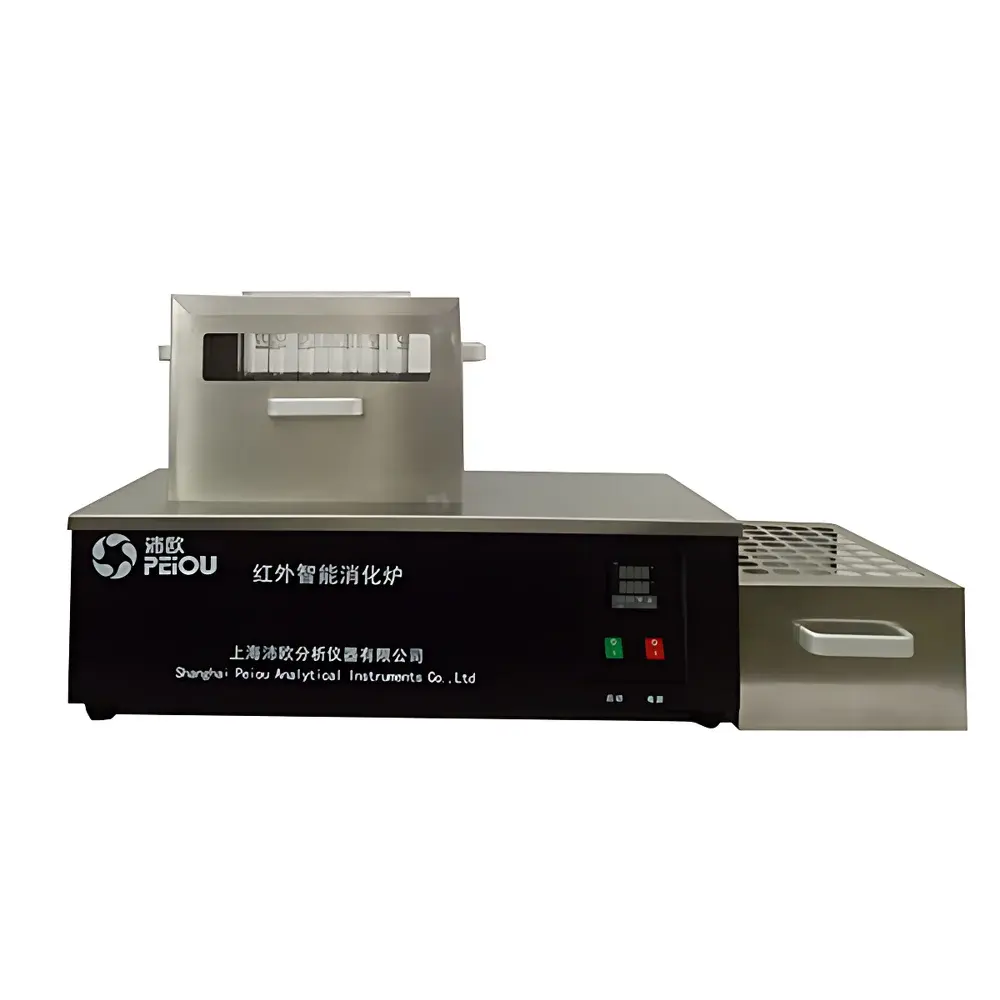
Shanghai Peiou SKD-48S2 Multi-Function Infrared Digestion Furnace
| Brand | Peiou |
|---|---|
| Origin | Shanghai, China |
| Manufacturer Type | Authorized Distributor |
| Country of Origin | China |
| Model | SKD-48S2 |
| Pricing | Available Upon Request |
| Control System | Microcontroller-based (64-step programmable ramp + timer) |
| Heating Method | Infrared quartz radiation |
| Number of Digestion Ports | 48 |
| Temperature Range | Ambient to 550 °C |
| Preheating Time to 400 °C | 22 min |
| Temperature Stability | ±1 °C |
| Voltage | AC 220 V |
| Power Consumption | 1950 W |
| Instrument Dimensions (W×D×H) | 655 × 340 × 210 mm |
| Digestion Tube Size | Ø25 × 300 mm |
| Safety Features | Dual independent switches (power & heating), over-current protection, earth-leakage circuit breaker, optional anti-explosion tube holder |
| Exhaust System | Stainless steel fume hood with integrated SO₂ scrubbing via water-trap and external vacuum pump |
| Compliance | CE-marked heating module |
Overview
The Shanghai Peiou SKD-48S2 Multi-Function Infrared Digestion Furnace is a high-capacity, microprocessor-controlled thermal digestion system engineered for reproducible, high-throughput sample preparation in accredited analytical laboratories. Designed around infrared quartz radiation heating—rather than conventional resistive or ceramic elements—the SKD-48S2 delivers rapid, uniform energy transfer directly to digestion tubes, minimizing thermal lag and reducing wall deposition (“wall hanging”) during acid digestion. This principle ensures consistent thermal exposure across all 48 positions, critical for applications requiring strict method adherence per ASTM D5175, ISO 11047, or EPA Method 3050B. The furnace operates within a calibrated ambient-to-550 °C range, supporting both open-vessel wet digestion (e.g., HNO₃–H₂SO₄–HClO₄ mixtures) and semi-closed protocols used in trace metal analysis by ICP-OES and ICP-MS. Its robust mechanical architecture and modular quartz heating elements are chemically inert to concentrated mineral acids—including hydrofluoric acid when properly shielded—making it suitable for geological, agricultural, and environmental matrices where matrix complexity demands rigorous thermal control.
Key Features
- Infrared quartz heating modules provide rapid thermal response (22 minutes to reach 400 °C), high emissivity (>92% in 2–6 µm band), and long operational lifetime under corrosive conditions.
- 64-step programmable temperature ramping with timer-based hold segments enables precise replication of multi-stage digestion protocols—essential for method validation and inter-laboratory comparability.
- Dual independent power and heating switches allow isolation of thermal circuits during maintenance or safety checks, aligning with laboratory electrical safety standards (IEC 61010-1).
- PID-integrated digital temperature controller ensures ±1 °C stability across the full operating range, verified at three points (100 °C, 300 °C, 500 °C) per internal calibration routine.
- Stainless steel fume extraction hood with integrated water-scrubbed exhaust ducting captures and neutralizes SO₂, NOₓ, and Cl₂ vapors generated during sulfate or nitrate digestion, meeting local occupational exposure limits (OSHA PELs) and EU Directive 2004/101/EC.
- Over-current and residual-current (30 mA) protection circuits comply with EN 61000-6-3 for electromagnetic compatibility and EN 61000-6-4 for immunity.
- Modular 48-position cavity accommodates standard Ø25 × 300 mm borosilicate or quartz digestion tubes; uniform radial heat distribution maintains ≤±2 °C inter-port variance at 450 °C.
Sample Compatibility & Compliance
The SKD-48S2 supports digestion of organic and inorganic solid samples—including plant tissues, soil aggregates, feedstuffs, food composites, sediments, and metallurgical slags—using EPA-approved oxidizing acid systems. Its CE-certified infrared modules meet EN 61326-1 for laboratory equipment EMC and EN 61010-1 for safety. While not FDA 21 CFR Part 11–compliant out-of-the-box (lacking audit trail and electronic signature capability), the instrument’s deterministic control logic and non-volatile parameter storage support GLP-aligned documentation when paired with validated lab notebooks or LIMS-integrated logging. It conforms to ISO/IEC 17025:2017 clause 6.4.3 regarding equipment suitability for intended use, provided periodic verification (e.g., thermocouple calibration against NIST-traceable reference) is performed per laboratory SOP.
Software & Data Management
The SKD-48S2 utilizes embedded firmware without external PC dependency; all program parameters—including ramp rates, dwell times, and setpoints—are stored in EEPROM with battery-backed retention. No proprietary software is required for operation. For traceability, users may log run parameters manually or integrate the unit into a broader digital workflow via RS-232 or optional USB-to-serial interface (firmware v2.3+). Output signals include real-time temperature analog voltage (0–5 V) and digital status flags (heating active, fault condition), enabling connection to SCADA or LabVIEW-based monitoring platforms. Audit-ready records require external timestamped capture; no built-in data export or electronic signature functionality is implemented.
Applications
- Preparation of biological and botanical samples for total Kjeldahl nitrogen (TKN), phosphorus, and heavy metals (Cd, Pb, As, Hg) quantification.
- Soil and sediment digestion prior to AAS or ICP analysis per ISO 11466 and GB/T 22105.3–2008.
- Feed and foodstuff analysis for macronutrients (Ca, Mg, K) and contaminants under AOAC 985.01 and ISO 6496.
- Geochemical sample dissolution for rare earth element profiling using HF–HNO₃–HClO₄ mixtures (with appropriate tube selection and ventilation).
- Quality control in fertilizer manufacturing, complying with ISO 8157 and NY 525–2021 specifications.
FAQ
Is the SKD-48S2 compatible with hydrofluoric acid (HF) digestion?
Yes—when using quartz digestion tubes and ensuring full containment within the stainless steel fume hood; however, HF procedures require additional PPE and secondary containment per ANSI Z88.2–2015.
Can digestion programs be exported or backed up externally?
No; programs reside in onboard EEPROM. Users must document settings manually or via external logging of serial output.
What maintenance is required for the infrared heating modules?
Annual visual inspection for quartz tube integrity and cleaning of reflector surfaces with isopropanol; no recalibration is needed unless physical damage occurs.
Does the unit support GLP-compliant operation?
It meets hardware-level GLP requirements (traceable calibration, stable performance); full compliance depends on laboratory procedural controls, including operator training records and calibration logs.
Is the optional anti-explosion tube holder certified to any safety standard?
The accessory conforms to DIN EN 15194 for mechanical restraint under thermal stress but is not independently CE-marked; its use is recommended for high-boiling-point acid mixtures above 350 °C.



