
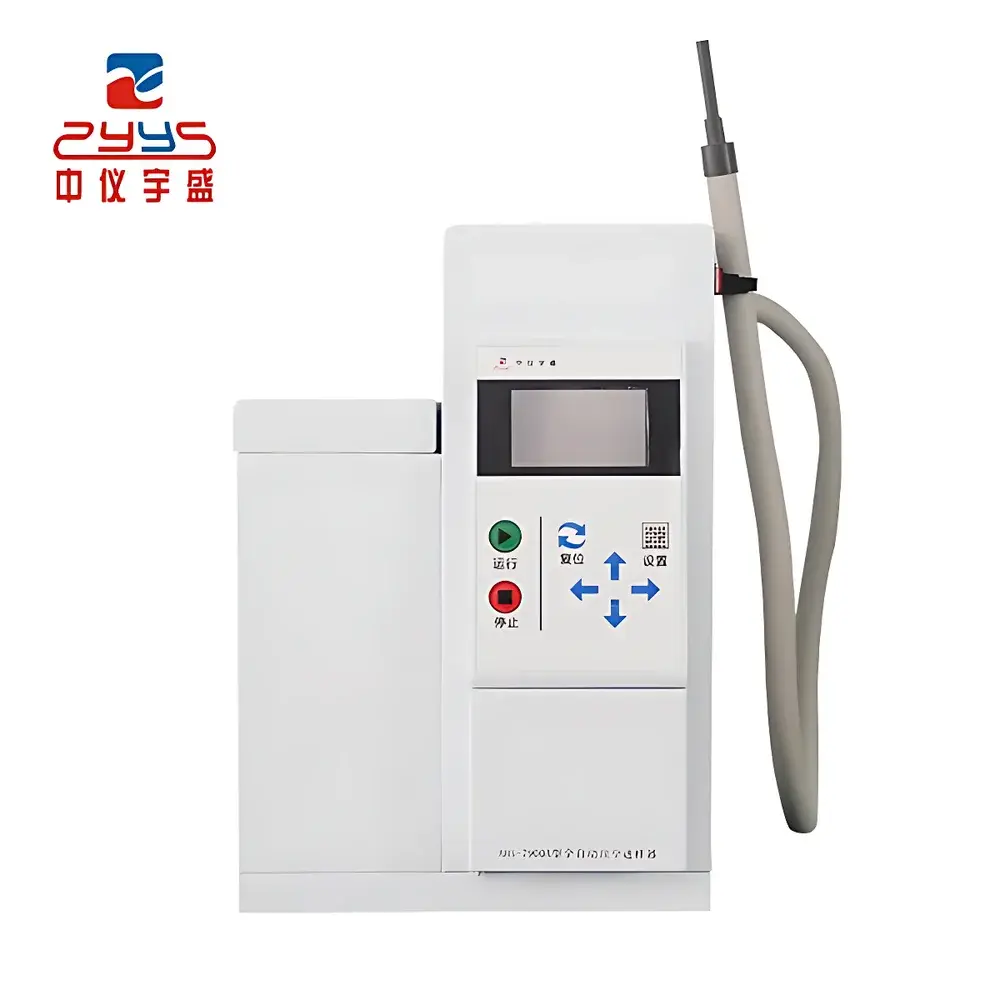
Zhongyi Yusheng AHS-7900A Fully Automated Static Headspace Sampler
| [Brand | Zhongyi Yusheng |
|---|---|
| Origin | Beijing, China |
| Manufacturer Type | OEM Manufacturer |
| Instrument Type | Static Headspace Sampler |
| Automation Level | Fully Automated |
| Sample Capacity | 20 positions |
| Vial Size | 20 mL |
| Oven Temperature Range | Ambient +1°C to 220°C (1°C increment) |
| Valve Temperature Range | Ambient +1°C to 220°C (1°C increment) |
| Temperature Control Accuracy | ±0.1°C |
| Sample Introduction | Pressure-balanced loopless injection controlled by pressurization time and pressure |
| Software Control | PC-based method programming with real-time status animation |
| Compliance | Designed for ASTM D6866, ISO 11843, USP <467>, EP 2.4.24, and Chinese EPA/HJ standards] |
Overview
The Zhongyi Yusheng AHS-7900A is a fully automated static headspace sampler engineered for high-throughput, reproducible volatile organic compound (VOC) analysis in environmental, pharmaceutical, forensic, and industrial quality control laboratories. It operates on the principle of static headspace equilibration—where a sealed sample vial is heated to promote partitioning of analytes from the liquid or solid matrix into the vapor phase above it. Following thermal equilibrium, the instrument precisely transfers a representative aliquot of the headspace gas into a coupled gas chromatograph (GC) or GC–MS system via pressure-balanced, loopless injection. This methodology eliminates solvent interference, minimizes matrix effects, and ensures compatibility with trace-level quantitation protocols required under regulatory frameworks such as USP , EP 2.4.24, and ISO 17025-accredited workflows.
Key Features
- Fully automated batch processing of up to 20 × 20 mL headspace vials without manual intervention—ideal for unattended overnight operation.
- Independent triple-zone temperature control: sample oven, injection valve, and transfer line—all adjustable from ambient +1°C to 220°C with ±0.1°C stability, ensuring precise equilibration and minimal condensation during transport.
- Pressure-balanced, loopless injection mechanism delivers narrow peak profiles and exceptional retention time reproducibility (RSD <1.5% for RT, <2.0% for peak area across 20 injections).
- Integrated self-diagnostic routines at startup—including vial tray homing, positional calibration, and fault logging—to prevent mechanical misalignment and vial jamming.
- Time-programmable sequence execution: automatic pressurization, equilibration, sampling, injection, and post-run backflush of both the transfer line and injection valve to eliminate carryover between samples.
- Universal GC interface support: compatible with Agilent, Thermo Fisher, Shimadzu, PerkinElmer, and Waters GC systems via standardized pneumatic and electronic trigger signals; no hardware modification required.
- Modular expansion capability: firmware-upgradable support for dynamic headspace (purge-and-trap), thermal desorption coupling, and cryo-focusing via optional low-temperature trap modules.
Sample Compatibility & Compliance
The AHS-7900A accommodates standard 20 mL crimp-top headspace vials with magnetic or screw caps, supporting aqueous, slurry, solid, and semi-solid matrices—including soil, sediment, wastewater, blood, polymers, and sterilized medical devices. Its operational parameters align with over 20 national and industry-specific methods, including HJ 620–2011 (volatile halocarbons in water), HJ 643–2013 (VOCs in solid waste), GB/T 5750.8–2023 (drinking water organics), and GA/T 842–2019 (blood ethanol quantification). The system supports audit-ready data integrity through timestamped method logs, user-access-controlled parameter locking, and exportable CSV/CSVX reports—facilitating compliance with GLP, GMP, and FDA 21 CFR Part 11 requirements when deployed with validated LIMS or chromatography data systems (CDS).
Software & Data Management
Controlled via Windows-compatible desktop software, the AHS-7900A enables full method development—including multi-step temperature ramps, variable pressurization durations, and conditional event triggers (e.g., GC ready signal). Real-time graphical animation displays active zones, valve states, and elapsed cycle times. All method files are digitally signed and versioned; audit trails record operator ID, parameter changes, run start/stop timestamps, and error codes. Raw metadata—including vial position, temperature setpoints, injection pressure, and equilibration duration—is embedded in exported result files for traceability. Optional OPC UA integration allows centralized monitoring within industrial automation environments.
Applications
Typical use cases include residual solvent analysis in pharmaceutical APIs per ICH Q3C guidelines; ethylene oxide residue testing in sterilized medical devices (GB/T 16886.7–2015); VOC profiling in packaging materials (SN/T 4148–2015); forensic blood alcohol quantitation (GA/T 842–2019); and regulatory screening of chlorinated solvents, benzene-series compounds, ketones, ethers, and nitriles in soil, water, and waste matrices per China’s HJ series environmental standards. Its robust thermal design and inert flow path also support analysis of thermally labile compounds such as acrylonitrile and pyridine (HJ 742–2015, HJ 1072–2019).
FAQ
Is the AHS-7900A compatible with third-party GC–MS systems?
Yes—it provides TTL-level trigger outputs and accepts external start signals, enabling seamless synchronization with all major GC and GC–MS platforms.
Can the system perform quantitative analysis without internal standard addition?
While external calibration is supported, optimal accuracy for complex matrices requires internal standardization; the software includes dedicated fields for IS response factor calculation and normalization.
What maintenance intervals are recommended for long-term reliability?
Valve seals and septa should be inspected every 500 runs; the transfer line is designed for cleaning via automated backflush and does not require routine disassembly.
Does the instrument support 10 mL vials or alternative vial formats?
The standard carousel is configured for 20 mL vials only; adapter kits for 10 mL vials are available as optional accessories upon request.
How is data integrity ensured during multi-user laboratory deployment?
Role-based access control, electronic signatures, and immutable audit logs meet ALCOA+ principles and support inspection readiness for ISO/IEC 17025 accreditation.






