
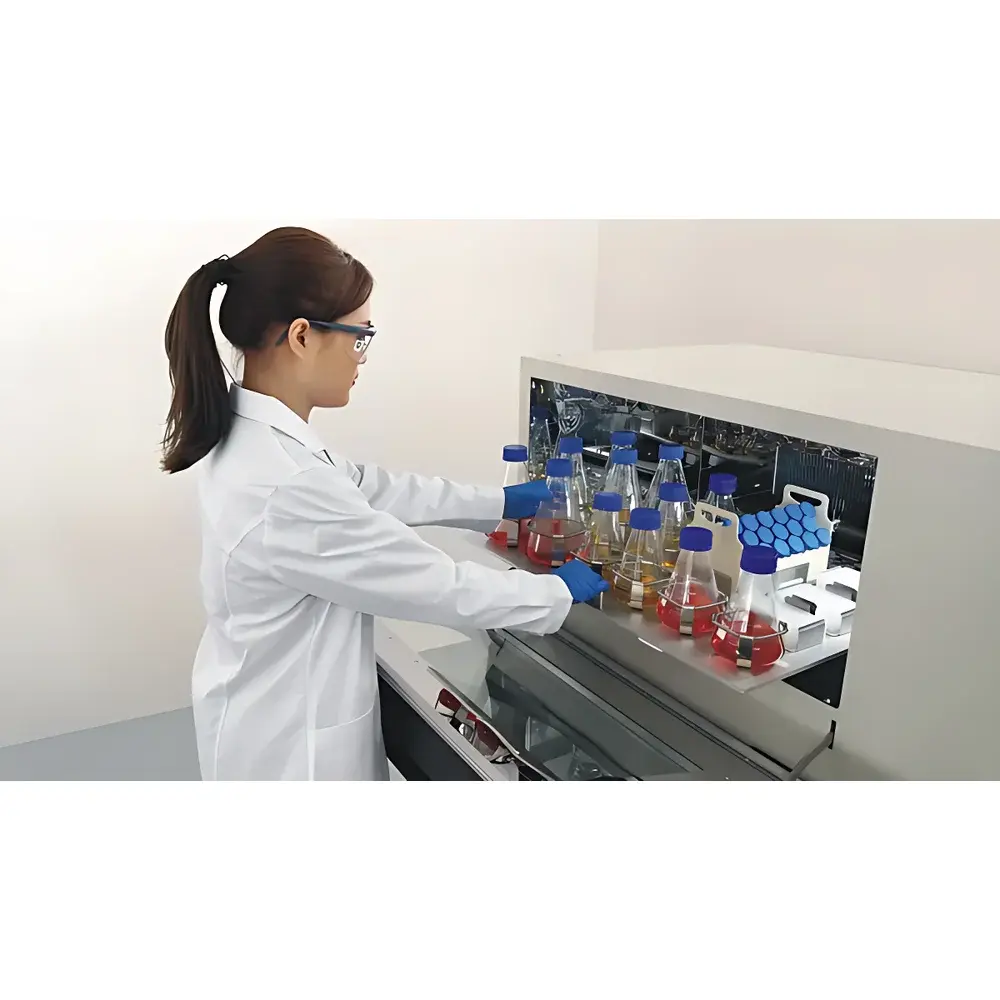
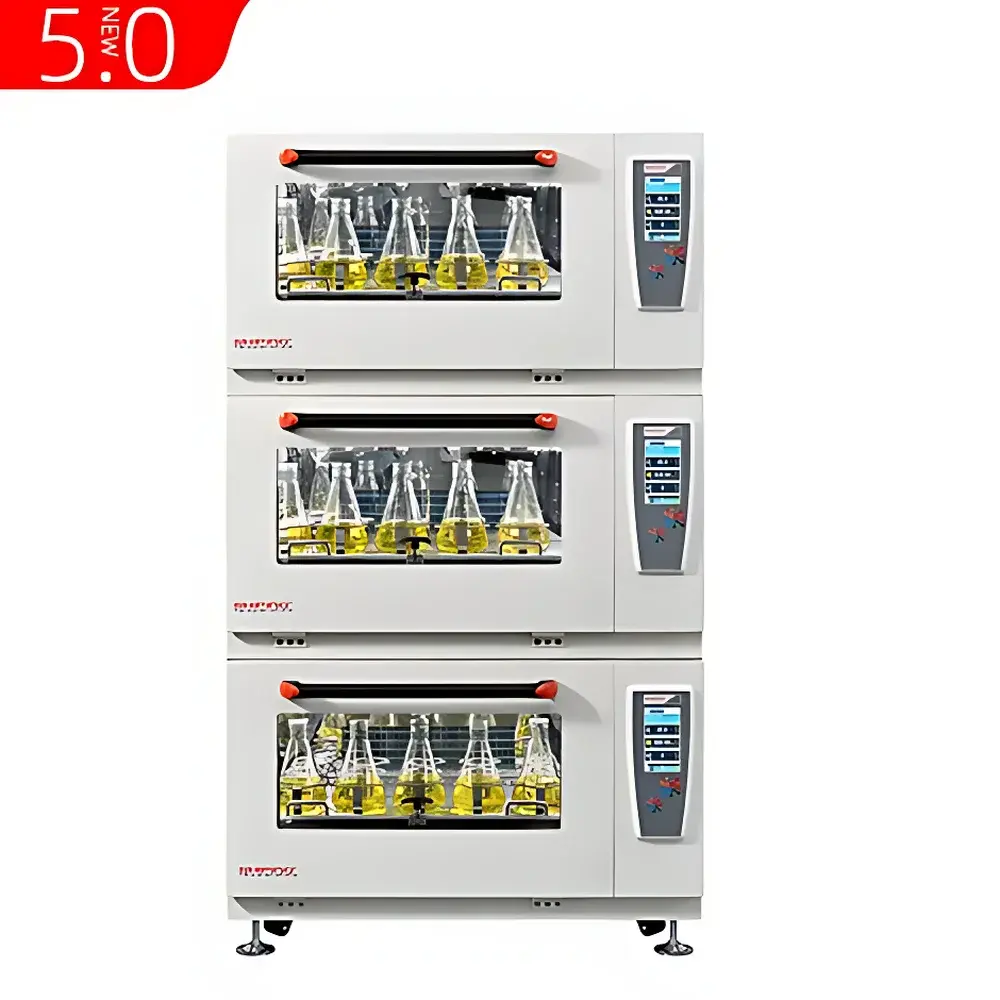
Shanghai Shiping DJS-D2012R Plus Stacked Incubated Orbital Shaker with 50 mm Amplitude
| Brand | Shanghai Shiping |
|---|---|
| Origin | Shanghai, China |
| Manufacturer Type | Direct Manufacturer |
| Product Category | Domestic |
| Model | DJS-D2012R Plus |
| Price Range | USD 7,000–14,000 |
| Instrument Type | Stackable Incubated Orbital Shaker |
| Timer Range | 0–999.59 h |
| Oscillation Frequency | 30–300 rpm |
| Amplitude | 50 mm (orbital diameter) |
| Temperature Range | 4–60 °C |
| Number of Shaking Platforms | 1 |
| Chamber Volume | 189 L |
| Interior Dimensions | 870 × 590 × 398 mm |
| Power Consumption | 1652 W |
| Cooling System | R134a refrigerant with imported French compressor |
| Heating/Cooling Control | PID microprocessor-based environmental scanning controller |
| Display | 7-inch full-color TFT touch screen with backlight |
| Data Interface | USB port + built-in thermal mini-printer |
| Safety Features | Dual independent over-temperature/over-speed protection, motor overheat cutoff, leak current protection, compressor overload protection, sensor fault detection |
| Compliance | Designed for GLP-compliant laboratories |
Overview
The Shanghai Shiping DJS-D2012R Plus is a high-capacity, stackable incubated orbital shaker engineered for demanding life science applications requiring simultaneous temperature control and precise mechanical agitation. It operates on the principle of orbital motion—where the platform rotates in a horizontal circular path—generating uniform shear forces ideal for aerobic microbial cultivation, suspension cell culture, enzyme kinetics, and biochemical reaction optimization. Unlike reciprocating or linear shakers, its single-axis balanced drive mechanism minimizes vibration transmission to adjacent equipment and ensures long-term mechanical stability across extended operational cycles. The unit integrates refrigeration (R134a) and resistive heating within a fully insulated chamber, enabling stable setpoint maintenance from 4 °C (near-refrigerated) to 60 °C (sub-boiling), with temperature uniformity ≤±1 °C at 37 °C and resolution of 0.1 °C. Its modular stacking architecture supports up to three identical units vertically aligned—occupying only the footprint of a single shaker—making it especially suitable for space-constrained core facilities, bioprocess development labs, and GMP-aligned pilot-scale fermentation suites.
Key Features
- Stackable Modular Design: Three DJS-D2012R Plus units can be safely stacked without structural reinforcement or external support frames, preserving floor space while scaling throughput—ideal for multi-experiment parallelization under identical environmental conditions.
- Single-Axis Balanced Drive System: Patented low-noise mechanical architecture reduces operational sound pressure to <55 dB(A) at 1 m distance, eliminating resonant coupling and extending bearing service life beyond 20,000 hours.
- Full-Function Touch Interface: 7-inch capacitive TFT display with intuitive icon-driven navigation supports real-time parameter monitoring, eight-segment programmable ramping profiles, password-protected parameter locking, and factory-reset recovery.
- Robust Chamber Construction: 304 stainless steel interior with seamless mirror-finish corners and electropolished surfaces meets ISO 14644-1 Class 5 cleanroom compatibility requirements; exterior chassis fabricated from QT cast iron and cold-rolled steel ensures torsional rigidity during high-RPM operation.
- Comprehensive Safety Architecture: Dual independent thermal cutoffs (mechanical bimetal + electronic PID override), isolated ground-fault circuit interruption (GFCI), compressor high-pressure shutdown, and real-time motor winding temperature sensing provide redundant protection per IEC 61010-1 Ed. 3.0.
- Energy-Efficient Thermal Management: Variable-speed DC compressor and adaptive PID tuning reduce power consumption by up to 22% versus fixed-speed alternatives, with frost-free air circulation ensuring consistent humidity distribution across the entire 189 L cavity.
Sample Compatibility & Compliance
The DJS-D2012R Plus accommodates standard laboratory vessels including Erlenmeyer flasks (up to 2000 mL × 12), Fernbach flasks, culture bottles, and deep-well plates via customizable aluminum bottle clamps with 360° elastic retention. Its 50 mm orbital amplitude delivers optimal oxygen transfer rates (kLa) for aerobic bacterial and yeast cultures—validated against ASTM D5127-22 for dissolved oxygen correlation. The system complies with electromagnetic compatibility standards EN 61326-1:2013 and safety standard EN 61010-1:2010. When operated with validated firmware and connected to a 21 CFR Part 11–compliant LIMS, it supports audit-trail generation for temperature, speed, and runtime parameters—enabling full traceability in FDA-regulated QC/QA environments. Chamber materials conform to USP Class VI cytotoxicity testing, and surface finish satisfies ISO 10993-5 biocompatibility criteria for indirect contact applications.
Software & Data Management
Onboard data logging records temperature, speed, and elapsed time at user-selectable intervals (1 s to 60 min), storing up to 30 days of continuous operation history internally. USB export enables CSV-formatted data transfer for post-processing in MATLAB, Python (Pandas), or JMP. The embedded thermal printer provides hard-copy documentation of start/stop events, alarm triggers, and calibration verification reports—critical for GLP audits. Optional Ethernet connectivity (via third-party RS485-to-Ethernet bridge) permits integration into centralized lab infrastructure management systems (LIMS/ELN). All parameter changes are timestamped and logged with operator ID if network-authenticated login is enabled—supporting ALCOA+ data integrity principles (Attributable, Legible, Contemporaneous, Original, Accurate, Complete, Consistent, Enduring, Available).
Applications
- Microbial growth studies (E. coli, Bacillus spp., Pseudomonas) under controlled hypothermic or thermophilic conditions
- Suspension-based mammalian cell culture (CHO, HEK293) requiring gentle yet uniform mixing at physiological temperatures
- Enzyme immobilization assays where substrate diffusion kinetics depend on orbital shear profile
- Antibiotic susceptibility testing (AST) using broth microdilution formats with automated agitation
- Biochemical pathway analysis involving multi-step enzymatic cascades sensitive to thermal drift
- Biopolymer solubilization and nanoparticle dispersion protocols requiring reproducible energy input
FAQ
What is the maximum flask capacity per platform?
The unit supports up to twelve 2000 mL Erlenmeyer flasks, fifteen 1000 mL flasks, twenty-eight 500 mL flasks, or forty 250 mL flasks—depending on configuration and required headspace.
Does the shaker support programming of multi-stage temperature and speed ramps?
Yes—the onboard controller allows eight-segment programmable curves with independent setpoints for temperature, RPM, and dwell time, enabling complex protocols such as cold-start induction followed by gradual thermal ramping.
Is remote monitoring possible via Ethernet or Wi-Fi?
Native Ethernet or Wi-Fi is not included; however, industrial RS485 communication is available, and third-party protocol converters enable secure integration into existing building management or lab automation networks.
How is calibration traceability maintained?
Each unit ships with NIST-traceable calibration certificates for temperature (PT100 sensor) and rotational speed (optical encoder), valid for 12 months; field recalibration tools and SOP templates are provided for ISO/IEC 17025-accredited labs.
Can UV sterilization be performed inside the chamber?
An optional 254 nm UV-C lamp module is available as an accessory, installed above the platform with interlocked door safety cutoff—validated for ≥3-log reduction of common airborne contaminants per ISO 14644-1 Annex B.




