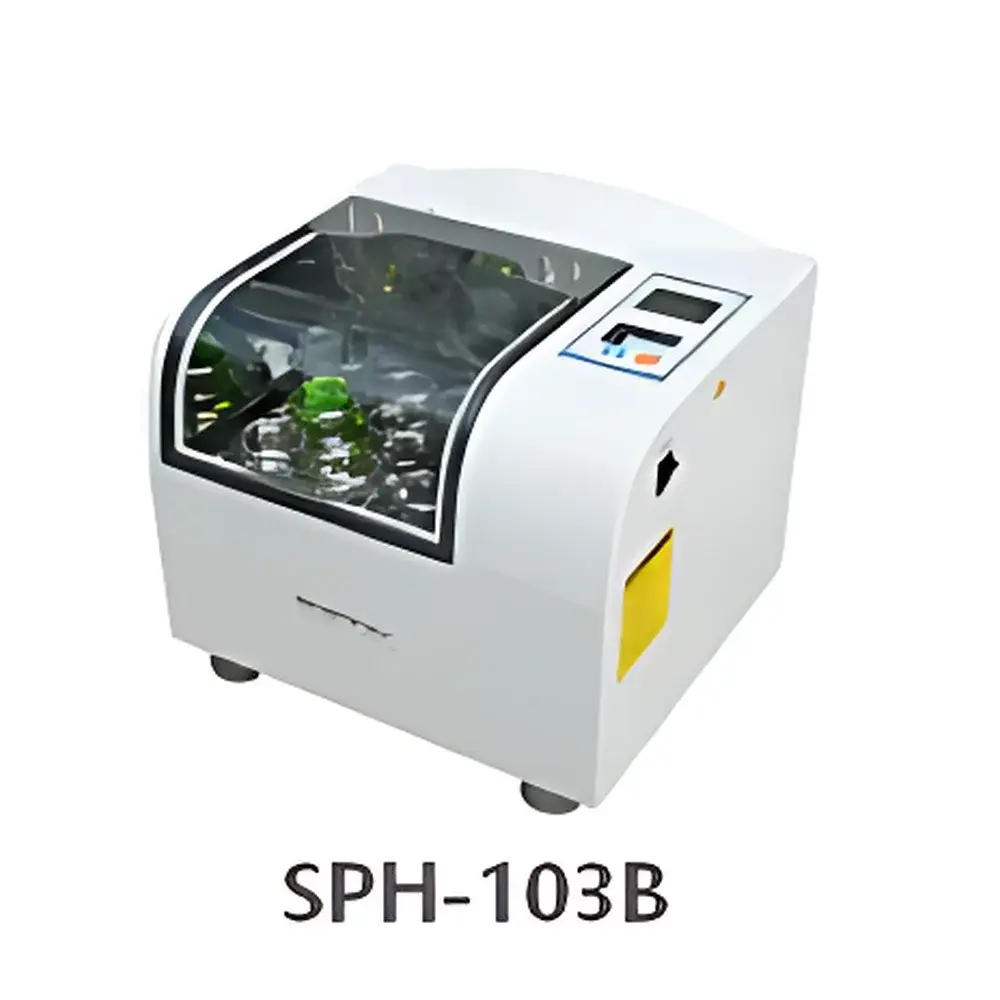
Shanghai Shiping SPH-103B Advanced Benchtop Incubated Orbital Shaker
| [Brand | Shanghai Shiping |
|---|---|
| Origin | Shanghai, China |
| Model | SPH-103B |
| Temperature Range | Ambient +5°C to 60°C |
| Oscillation Mode | Orbital (Rotary) |
| Oscillation Frequency | 30–400 rpm |
| Frequency Accuracy | ±1 rpm |
| Orbit Diameter | Φ25 mm |
| Timer Range | 0–500 h |
| Platform Size | 260 × 260 mm |
| Chamber Dimensions (W×D×H) | 360 × 340 × 280 mm |
| Platform Quantity | 1 |
| Power Consumption | 280 W |
| Cooling System | CFC-Free R134a |
| Heating Power | 150 W |
| Motor Type | Brushless AC Induction Motor |
| Control System | PID Microprocessor with LCD Dual-Display |
| Safety Features | Over-Temp/Over-Speed Alarms, Independent Thermal Cut-Out, Lid-Open Stop, Auto-Restart after Power Failure |
| Compliance | CE-marked design principles |
Overview
The Shanghai Shiping SPH-103B Advanced Benchtop Incubated Orbital Shaker is an engineered solution for precise, reproducible cultivation and mixing of biological samples under controlled thermal and mechanical conditions. Designed around orbital (rotary) motion dynamics—where the platform rotates in a circular path at a defined radius (Φ25 mm)—this shaker ensures uniform suspension of cells, microorganisms, or reagents without shear-induced damage typical of reciprocating or vortex agitation. Its integrated P.I.D. microprocessor-controlled heating system maintains temperature stability within ±0.1°C, while forced-air convection ensures chamber uniformity of ±0.5°C across the full operating range (ambient +5°C to 60°C). The unit operates as a standalone incubated shaker—not a refrigerated model—making it optimal for mesophilic microbial growth, mammalian cell passaging, enzyme reaction kinetics, and hybridization protocols requiring sustained warmth and gentle agitation. Its compact footprint (560 × 530 × 560 mm) and 31 kg net weight support flexible placement on laboratory benches or vibration-dampened surfaces.
Key Features
- Orbital shaking mechanism with precisely calibrated Φ25 mm orbit diameter—optimized for homogeneous suspension of suspension cultures and low-shear mixing of sensitive biologics.
- Brushless AC induction motor delivering consistent torque across the full 30–400 rpm range; no carbon brushes, zero maintenance, and extended service life (>20,000 h MTBF).
- Intelligent PID microprocessor controller with dual-line backlit LCD display showing real-time temperature, speed, and timer—plus user-defined setpoints and deviation alerts.
- Robust safety architecture: independent over-temperature cut-off, dual-limit speed alarms, lid-open automatic stop, and auto-restart functionality following power interruption.
- Ergonomic design with gas-spring assisted tempered glass lid—enabling unobstructed visual monitoring and smooth, balanced operation during frequent access.
- CFC-free R134a refrigerant-free thermoregulation system compliant with international environmental directives (EU F-Gas Regulation No. 517/2014).
- Modular platform compatibility: standard stainless-steel deck (260 × 260 mm) accepts universal bottle clamps, microplate carriers, tube racks, and spring-loaded platforms (optional accessories).
Sample Compatibility & Compliance
The SPH-103B accommodates common labware configurations including up to nine 100 mL Erlenmeyer flasks or four 250 mL bottles per run—ideal for small-batch culture expansion, plasmid prep, protein expression screening, or antibody labeling workflows. Its stainless-steel interior chamber (mirror-finish AISI 304) resists corrosion from repeated ethanol or sodium hypochlorite decontamination. While not certified to ISO 13485 or FDA 21 CFR Part 11 out-of-the-box, the device supports audit-ready operation when paired with external electronic lab notebook (ELN) systems: all parameter changes—including temperature, speed, and timer—are logged with timestamps and user ID via optional RS-232/USB data export. The absence of active cooling excludes use in psychrophilic applications, but its ambient+5°C lower limit satisfies most standard microbiological (ISO 8589), cell culture (ATCC guidelines), and biochemical assay (USP ) requirements.
Software & Data Management
The SPH-103B employs embedded firmware—not PC-dependent software—ensuring deterministic response and operational independence. All settings (including eight-segment programmable ramp profiles) are retained in non-volatile memory. Real-time parameters appear simultaneously on the LCD: setpoint vs. actual temperature, target vs. measured rpm, and remaining time. Optional data logging (via USB-to-serial adapter) exports comma-separated values (.csv) files containing timestamped records of temperature, speed, and alarm events—compatible with LabArchives, Benchling, or custom Python-based QA validation scripts. For GLP/GMP environments, users may configure manual logbooks aligned with Annex 11 principles: change control, version tracking, and signature fields for calibration verification.
Applications
- Mammalian and insect cell line propagation in serum-containing or chemically defined media.
- Bacterial and yeast fermentation for recombinant protein production (e.g., E. coli BL21(DE3), Pichia pastoris).
- Nucleic acid hybridization (Southern/Northern blotting), antigen-antibody binding assays, and ELISA plate washing pre-incubation.
- Solubility testing of small-molecule APIs under pharmacopeial temperature-stress conditions (USP ).
- Pre-analytical sample homogenization prior to HPLC, GC-MS, or NGS library preparation.
- Enzymatic digestion optimization (e.g., restriction endonuclease kinetics, protease cleavage time courses).
FAQ
Is the SPH-103B suitable for cold-sensitive applications such as cryopreservation recovery?
No—the unit lacks active refrigeration and cannot operate below ambient +5°C. For sub-ambient incubation, consider models with compressor-based cooling (e.g., SPH-200B variant).
Can I validate temperature uniformity per ISO/IEC 17025 requirements?
Yes—its ±0.5°C chamber uniformity specification aligns with ISO 17025 clause 5.10.4 for equipment qualification; users should perform three-point mapping (center, front-left, rear-right) using NIST-traceable PT100 probes.
Does the shaker support regulatory-compliant audit trails?
The base unit does not generate internal electronic audit trails, but exported .csv logs—when archived with metadata and digital signatures—fulfill ALCOA+ principles when integrated into validated ELN systems.
What is the maximum flask size supported on the standard platform?
The 260 × 260 mm deck accommodates up to four 250 mL baffled flasks or nine 100 mL flasks with standard clamps; larger vessels require custom fixture design.
How is motor longevity ensured without brush replacement?
The brushless AC induction motor eliminates arcing, wear debris, and commutator degradation—achieving >20,000 hours MTBF under continuous 37°C/150 rpm operation per IEC 60034-18-41 test standards.
Related Products