
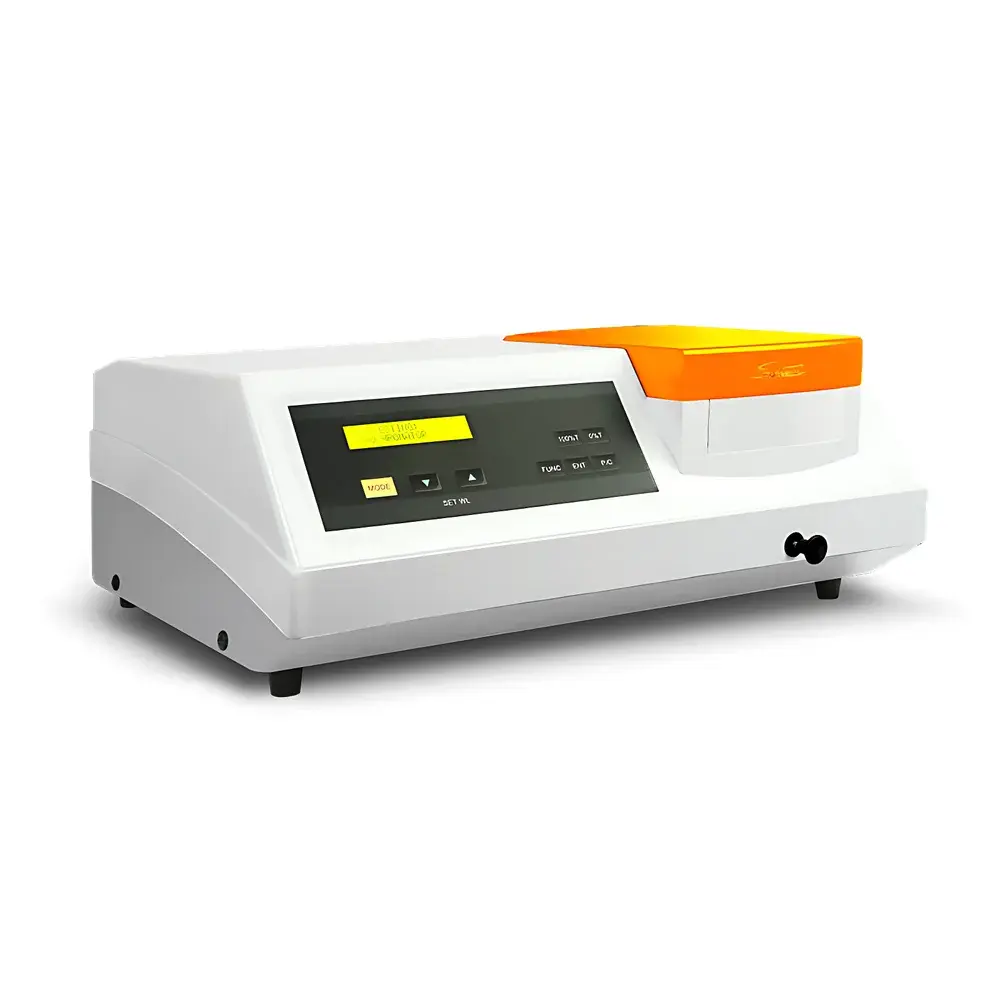
Shanghai Spectrum SP-723 Visible Spectrophotometer
| Brand | Shanghai Spectrum |
|---|---|
| Origin | Shanghai, China |
| Manufacturer Type | Authorized Distributor |
| Product Origin | Domestic (China) |
| Model | SP-723 |
| Optical System | Single-beam self-collimating optical path with 1200 lines/mm holographic grating |
| Detector | Photodiode array |
| Wavelength Setting | Automatic |
| Sample Chamber Capacity | Accommodates cuvettes from 5 mm to 100 mm pathlength |
| Minimum Sample Volume | 200 µL (with optional ultra-micro cuvette holder) |
| Display | 2-line × 20-character LCD |
| Data Output | Analog output + RS-232C serial interface |
| Compliance | Designed for educational, industrial QC, and environmental monitoring applications per standard laboratory practice guidelines (e.g., ISO/IEC 17025–aligned operation) |
Overview
The Shanghai Spectrum SP-723 Visible Spectrophotometer is a precision single-beam instrument engineered for quantitative absorbance measurements in the visible spectral region (typically 320–1100 nm, consistent with standard visible spectrophotometer design conventions). It employs a self-collimating optical architecture featuring a high-efficiency 1200 lines/mm holographic grating monochromator, ensuring stable wavelength dispersion and minimal thermal drift during extended operation. The instrument operates on Beer–Lambert law principles, converting light attenuation at selected wavelengths into concentration data for analytes such as nitrate, phosphate, COD reagents, dyes, food colorants, and nucleic acids. Its robust mechanical design prioritizes long-term photometric stability and user reproducibility—particularly critical in teaching laboratories, routine quality control environments, and field-deployable environmental monitoring workflows.
Key Features
- Single-beam self-collimating optical path optimized for mechanical stability and reduced alignment sensitivity
- High-resolution 1200 lines/mm holographic grating for consistent spectral resolution across the visible range
- Photodiode array detector enabling rapid spectral acquisition and improved signal-to-noise ratio versus traditional photomultiplier tubes
- Large-capacity sample compartment accommodating standard cuvettes from 5 mm to 100 mm pathlength—including dedicated support for 100 mm cells used in low-absorbance or trace-level analysis
- Automatic wavelength scanning and setting via onboard microprocessor control—eliminating manual dial adjustment and reducing operator-induced error
- Low-volume capability: compatible with optional ultra-micro cuvette holder for sample volumes as small as 200 µL—ideal for precious biological samples including DNA, RNA, and protein solutions
- Integrated 2-line × 20-character LCD display for real-time parameter readout, absorbance/transmittance values, and status prompts
- Dual-output connectivity: analog voltage output for chart recorder integration and RS-232C serial interface for PC-based data logging and instrument control
Sample Compatibility & Compliance
The SP-723 supports standard quartz, glass, and plastic cuvettes with pathlengths ranging from 5 mm to 100 mm, enabling flexibility across concentration ranges—from high-concentration industrial process streams to dilute environmental water extracts. Its optical design meets baseline performance expectations for visible-range spectrophotometry under ISO 6425 (general requirements for laboratory instruments) and aligns with methodological frameworks referenced in EPA Method 365.2 (phosphate), APHA Standard Methods 4500-NO₃⁻ F (nitrate), and USP (spectrophotometric analysis). While not certified to GLP or FDA 21 CFR Part 11 out-of-the-box, its RS-232C interface permits integration into validated LIMS or ELN systems where audit trails, electronic signatures, and data integrity controls are implemented at the software layer.
Software & Data Management
The SP-723 operates autonomously via embedded firmware but interfaces seamlessly with third-party data acquisition software via RS-232C protocol (ASCII command set, 9600 baud, no parity). Users may configure time-series absorbance logging, multi-wavelength kinetic assays, and standard curve generation using common platforms such as LabVIEW, MATLAB, or custom Python scripts (PySerial-supported). Analog output (0–1 V or 0–10 V proportional to absorbance) allows direct connection to strip-chart recorders or PLC-based monitoring systems in continuous-process environments (e.g., wastewater treatment effluent streams). All measurement data are timestamped at acquisition; metadata—including wavelength, pathlength, zero-reference condition, and operator ID (if entered manually)—can be appended via host software.
Applications
- Educational laboratories: Undergraduate analytical chemistry and environmental science curricula requiring hands-on exposure to spectrophotometric quantification principles
- Food & beverage QA/QC: Colorimetric determination of sucrose (via anthrone assay), total polyphenols, sulfite, and caramel color intensity (E150)
- Water & wastewater analysis: Monitoring orthophosphate, nitrate, iron(II), chromium(VI), and chlorine residual using APHA- or ISO-standard colorimetric methods
- Industrial process control: Real-time tracking of dye concentration in textile effluents, pulp brightness in paper mills, and metal ion levels in electroplating baths
- Molecular biology support: Rapid nucleic acid quantification (A₂₆₀/A₂₈₀ ratio) and protein estimation (Bradford, Lowry) with ultra-micro accessories
FAQ
What is the typical wavelength range supported by the SP-723?
While not explicitly specified in factory documentation, the SP-723 is configured for visible-region operation and functions reliably from approximately 320 nm to 1100 nm—consistent with standard visible spectrophotometers utilizing silicon-based photodiode arrays.
Can the SP-723 perform kinetic or time-resolved measurements?
Yes—when connected to an external data acquisition system via RS-232C or analog output, it supports continuous absorbance monitoring at user-defined intervals (e.g., 0.5–5 s sampling rate), enabling enzyme kinetics, reaction rate studies, and dissolution profiling.
Is GMP/GLP compliance achievable with this instrument?
The hardware itself does not include built-in audit trail, electronic signature, or 21 CFR Part 11 features; however, full compliance can be established through validated third-party software controlling the device and managing raw data storage, versioning, and user access logs.
Does the SP-723 require wavelength calibration verification?
Yes—routine verification using NIST-traceable holmium oxide or didymium filters is recommended per ISO/IEC 17025 Clause 6.4.10; the instrument supports manual wavelength calibration offset adjustment via service mode.
Are cuvettes and ultra-micro holders supplied with the base unit?
Standard 10 mm square glass cuvettes are typically included; the ultra-micro cuvette holder and specialized 200 µL cells are optional accessories ordered separately.
Related Products





