
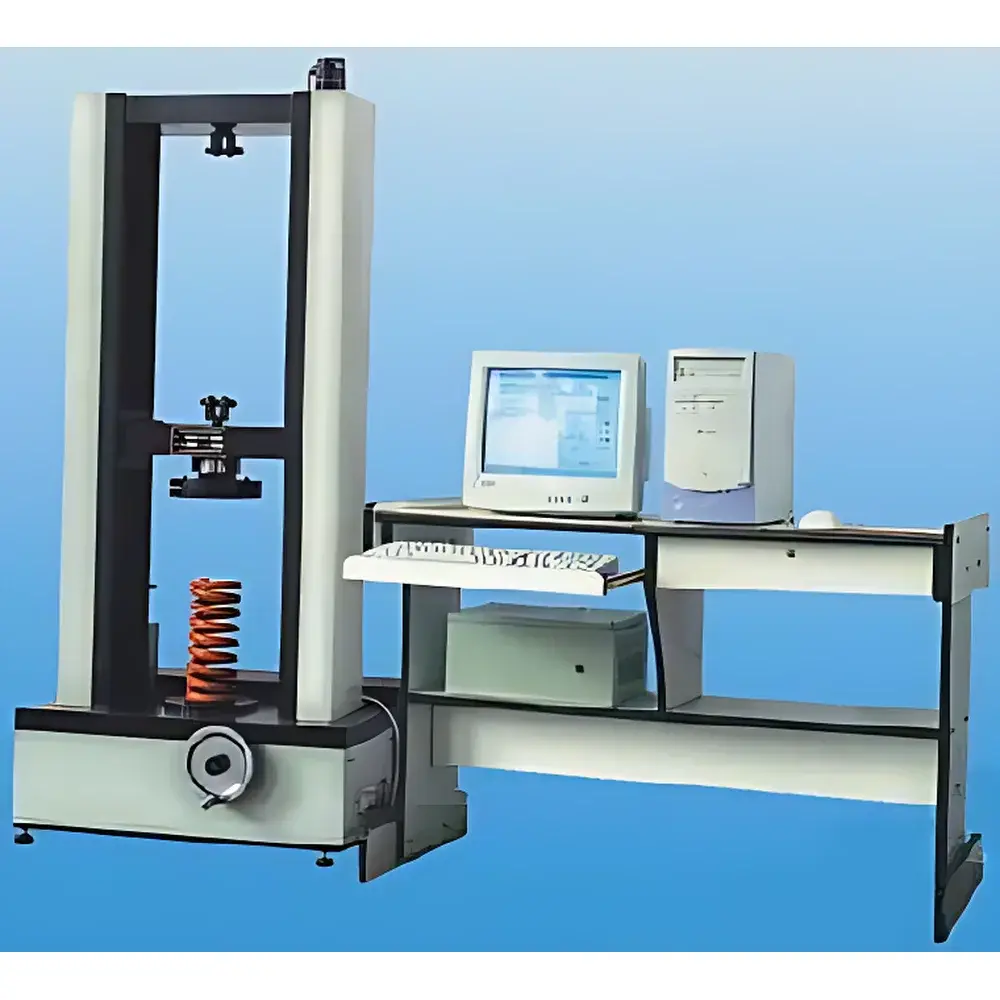
Shanghai Trial Test MC009-TLW Series Microcomputer-Controlled Spring Testing Machine
| Origin | Shanghai, China |
|---|---|
| Manufacturer Type | Authorized Distributor |
| Origin Category | Domestic (PRC) |
| Model | MC009-TLW Series |
| Pricing | Available Upon Request |
| Max Test Load | 10,000 N (4-range auto-ranging) |
| Accuracy Class | Grade 1 (per GB/T 228.1 & ISO 7500-1) |
| Force Resolution | 0.05% of full scale per range |
| Displacement Resolution | 0.01 mm |
| Displacement Accuracy | ±0.5% of reading |
| Speed Range | 0.05–500 mm/min (infinitely variable) |
| Effective Test Height | ≈1000 mm |
| Compression Platen Diameter | Ø200 mm |
| Power Supply | 380 VAC ±10%, 50 Hz |
Overview
The MC009-TLW Series Microcomputer-Controlled Spring Testing Machine is a precision electromechanical system engineered for static mechanical characterization of compression, tension, and extension springs across industrial quality control, R&D, and certification laboratories. It operates on the principle of controlled quasi-static loading via a servo-driven vertical actuation system, enabling high-fidelity measurement of force–displacement relationships under programmable boundary conditions. Designed to comply with core mechanical testing standards—including GB/T 228.1 (metallic materials), ISO 7500-1 (static uniaxial testing machines), and ASTM E4 (verification of force-measuring instruments)—the machine delivers traceable, repeatable data essential for spring stiffness verification, load-deflection profiling, relaxation assessment, and fatigue pre-conditioning validation. Its rigid portal frame architecture, coupled with dual-sensor signal conditioning (load cell + rotary encoder), ensures minimal compliance error and robust performance across long-duration tests in ambient-controlled environments (10–35 °C, ≤80% RH, non-vibrating, non-corrosive).
Key Features
- Rigid double-column portal frame construction with reinforced crosshead guidance for axial alignment stability and minimal lateral deflection during high-load compression cycles.
- Panasonic AC servo motor and digital drive system delivering precise speed regulation (0.05–500 mm/min), zero-speed holding torque, and smooth acceleration/deceleration profiles without overshoot.
- High-accuracy load measurement using calibrated S-type or canister-type load cells (10,000 N max, 4 auto-ranging spans), with resolution down to 0.05% of full scale per range and integrated thermal drift compensation.
- Optical encoder-based displacement sensing with 0.01 mm resolution; real-time compensation for system compliance (including sensor deformation and frame elasticity) ensures true specimen deformation accuracy.
- Comprehensive hardware safety interlocks: mechanical limit switches at upper/lower crosshead positions, over-force cutoff (>110% rated load), dynamic rupture stop (instant halt upon sudden load drop >15% within 2 ms), overcurrent/overvoltage protection, and overspeed monitoring.
- Automated test sequencing including programmable pre-compression cycles, multi-point force–deflection interrogation (up to 10 user-defined points with independent up/down stroke evaluation), and configurable initial contact detection based on threshold force activation.
Sample Compatibility & Compliance
The MC009-TLW accommodates cylindrical, conical, disc, and leaf springs with outer diameters up to 180 mm and free heights ≤950 mm—compatible with standard ISO 2691, DIN 2095, and GB/T 23935 test geometries. It supports both compression-only and tension-capable configurations (with optional hook fixtures). All force and displacement measurements are traceable to national metrological standards, and the system meets Grade 1 accuracy requirements per ISO 7500-1:2018 and GB/T 228.1–2021. The mechanical design conforms to EN ISO 12100 for machinery safety, and electrical components comply with IEC 61000-6-2/6-4 for electromagnetic compatibility. While not inherently 21 CFR Part 11 compliant, audit-ready operation is achievable through optional software validation packages supporting GLP/GMP documentation workflows.
Software & Data Management
Control and analysis are executed via Windows-based proprietary software (v3.2+, compatible with Windows 10/11 64-bit), featuring a fully graphical interface with real-time dual-axis plotting (force vs. displacement), customizable parameter dashboards, and keyboard/mouse-driven workflow navigation. The software performs automatic zeroing, auto-ranging, and real-time calibration verification. Core computational functions include segmental stiffness calculation (k = ΔF/Δδ), hysteresis loop quantification, permanent set evaluation, and yield point detection via tangent modulus analysis. Data is stored in structured binary format with embedded metadata (operator ID, timestamp, environmental logs); export options include CSV, Excel, PDF reports, and vector-based SVG plots. Raw data streams support third-party integration via TCP/IP API or OPC UA (optional module). Audit trails record all parameter changes, test starts/stops, and manual interventions—enabling full traceability for internal QA audits.
Applications
This system serves critical roles in automotive suspension component validation (coil spring rate consistency), medical device spring qualification (e.g., surgical stapler actuators), aerospace fastener preload verification, precision instrumentation calibration (e.g., pressure gauge Bourdon tubes), and consumer electronics tactile feedback mechanism testing (button click force curves). It is routinely deployed for supplier qualification against OEM specifications (e.g., Ford WSS-M1A365-B3, GM GMW14872), regulatory submissions requiring mechanical test evidence (ISO 13485 clause 7.5.2), and failure analysis root-cause investigations involving spring relaxation or set development. Educational institutions utilize it for materials science labs focused on Hooke’s law deviation analysis and viscoelastic modeling of polymer-based springs.
FAQ
What standards does this machine comply with for calibration and verification?
It satisfies ISO 7500-1:2018 (static testing machines), GB/T 228.1–2021 (tensile testing), and ASTM E4–2022 (force verification). Calibration certificates include uncertainty budgets per ISO/IEC 17025 requirements.
Can the system perform cyclic loading or fatigue tests?
No—it is designed exclusively for static and quasi-static monotonic tests. For fatigue applications, a dedicated servo-hydraulic or electrodynamic fatigue tester is recommended.
Is the software compatible with modern Windows operating systems?
Yes—version 3.2+ supports Windows 10 and 11 (64-bit). Legacy Windows 98/XP drivers are provided only for archival data migration.
How is system compliance error compensated during displacement measurement?
The software applies real-time correction using pre-characterized frame and sensor deformation coefficients derived from NIST-traceable calibration routines, isolating true specimen strain from machine compliance.
What documentation is included for regulatory submissions?
Standard delivery includes factory calibration report, conformity declaration (CE-marked per Machinery Directive 2006/42/EC), user manual with maintenance schedules, and software validation summary. Full 21 CFR Part 11 compliance requires optional IQ/OQ/PQ protocol execution.



