
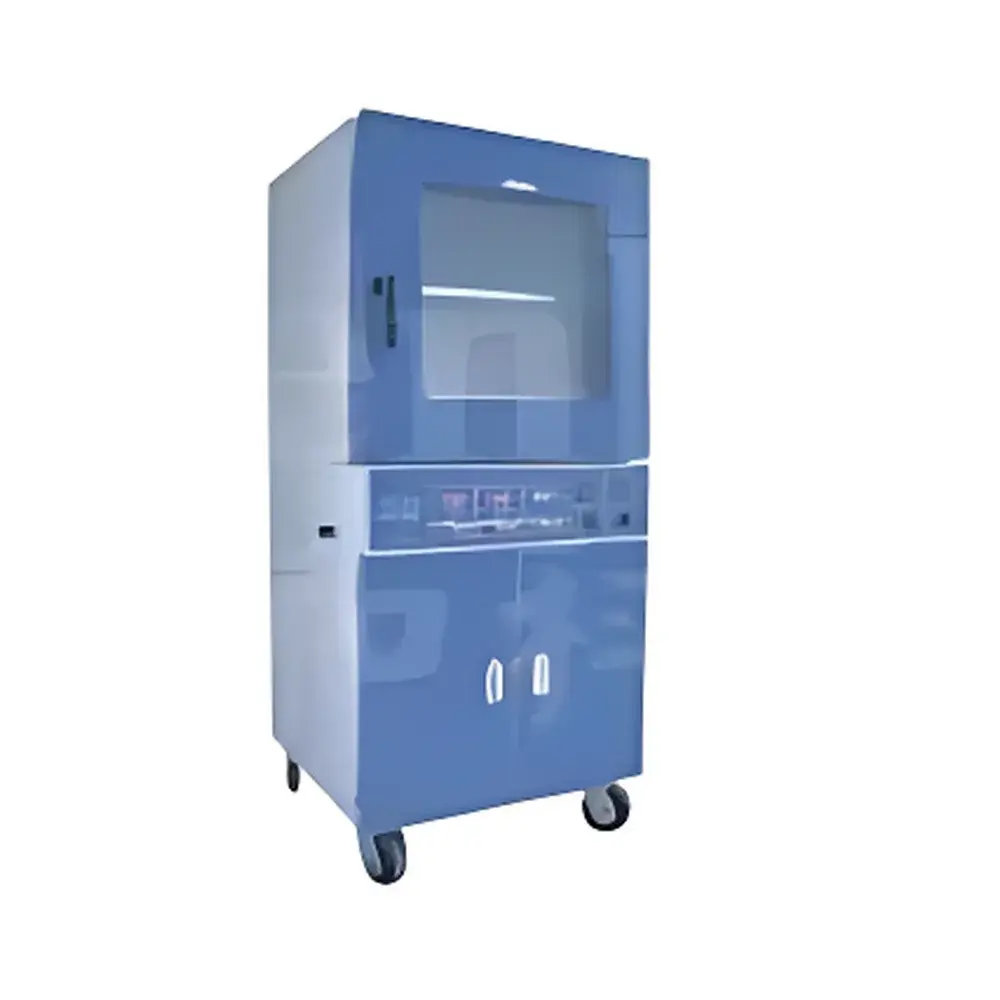
Shanghai Yiheng DZF-6053 Vacuum Drying Oven
| Brand | Shanghai Yiheng |
|---|---|
| Origin | Shanghai, China |
| Model | DZF-6053 |
| Instrument Type | Vacuum Oven |
| Temperature Range | RT+10°C to 200°C |
| Temperature Uniformity | ±1°C |
| Temperature Resolution | 0.1°C |
| Achievable Vacuum Level | 133 Pa |
| Internal Chamber Dimensions | 415 × 370 × 345 mm |
| External Dimensions | 730 × 560 × 550 mm |
| Chamber Material | Stainless Steel (SUS304) |
| Heating Method | Electric Resistance Heating |
| Power Input | 1400 W |
| Standard Shelves | 3 pcs |
| Door | Double-layer Tempered Glass with Silicone Sealing Gasket |
Overview
The Shanghai Yiheng DZF-6053 Vacuum Drying Oven is an engineered solution for moisture removal, solvent evaporation, thermal stabilization, and oxygen-sensitive sample processing in research laboratories, quality control environments, and pilot-scale production settings. Operating on the principle of reduced-pressure drying—where lowering ambient pressure depresses the boiling point of volatile components—the DZF-6053 enables efficient dehydration at lower temperatures than conventional convection ovens. This minimizes thermal degradation of heat-labile compounds such as pharmaceutical actives, polymer precursors, biological extracts, and nanomaterial dispersions. The unit integrates a microprocessor-based PID temperature controller with real-time feedback loop calibration, ensuring stable thermal profiles across the full operating range (RT+10°C to 200°C). Its robust stainless steel chamber (SUS304), double-layer tempered glass viewport, and compression-adjustable silicone door gasket collectively maintain vacuum integrity down to 133 Pa—meeting baseline requirements for inert-atmosphere processing per ISO 12798:2018 (vacuum drying procedures) and supporting GLP-compliant workflows where environmental control traceability is essential.
Key Features
- Stainless steel interior chamber (415 × 370 × 345 mm) with seamless welding and electropolished finish for corrosion resistance and ease of cleaning.
- Microcomputer-controlled PID temperature regulation with 0.1°C resolution and ±1°C uniformity across the working volume, validated per ASTM E2203–21 (Standard Practice for Calibration of Laboratory Ovens).
- Double-layer tempered glass observation window with anti-shatter properties—enabling continuous visual monitoring without vacuum interruption.
- Adjustable door sealing mechanism with integrally molded silicone gasket, designed to sustain vacuum integrity over extended cycles (≥12 h at ≤200 Pa).
- Optimized heating architecture delivering up to 50% faster ramp-to-setpoint versus legacy vacuum oven designs, verified under identical load conditions (2 kg aluminum block, 25°C → 105°C).
- Three removable, perforated stainless steel shelves (standard configuration), compatible with optional shelf supports for customized stacking arrangements.
- Front-panel digital interface with LED display, parameter lock function, and auto-start timer—supporting unattended operation in regulated environments.
Sample Compatibility & Compliance
The DZF-6053 accommodates a broad spectrum of sample formats including Petri dishes, weighing boats, glass vials (up to 100 mL), ceramic crucibles, and custom fixtures mounted on standard shelves. It is routinely deployed for residual solvent analysis (per ICH Q5C), moisture content determination (per USP Loss on Drying), pre-conditioning of hygroscopic reference standards, and thermal desorption of catalyst supports. While not certified to UL/CSA or CE for hazardous location use, its construction complies with general laboratory safety guidelines outlined in ANSI Z9.5–2022 (Laboratory Ventilation). Vacuum system compatibility includes standard KF-16 and NW25 flange interfaces for integration with external oil-free scroll pumps or dual-stage rotary vane systems meeting ISO 8573-1 Class 4 purity requirements.
Software & Data Management
The DZF-6053 operates as a standalone instrument with no embedded data logging or network connectivity. However, its analog voltage output (0–5 V DC, proportional to chamber temperature) allows integration with third-party data acquisition systems (e.g., National Instruments DAQmx, LabVIEW) for time-stamped thermal profiling. For audit-ready documentation, users may pair the oven with external chart recorders or USB-connected thermocouple loggers (Type K, ±0.5°C accuracy) configured to meet FDA 21 CFR Part 11 requirements when used in pharmaceutical QC labs. All operational parameters—including setpoint, actual temperature, elapsed time, and vacuum status—are retained on the front panel display for manual transcription into electronic lab notebooks (ELNs) or LIMS platforms.
Applications
- Removal of residual solvents from APIs and excipients prior to lyophilization or tablet compression.
- Drying of moisture-sensitive electronic components (e.g., MEMS sensors, OLED substrates) under nitrogen-purged vacuum.
- Thermal aging studies of elastomers and adhesives under controlled low-oxygen conditions (ASTM D573).
- Preparation of anhydrous reagents and catalysts requiring exclusion of atmospheric moisture and O₂.
- Accelerated stability testing of coated medical devices per ISO 11607-1 Annex B protocols.
- Weight-loss-on-drying (WLOD) assays for raw material release in food, cosmetic, and polymer supply chains.
FAQ
What vacuum level can the DZF-6053 achieve without an external pump?
The unit does not include an integrated vacuum pump; it requires connection to an external vacuum source. When paired with a standard two-stage rotary vane pump (e.g., 2 m³/h capacity), it consistently reaches and holds ≤133 Pa.
Is the chamber suitable for acidic vapor exposure?
The SUS304 stainless steel chamber provides moderate resistance to organic acids and mild inorganic vapors but is not recommended for prolonged exposure to concentrated HCl, HF, or oxidizing acids such as nitric acid.
Can the oven be operated under inert gas purge while maintaining vacuum?
Yes—by connecting a regulated inert gas line (N₂ or Ar) to the dedicated inlet port and configuring the vacuum relief valve, users can establish dynamic purge-vacuum cycling or static inert blanket conditions at sub-atmospheric pressure.
Does the DZF-6053 support validation protocols like IQ/OQ/PQ?
While the unit lacks factory-installed validation documentation, its mechanical and control architecture permits full qualification using user-defined protocols aligned with GAMP5 and ISO/IEC 17025 requirements.
What maintenance intervals are recommended for long-term reliability?
Silicone door gaskets should be inspected quarterly and replaced annually; heating element continuity and thermal fuse integrity should be verified semiannually per internal preventive maintenance SOPs.



