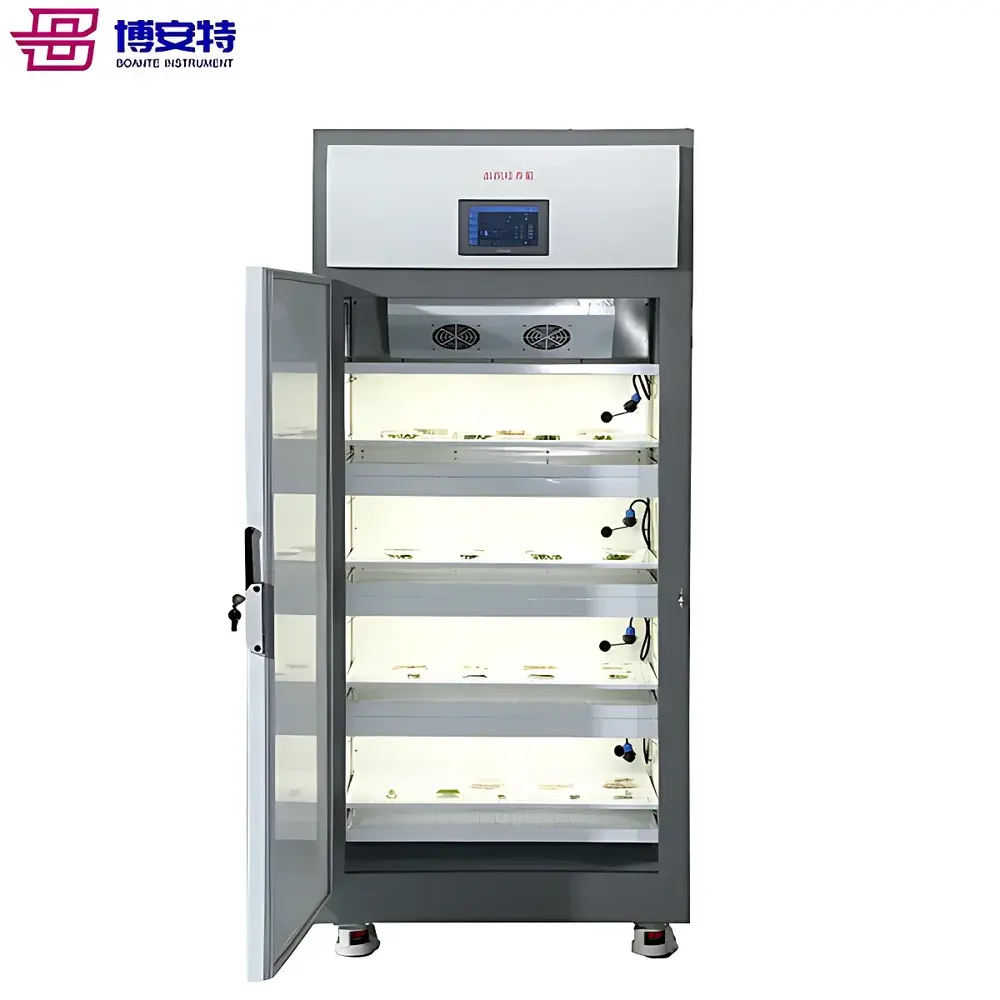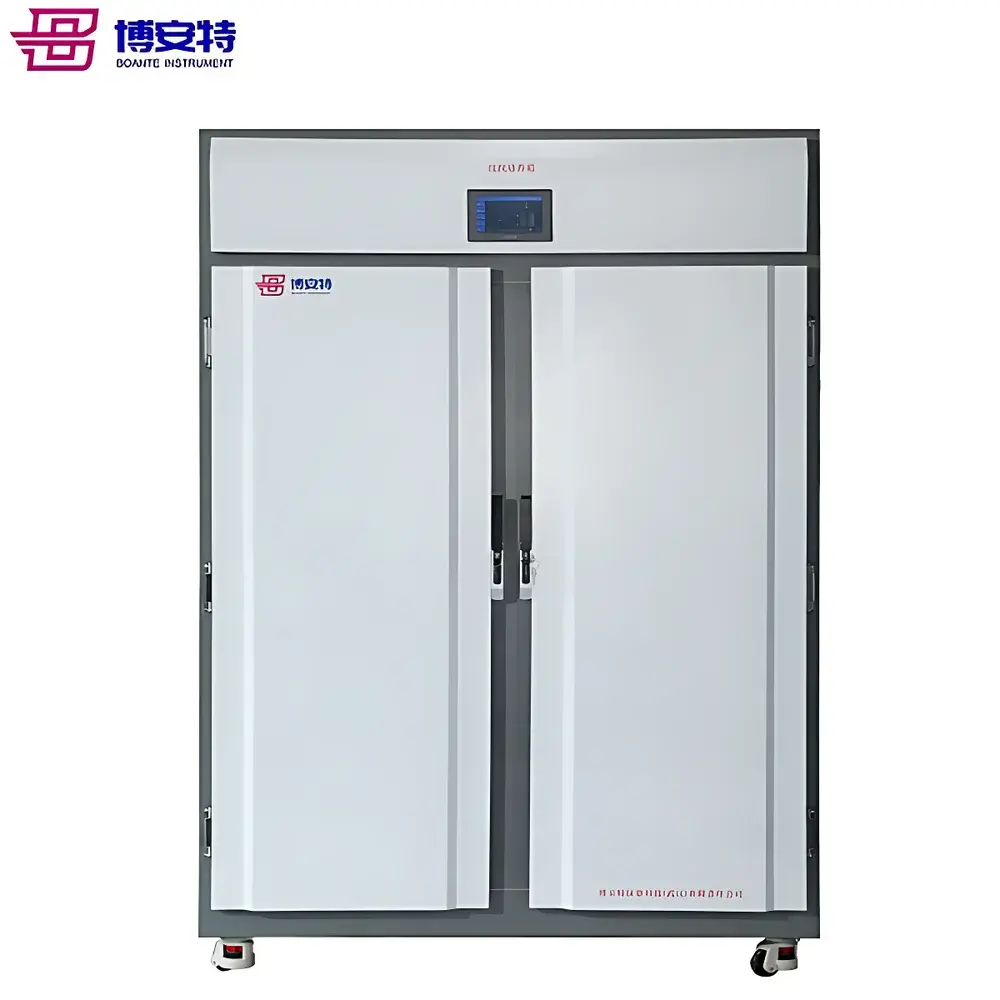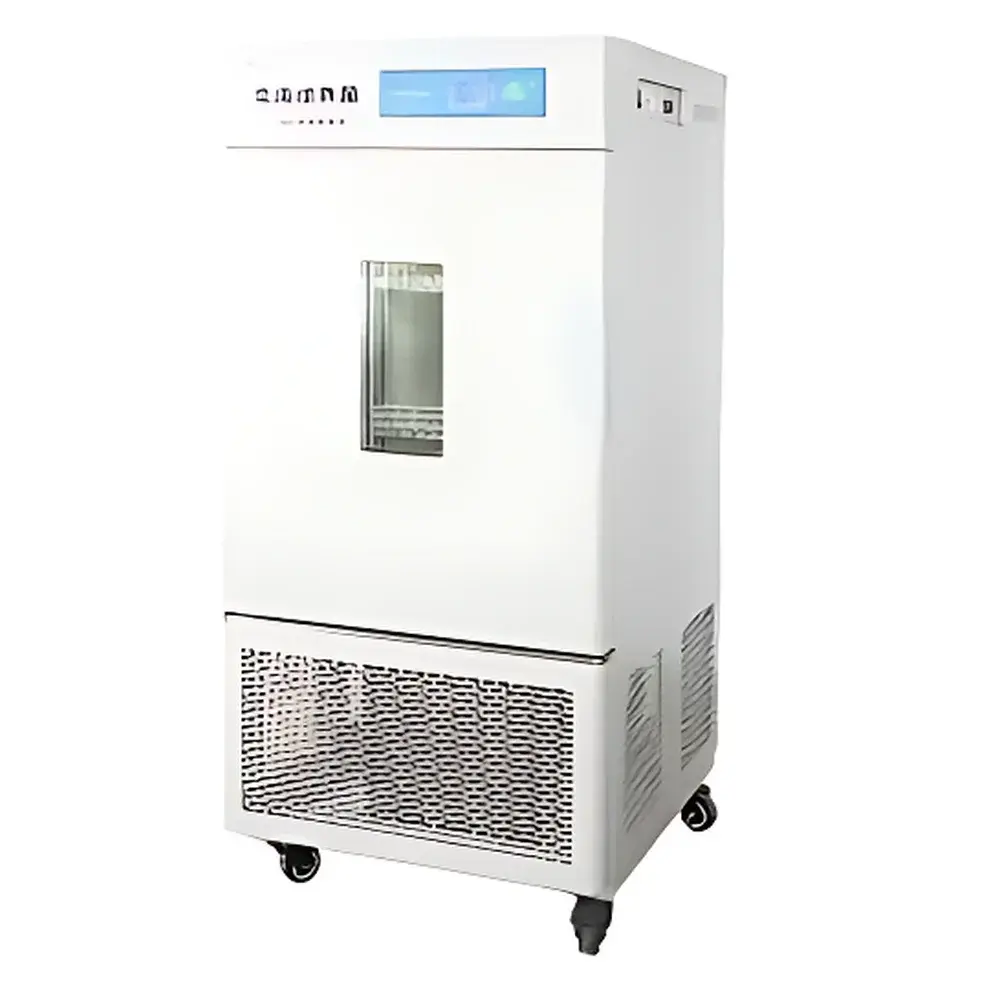
Shanghai Yiheng LRH Series Low-Temperature Biochemical Incubator
| Brand | Shanghai Yiheng |
|---|---|
| Origin | Shanghai, China |
| Model | LRH Series |
| Temperature Range | L: −10 to 65°C |
| A | −20 to 65°C |
| B | −40 to 65°C |
| Temperature Resolution | 0.1°C |
| Temperature Uniformity (Hot/Cold) | ±0.5°C / ±1.0°C |
| Power Supply | AC 220 V / 380 V, 50 Hz |
| Operating Ambient Temperature | +5 to 35°C |
| Input Power | 1100–7100 W (model-dependent) |
| Interior Dimensions (W×D×H, mm) | 400×300×420 to 800×700×900 |
| Exterior Dimensions (W×D×H, mm) | 660×720×930 to 1000×1210×1980 |
| Standard Shelves | 2–3 pcs |
| Timer Range | 0–9999 min |
| Refrigerant | R134a |
| Test Port | Ø25 mm (left side) |
| Compliance | Designed for GLP-compliant laboratories |
Overview
The Shanghai Yiheng LRH Series Low-Temperature Biochemical Incubator is a precision-engineered environmental chamber designed for stable, long-term temperature control across a broad operational range—from sub-zero conditions (down to −40°C) to moderate warmth (up to 65°C). Built on a dual-stage refrigeration architecture with high-efficiency compressors and optimized air circulation, the LRH series delivers rapid cooling—achieving setpoints up to 40% faster than conventional low-temperature incubators—while maintaining thermal stability critical for sensitive biological applications. Its core measurement and control principle relies on PID-regulated thermistor feedback combined with forced-air convection, ensuring uniform heat distribution and minimal spatial gradient (±0.5°C at elevated temperatures, ±1.0°C at sub-zero setpoints). This architecture meets the fundamental requirements of biochemical storage, microbial cultivation, stability testing, and cell-based assay workflows where reproducibility, traceability, and environmental fidelity are non-negotiable.
Key Features
- Mirror-finish stainless-steel interior with seamless, radius-rounded corners and removable shelf supports—enabling complete decontamination and compliance with ISO 14644 cleanroom-compatible cleaning protocols.
- Microprocessor-based temperature controller with 0.1°C resolution, real-time deviation monitoring, and auto-tuning capability for consistent setpoint attainment under variable load conditions.
- High-efficiency, low-noise international-brand compressor paired with an EC-type axial circulation fan and environmentally compliant R134a refrigerant—reducing energy consumption while extending service life and minimizing acoustic emission (<55 dB[A] typical).
- Dedicated Ø25 mm access port on the left chamber wall—facilitating external probe insertion, continuous temperature validation, or integration with third-party monitoring systems without compromising chamber integrity.
- Independent over-temperature cut-off circuit—hardwired as a fail-safe mechanism that interrupts power to heating/cooling elements if user-defined limits are exceeded, satisfying IEC 61010-1 safety requirements for laboratory equipment.
- Optional RS485 serial interface and thermal printer support—enabling automated data capture, time-stamped parameter logging, and alignment with electronic lab notebook (ELN) or LIMS environments.
Sample Compatibility & Compliance
The LRH incubators accommodate a wide spectrum of sample formats—including Petri dishes, multiwell plates, serum vials, culture flasks, and sealed storage containers—without risk of condensation-induced contamination, thanks to its condensate management system and non-drip evaporator design. All models conform to electromagnetic compatibility (EMC) standards per EN 61326-1 and electrical safety per EN 61010-1. While not certified as Class II medical devices, the LRH series is routinely deployed in GLP-regulated settings for stability studies (per ICH Q1A–Q1E), microbiological growth assessment (per ISO 8559, ASTM E2500), and reagent storage (per USP ). When equipped with the optional programmable controller and RS485 interface, audit trails, user access logs, and electronic signatures can be implemented to meet FDA 21 CFR Part 11 data integrity expectations.
Software & Data Management
The optional multi-segment programmable controller features a backlit LCD interface capable of storing up to 30 independent temperature profiles—each with definable ramp rates, dwell times (1–9999 minutes), fan speed modulation, and scheduled power states (auto-start, standby, shutdown). Parameter changes are logged with timestamps and operator IDs. Data export via RS485 enables bidirectional communication with SCADA platforms or custom Python/Matlab scripts for trend analysis. Raw temperature records—including chamber average, sensor-specific readings, and alarm events—are stored internally for ≥30 days and exportable in CSV format. No proprietary software installation is required; configuration is performed entirely through the front-panel interface or ASCII command protocol.
Applications
- Long-term storage of heat-labile reagents, sera, and primary cell stocks at controlled sub-zero temperatures (−20°C or −40°C).
- Temperature-stressed microbial growth assays for antibiotic susceptibility testing, bioburden evaluation, or spoilage organism kinetics.
- Accelerated stability testing of pharmaceutical formulations per ICH guidelines, including freeze-thaw cycling and intermediate condition exposure.
- Environmental simulation for plant tissue culture, fungal sporulation studies, and cold-acclimation experiments in plant physiology labs.
- Pre-conditioning of biosensors, microfluidic cartridges, and diagnostic assay kits prior to functional validation.
FAQ
What is the maximum allowable ambient temperature for continuous operation?
The unit must be installed in an environment maintained between +5°C and +35°C; operation outside this range may compromise refrigeration efficiency and trigger thermal protection.
Can the incubator maintain −40°C with full shelf loading?
Yes—models designated with the “B” suffix (e.g., LRH-50CB) are rated for −40°C at full capacity, verified per internal ISO/IEC 17025 calibration procedures.
Is the RS485 interface compatible with Modbus RTU protocol?
Yes—the interface implements standard Modbus RTU over RS485, allowing integration with industrial PLCs and building management systems.
Does the device include factory calibration documentation?
Each unit ships with a traceable NIST-traceable temperature verification report covering three points (−20°C, 25°C, 50°C) measured using accredited reference probes.
What maintenance intervals are recommended?
Compressor oil inspection every 24 months; condenser coil cleaning every 6 months in dusty environments; annual validation of temperature uniformity and alarm functionality per ISO/IEC 17025 Annex A.