
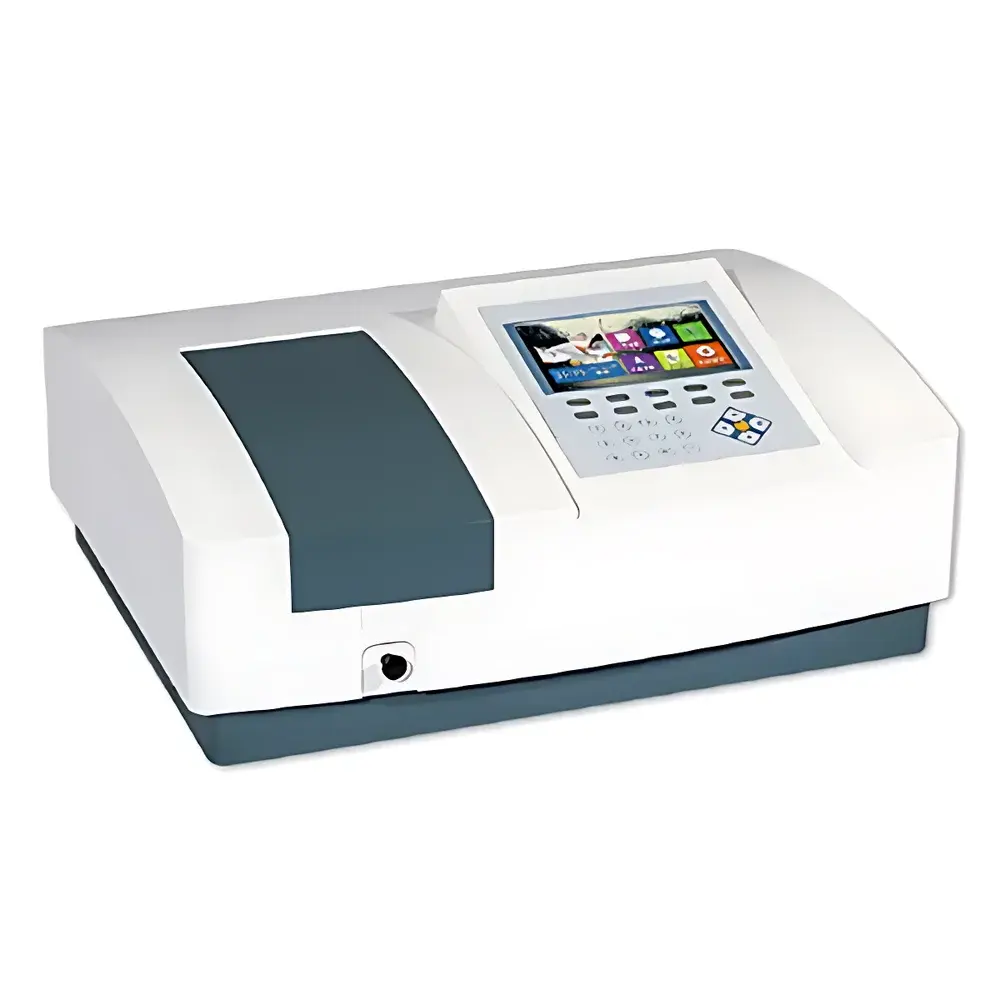
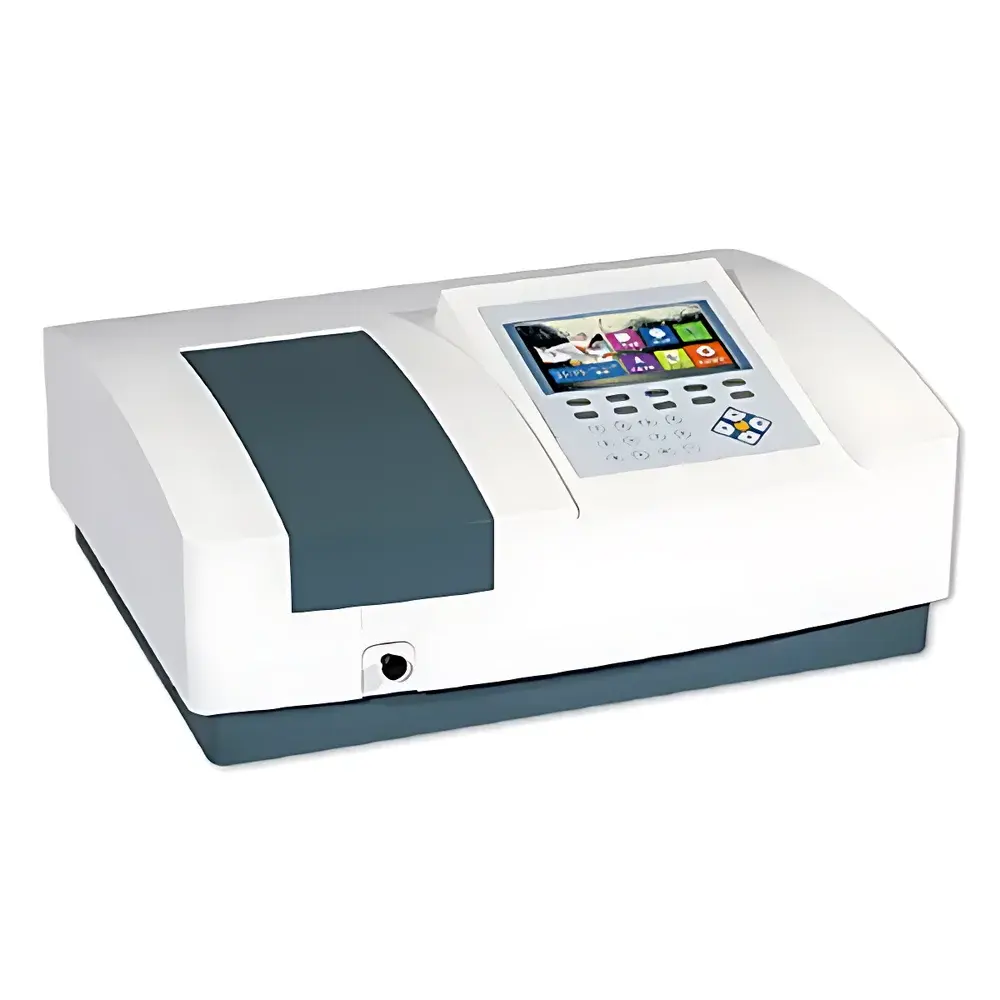
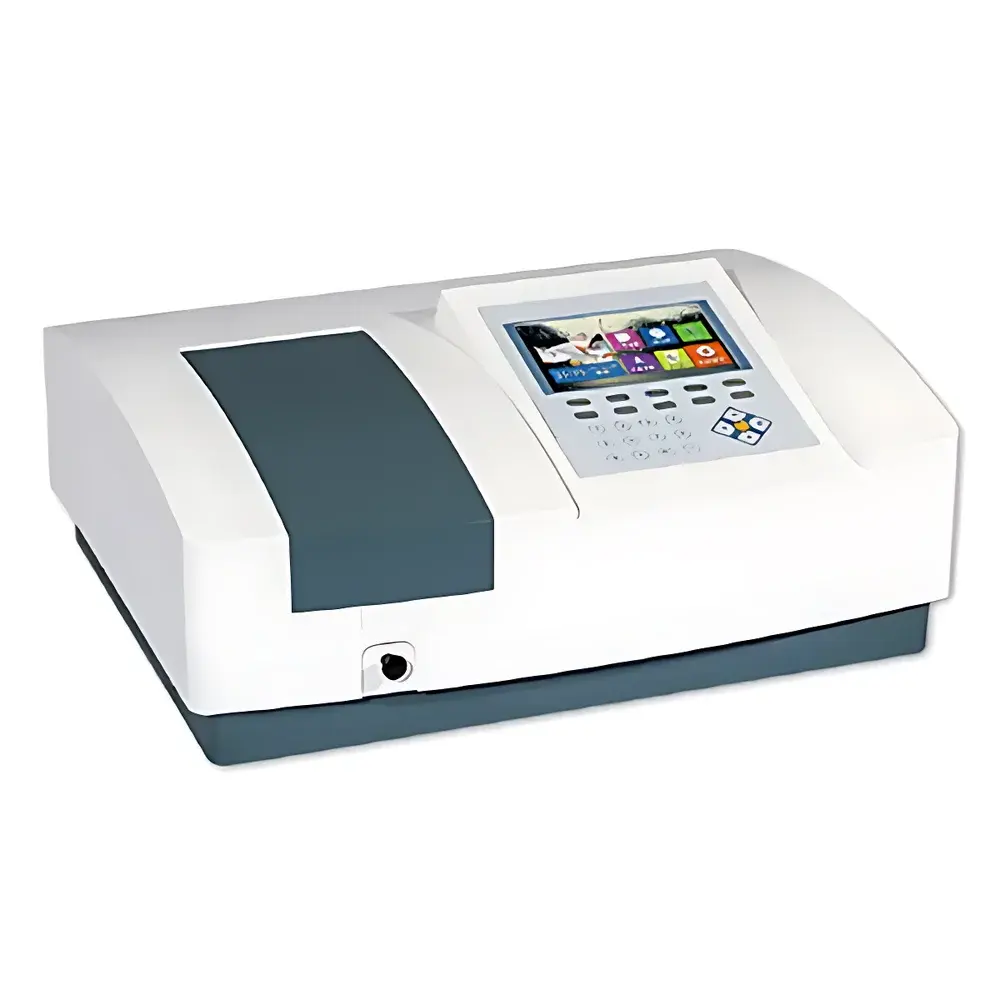
Shanghai Youke T-N6000SPlus Dual-Beam UV-Vis Spectrophotometer
| Brand | Shanghai Youke |
|---|---|
| Origin | Shanghai, China |
| Model | T-N6000SPlus |
| Optical System | Dual-beam |
| Detector Type | Photodiode Array (PDA) |
| Wavelength Range | 190–1100 nm |
| Spectral Bandwidth | 0.5 / 1 / 2 / 4 / 5 nm (selectable) |
| Wavelength Accuracy | ±0.3 nm |
| Wavelength Repeatability | ±0.1 nm |
| Stray Light | ≤0.02% T at 220 nm & 360 nm |
| Display | 7-inch color TFT-LCD touchscreen |
| Data Storage | Internal 8 GB flash memory (supports ≥5000 absorbance readings or 500 calibration curves) |
| Processor | 32-bit ARM Cortex-M3 @ 120 MHz |
| Lamp Life | ≥2000 h (tungsten & deuterium lamps, auto-switched) |
| Grating | 1200 lines/mm holographic plane grating |
| Sample Compartment | Extra-large, compatible with 5-cell wide rack and 8-position rotating carousel |
| Connectivity | RS-232 printer port, USB Host (Type-B), USB Device (Type-A), optional Ethernet/WiFi module |
| Data Export Formats | .CSV, .QUA, .TXT, .BMP |
| Software | PC-based spectral acquisition & analysis suite with GLP-compliant audit trail, method validation tools, and FDA 21 CFR Part 11-ready optional modules |
Overview
The Shanghai Youke T-N6000SPlus is a high-performance dual-beam ultraviolet-visible (UV-Vis) spectrophotometer engineered for precision quantitative and qualitative analysis in academic research laboratories, quality control environments, and routine analytical workflows. Its optical architecture employs a self-aligning Czerny-Turner monochromator with a sealed, vibration-isolated optical path—ensuring long-term photometric stability and minimal thermal drift. The instrument utilizes a high-efficiency 1200 lines/mm holographic plane grating and a photodiode array (PDA) detector to deliver rapid full-spectrum acquisition (190–1100 nm) with sub-nanometer wavelength resolution. Dual-beam operation compensates for source intensity fluctuations and cuvette-to-cuvette variability in real time, significantly enhancing measurement reproducibility—particularly critical for kinetic studies, multi-point calibration, and regulatory-compliant assays.
Key Features
- 7-inch capacitive color touchscreen interface enabling standalone operation—no external PC required for baseline correction, spectrum scanning, kinetic monitoring, or quantitative analysis.
- Dual-lamp system with automatic lamp selection and usage-time logging: imported deuterium lamp (UV range) and tungsten-halogen lamp (visible/NIR), both rated for ≥2000 hours of operational life.
- Optimized mechanical design featuring suspended optical assembly and high-precision sine-bar wavelength drive mechanism—minimizing mechanical hysteresis and ensuring wavelength accuracy of ±0.3 nm and repeatability of ±0.1 nm.
- Internal storage capacity of 8 GB NAND flash memory supports archival of up to 5000 single-point measurements or 500 multi-level calibration curves, with timestamped metadata and user-defined sample IDs.
- Direct data export via USB-A port to standard USB flash drives in four interoperable formats: .CSV (for Excel/Origin), .QUA (native spectral format), .TXT (ASCII tabular), and .BMP (publication-ready image).
- Comprehensive I/O options including RS-232 serial interface for legacy printers, USB Host (Type-B) for peripheral control, and standard USB Device (Type-A) for firmware updates and PC synchronization.
Sample Compatibility & Compliance
The T-N6000SPlus accommodates a broad range of sample configurations through its extra-large sample compartment—compatible with standard 10 mm pathlength cuvettes, micro-volume adapters, flow cells, and accessory holders for solid reflectance or fiber-optic probes. Optional accessories include a motorized 8-position rotating sample carousel and a 5-cell wide rack for high-throughput screening. From a regulatory standpoint, the instrument’s firmware architecture supports GLP (Good Laboratory Practice) workflows, including user access levels, electronic signature prompts, and audit-trail-enabled method execution logs. While not pre-certified, the system is fully compatible with validation protocols aligned with ISO/IEC 17025, USP , and ASTM E275–22 for spectrophotometric performance verification.
Software & Data Management
The bundled PC software provides full spectral acquisition, derivative analysis, peak integration, multi-component quantitation (via simultaneous equation solving), and time-resolved kinetics modeling. All data files embed embedded metadata—including instrument ID, operator name, date/time stamp, lamp status, and slit width—enabling traceability per FDA 21 CFR Part 11 requirements when deployed with optional electronic signature and audit-log modules. Firmware updates are delivered over HTTPS via official Youke servers; remote upgrade capability ensures sustained compliance with evolving analytical standards without on-site service visits.
Applications
This spectrophotometer serves diverse applications across pharmaceutical development (e.g., assay validation, dissolution testing, excipient compatibility), environmental monitoring (nitrate, phosphate, COD analysis), food safety (colorimetric detection of preservatives, antioxidants), biochemical research (protein quantification via Bradford/Lowry, enzyme kinetics), and materials science (thin-film transmittance/absorbance profiling). Its selectable spectral bandwidths (0.5–5 nm) allow optimization between resolution and signal-to-noise ratio—critical for distinguishing overlapping absorption bands in complex matrices.
FAQ
Does the T-N6000SPlus support GLP-compliant data integrity?
Yes—the instrument records full audit trails for all measurement events, including method changes, calibration updates, and user logins. With optional configuration, it meets core requirements of FDA 21 CFR Part 11 for electronic records.
Can I perform kinetic measurements without a connected computer?
Yes—the built-in touchscreen enables real-time kinetic acquisition, curve fitting, and rate constant calculation directly on the instrument display.
What is the maximum number of wavelengths that can be monitored simultaneously in multi-wavelength mode?
All wavelengths across the 190–1100 nm range are acquired simultaneously via the PDA detector; users may define up to 10 independent monitoring wavelengths per method.
Is the grating alignment user-serviceable?
No—the optical path is hermetically sealed and factory-aligned; no field adjustment is required or supported to maintain wavelength fidelity.
How is lamp lifetime tracked and reported?
The embedded firmware continuously logs cumulative on-time for each lamp and displays remaining estimated life on the main screen; replacement is facilitated by plug-and-play socket design.
Related Products



