
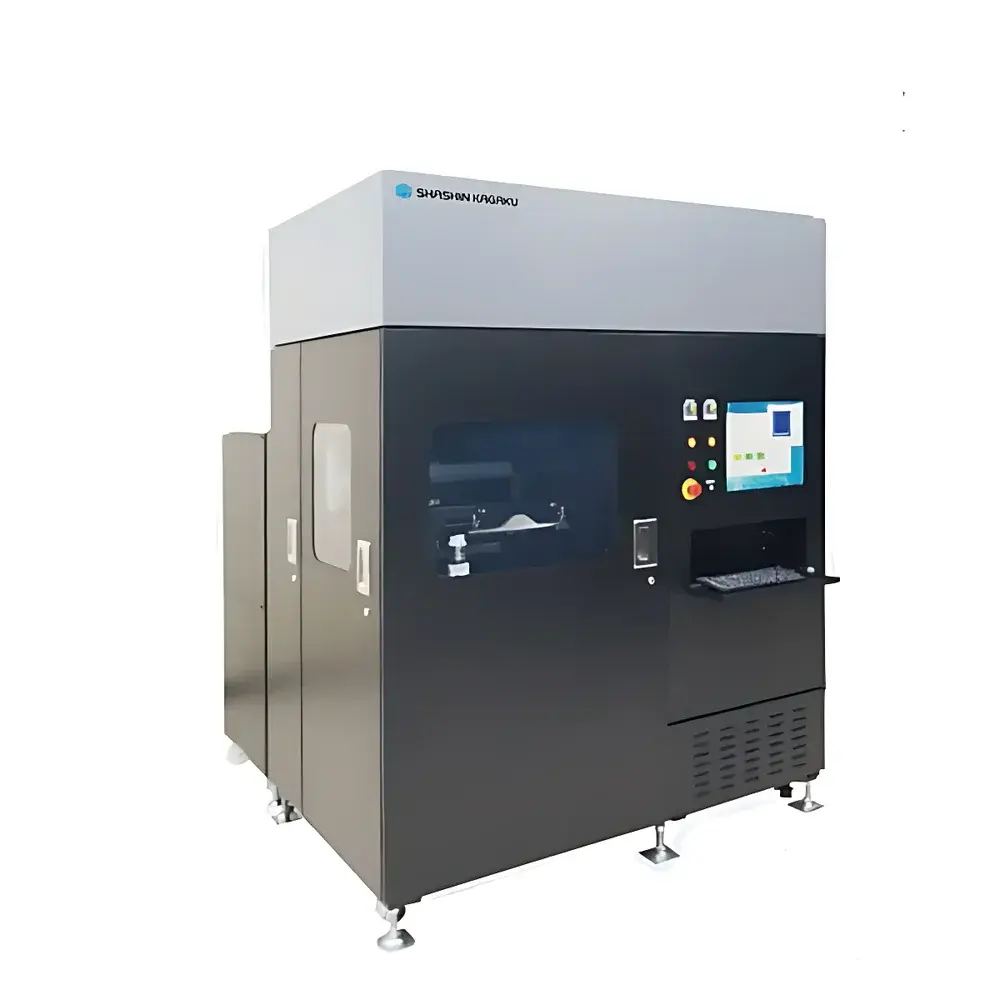
Shashin Kagaku SZ Series High-Resolution Ceramic Stereolithography (SLA) 3D Printer
| Brand | Shashin Kagaku |
|---|---|
| Origin | Japan |
| Manufacturer Type | Authorized Distributor |
| Origin Category | Imported |
| Model | SZ Series |
| Pricing | Available Upon Request |
| Build Envelope (SZ-1000) | 300 × 300 × 50 mm |
| Build Envelope (SZ-1100) | 100 × 100 × 50 mm |
| Build Envelope (SZ-2500) | 250 × 250 × 250 mm |
| Laser Spot Diameter Range | SZ-1000: φ10–φ100 µm |
| SZ-1100 | φ15–φ80 µm |
| SZ-2500 | φ80–φ300 µm |
| Layer Thickness Adjustment | SZ-1000: 5–100 µm |
| SZ-1100 | 10–200 µm |
| SZ-2500 | 50–200 µm |
| System Dimensions (SZ-1000) | 1800 × 1000 × 1800 mm |
| SZ-1100 | 1100 × 1750 × 1600 mm |
| SZ-2500 | 1600 × 1850 × 1950 mm |
Overview
The Shashin Kagaku SZ Series is a purpose-engineered stereolithography (SLA) platform designed specifically for high-fidelity additive manufacturing of advanced ceramic components. Unlike conventional polymer-focused SLA systems, the SZ Series integrates precision optical architecture with slurry-compatible photopolymerization mechanics to enable direct digital fabrication of green bodies from ceramic-loaded photosensitive suspensions. The system operates on the principle of dynamic laser scanning of UV-curable ceramic slurries—where functional particulates (e.g., alumina, zirconia, silicon carbide, or metal oxides) are uniformly dispersed in a tailored photoreactive resin matrix. Upon localized UV exposure via a galvanometer-driven optical head, crosslinking occurs at sub-50 µm resolution, preserving particle integrity and enabling near-net-shape sintered parts with controlled density gradients and minimal post-processing distortion. This technology bridges the gap between laboratory-scale prototyping and pre-production validation for functional ceramics used in thermal barrier coatings, microfluidic substrates, biomedical implants, and catalytic monoliths.
Key Features
- Optimized slurry handling architecture: Sealed, inert-atmosphere resin vat with temperature-stabilized dispensing and blade leveling mechanisms compatible with high-viscosity ceramic slurries (up to 8,000 mPa·s) and metal-oxide suspensions.
- High-resolution galvo-optical subsystem: Interchangeable F-theta lenses support tunable spot diameters—from φ10 µm (SZ-1000) to φ300 µm (SZ-2500)—enabling trade-off selection between surface fidelity and build speed across material classes.
- Multi-configurable build platforms: Three standard configurations (SZ-1000, SZ-1100, SZ-2500) offer distinct volumetric capacities and layer thickness ranges (5–200 µm), supporting both micro-architected lattice fabrication and larger-scale structural component development.
- Customization-ready mechanical framework: Modular design permits OEM-level adaptation—including bespoke build plate dimensions, slurry feed geometry,刮刀 (doctor blade) profile optimization, and UV source wavelength tuning (355 nm or 385 nm diode-pumped solid-state lasers).
- Thermal and environmental control: Integrated chamber temperature regulation (±0.5 °C stability) and optional nitrogen purge capability mitigate oxygen inhibition and ensure reproducible cure depth across multi-hour prints.
Sample Compatibility & Compliance
The SZ Series supports a broad spectrum of inorganic feedstocks formulated as photosensitive slurries—including oxide ceramics (Al2O3, ZrO2, SiO2, TiO2), non-oxides (SiC, Si3N4), ferrites, and composite pastes containing conductive fillers (e.g., Ni, Cu, or Ag particles). All hardware interfaces comply with IEC 61000-6-2/6-4 electromagnetic compatibility standards and meet CE marking requirements for industrial machinery. The system architecture accommodates GLP-compliant process documentation when paired with optional audit-trail-enabled software modules, and raw material traceability workflows align with ISO 13485 and ASTM F3122-18 guidelines for additive manufacturing of medical-grade ceramics.
Software & Data Management
Control is executed via Shashin Kagaku’s proprietary SLA-Ceramic Suite v4.x—a Windows-based application supporting STL, 3MF, and native CAD import with automatic support generation, orientation optimization, and slice parameter mapping per layer group. Real-time laser power calibration, voxel-wise exposure time modulation, and closed-loop feedback from photodiode-integrated scanning heads ensure consistent energy dosage across variable feature densities. All print logs—including laser path coordinates, exposure duration per voxel, resin temperature history, and layer lift timestamps—are stored in SQLite databases with SHA-256 hash integrity verification. Optional integration with LIMS platforms enables automated metadata tagging aligned with FDA 21 CFR Part 11 electronic record requirements.
Applications
- Prototyping of porous ceramic filters and catalytic substrates with controlled pore size distribution (1–50 µm) and tortuosity.
- Fabrication of dental and orthopedic scaffolds requiring precise interconnectivity and surface roughness < 0.8 µm Ra post-debinding.
- Development of micro-reactor channels and MEMS-compatible ceramic housings with wall thicknesses down to 80 µm.
- Rapid iteration of thermally stable nozzles, insulators, and wear-resistant tooling inserts for semiconductor and aerospace applications.
- Academic research into colloidal stability limits, photopolymer kinetics in particulate-laden media, and sintering shrinkage prediction models.
FAQ
What types of ceramic slurries are validated for use with the SZ Series?
Shashin Kagaku provides technical documentation for >12 commercially available ceramic slurries—including aqueous and acrylate-based dispersions of α-alumina, yttria-stabilized zirconia, and hydroxyapatite—with recommended rheological windows and photoinitiator concentrations.
Is post-processing equipment (e.g., debinding or sintering furnaces) supplied by Shashin Kagaku?
While the SZ Series is a standalone printing platform, Shashin Kagaku offers collaborative integration support with third-party furnace vendors and provides thermal cycle profiles optimized for each material system.
Can the system be operated in a Class 1000 cleanroom environment?
Yes—the SZ Series meets ISO 14644-1 Class 6 air cleanliness requirements out-of-the-box; optional HEPA-filtered enclosure upgrades are available for Class 5 compliance.
Does the software support batch processing of multiple parts with independent orientation and exposure settings?
Yes—SLA-Ceramic Suite includes queue-based job management with per-part parameter override, enabling heterogeneous part families to be printed in a single session without manual intervention.
What maintenance intervals are recommended for the optical train and resin delivery system?
Laser alignment verification is advised every 500 operational hours; F-theta lens cleaning and vat seal inspection are scheduled quarterly, with full galvo calibration recommended annually or after any mechanical impact event.



