
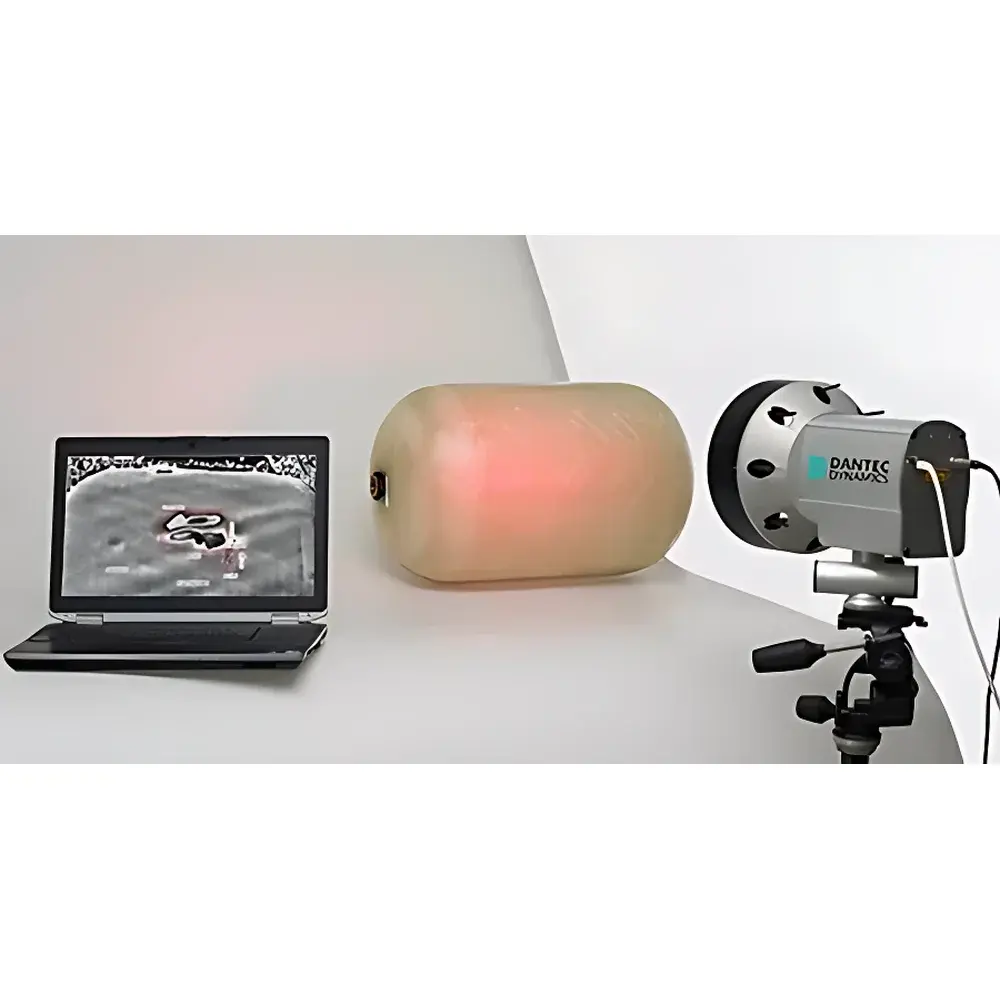
Shearography FlawScout System by Dantec Dynamics
| Brand | Dantec Dynamics |
|---|---|
| Model | FlawScout |
| Technology | Laser Shearography (Speckle Pattern Shearing Interferometry) |
| Origin | Germany |
| Detection Area per Frame | Up to 0.1 m² |
| Typical Inspection Time | <30 s per measurement |
| Excitation Options | Thermal, Vacuum, or Mechanical Vibration |
| Compliance | Designed for ISO 27958, ASTM E2614, and EN 13794-compliant NDT workflows |
| Software | FlawScout Control & Reporting Suite with Audit Trail and Export Capabilities |
Overview
The Dantec Dynamics FlawScout Shearography System is a high-sensitivity, full-field optical non-destructive testing (NDT) instrument engineered for quantitative defect detection in layered and composite structures. It operates on the principle of laser shearography—a time-averaged, coherent-optical interferometric technique that measures surface displacement gradients under controlled mechanical, thermal, or vacuum-induced strain. Unlike point-wise ultrasonic or single-pixel thermographic methods, FlawScout captures differential deformation fields across an entire region-of-interest in a single acquisition, enabling rapid identification of subsurface anomalies such as disbonds, delaminations, and impact damage without physical contact or ionizing radiation. Its core architecture integrates a stabilized HeNe or diode-pumped solid-state laser source, a dual-beam shearing interferometer with adjustable shear magnitude, a high-dynamic-range CMOS camera (12-bit or higher), and a rigid optomechanical platform optimized for vibration-insensitive operation in industrial environments.
Key Features
- Full-field, non-contact inspection with real-time fringe pattern generation and digital phase map reconstruction
- Configurable excitation modules: programmable thermal pulse (Peltier or flash lamp), vacuum chamber interface (up to −95 kPa), and calibrated shaker-based vibration actuation (5–500 Hz)
- Modular optical head design compatible with tripod mounting, robotic arm integration (via ISO 9409-1-50-4-M6 flange), or fixed-position overhead installation
- Sub-micron displacement gradient sensitivity (<0.1 µrad) enabling reliable detection of defects located up to 15 mm beneath the surface in CFRP laminates (per ASTM E2614 verification protocols)
- Ruggedized hardware enclosure rated IP52 for shop-floor deployment; operating temperature range: 10–35 °C, relative humidity ≤70% non-condensing
- Pre-calibrated shear vector alignment with automated focus and exposure optimization via live preview mode
Sample Compatibility & Compliance
FlawScout is validated for use across a broad spectrum of structural materials commonly employed in aerospace, energy, and transportation sectors—including carbon-fiber-reinforced polymer (CFRP) laminates, fiber-metal laminates (e.g., GLARE), aluminum and titanium honeycomb cores, ceramic matrix composites (CMCs), glass-fiber prepregs, rubber-coated substrates, cork-core sandwich panels, and bonded metal-to-metal joints. The system supports compliance with international NDT standards including ISO 27958 (shearography for composite inspection), ASTM E2614 (standard practice for shearography of composite materials), EN 13794 (non-destructive testing — shearography of composite components), and ASNT SNT-TC-1A Level II/III personnel qualification frameworks. All measurement data logs include embedded metadata (timestamp, excitation parameters, environmental conditions) required for GLP/GMP traceability and FDA 21 CFR Part 11–compliant audit trails when used in regulated manufacturing environments.
Software & Data Management
The FlawScout Control & Reporting Suite runs on Windows 10/11 x64 and provides integrated acquisition, real-time processing, defect annotation, and report generation. Core software capabilities include multi-frame averaging for noise reduction, adaptive contrast enhancement, false-color phase unwrapping, and threshold-based defect segmentation. Measurement sessions are stored in vendor-neutral HDF5 format with embedded EXIF-like metadata. Export options include PDF reports (with configurable templates), CSV displacement maps, TIFF-encoded fringe images, and XML-based inspection records compatible with enterprise LIMS or MES systems. Role-based user access control, electronic signatures, and immutable log files support regulatory validation requirements for quality assurance departments operating under ISO 9001 or AS9100 Rev D.
Applications
FlawScout serves critical functions across the product lifecycle—from R&D lab validation through serial production QA and in-service maintenance. Representative applications include: post-cure inspection of autoclave-processed CFRP fuselage panels; bondline integrity verification in adhesive-bonded wing skins; impact damage assessment after drop-weight testing per ASTM D7136; debond detection in honeycomb radar domes; quality gate screening of COPVs prior to hydrostatic proof testing; and field-deployable inspection of wind turbine blade root joints using portable vacuum excitation. Its speed and repeatability make it especially suitable for high-throughput environments where traditional tap-testing or ultrasonic C-scan would introduce bottlenecks.
FAQ
What types of defects can FlawScout reliably detect in CFRP laminates?
Disbonds, delaminations, impact-induced matrix cracking, porosity clusters, resin-rich/resin-starved zones, and incomplete cure interfaces—provided they induce measurable out-of-plane strain under applied excitation.
Is operator certification required to operate the system?
Yes. Personnel must complete Dantec Dynamics’ certified FlawScout Operator Training Program (Level I per ISO 9712), covering optical alignment, excitation parameter selection, fringe interpretation, and report documentation.
Can FlawScout be integrated into automated production lines?
Yes. The system supports Ethernet/IP and OPC UA communication protocols for synchronization with PLCs, robotic positioners, and MES platforms.
Does the system require darkroom conditions?
No. FlawScout employs active laser illumination and ambient-light rejection algorithms, permitting operation under typical factory lighting (≤500 lux).
How is measurement traceability maintained for audit purposes?
Each acquired dataset includes embedded calibration certificate IDs, environmental sensor readings, and cryptographic hash signatures ensuring data integrity from acquisition through archival.



