
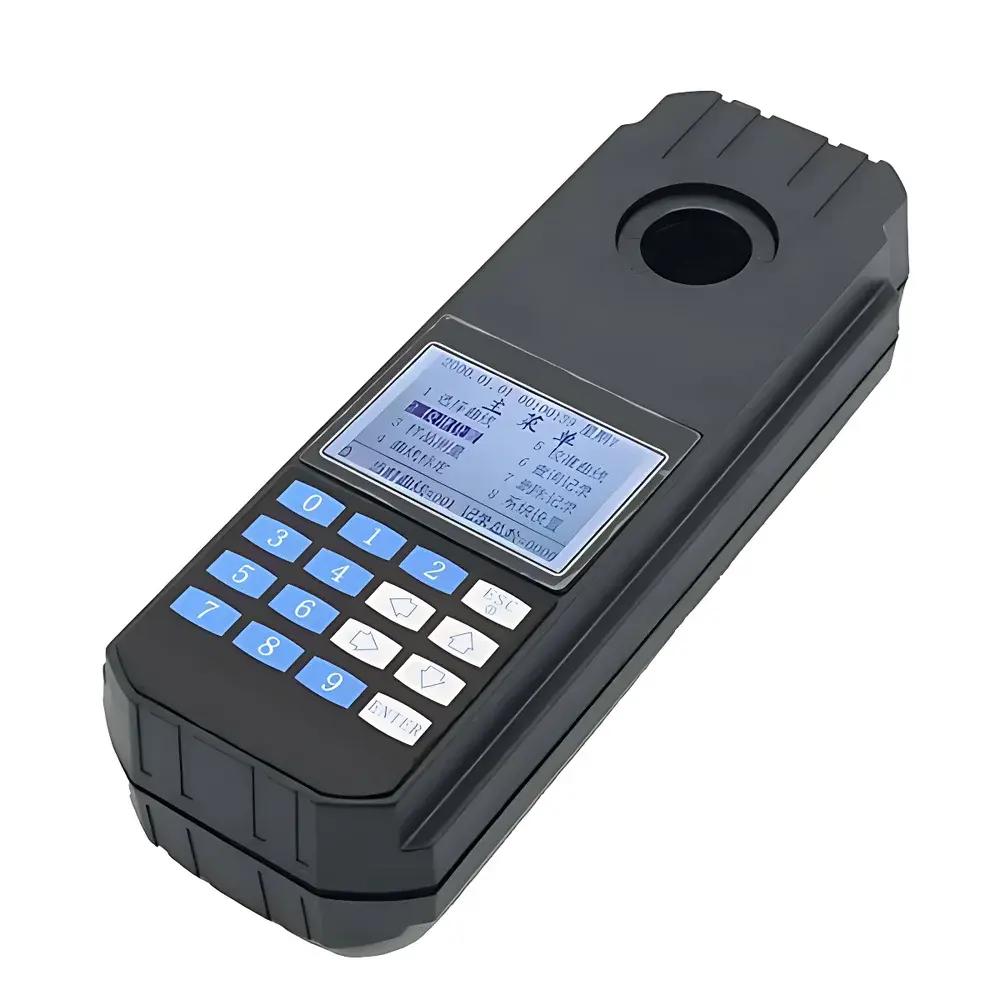
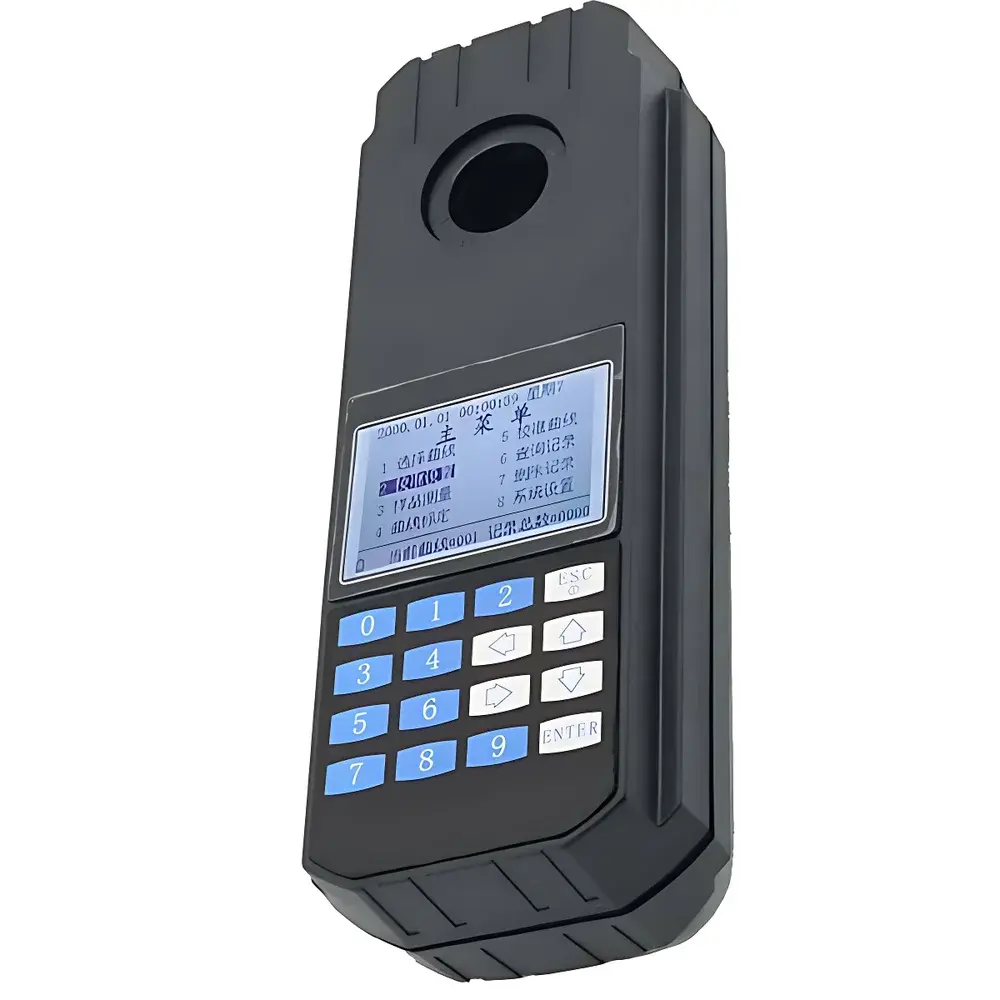
Shenchanghong CHMO-123 Portable Molybdenum Photometer
| Brand | Shenchanghong |
|---|---|
| Origin | Guangdong, China |
| Manufacturer Type | Direct Manufacturer |
| Country of Origin | China |
| Model | CHMO-123 |
| Instrument Type | Benchtop Laboratory Photometer |
| Detection Principle | Colorimetric Photometry (Absorption Spectrophotometry at Fixed Wavelength) |
| Target Analyte | Molybdenum (Mo) in Aqueous Samples |
| Measurement Range | 0.05–1.0 mg/L |
| Accuracy | ≤ ±5% of Full Scale |
| Repeatability | ≤ 3% RSD |
| Optical Stability | Absorbance Drift < 0.002 A within 20 min |
| Resolution | 0.05 mg/L |
| Dimensions (H×W×D) | 130 mm × 266 mm × 200 mm |
| Weight | < 1.0 kg |
| Operating Temperature | 5–40 °C |
| Relative Humidity | ≤ 85% RH (non-condensing) |
| Power Supply | AC 220 V ± 10%, 50 Hz ± 0.5 Hz |
| Light Source | High-intensity, Long-life (100,000 h) Monochromatic LED |
| Optical System | Precision Narrow-band Interference Filter |
| Display | Backlit LCD with Chinese Menu Interface |
| Data Storage | Internal Non-volatile Memory for Calibration Curves & Measurement History |
| Housing Material | Corrosion-resistant ABS Polymer |
| Microcontroller | Low-power 16-bit MCU Architecture |
Overview
The Shenchanghong CHMO-123 Portable Molybdenum Photometer is a dedicated benchtop analytical instrument engineered for the quantitative determination of molybdenum (Mo) in aqueous environmental and industrial samples using standardized colorimetric photometry. Based on the principle of absorption spectrophotometry at a fixed wavelength—typically selected to match the maximum absorbance peak of the Mo–complex formed with a specific chromogenic reagent (e.g., thiocyanate or diethylaminedithiocarbamate under controlled acidic conditions)—the CHMO-123 delivers trace-level quantification within the validated range of 0.05 to 1.0 mg/L. Its optical architecture integrates a high-stability monochromatic LED light source and a narrow-band interference filter to minimize spectral interference from turbidity, colored organics, or coexisting metal ions—critical for reliable performance in complex matrices such as municipal wastewater, industrial effluents, and surface water with variable background chemistry. Designed for routine compliance monitoring and field-deployable lab use, the instrument meets foundational requirements for method reproducibility and operational robustness in non-GMP but quality-conscious environmental testing environments.
Key Features
- Stable optical platform: 100,000-hour lifetime monochromatic LED combined with precision narrow-band filtering ensures long-term photometric consistency and minimal drift (<0.002 A over 20 minutes).
- Dedicated molybdenum assay protocol: Pre-optimized reaction kinetics and reagent formulation support rapid, single-step color development with total analysis time ≤20 minutes per sample.
- User-configurable calibration: Supports both factory-loaded calibration curves and user-defined multi-point standard curves stored in non-volatile memory—enabling method adaptation across varying regulatory or internal QA/QC requirements.
- Intuitive human interface: Backlit LCD display with full Chinese menu navigation simplifies operation for technicians without advanced spectroscopy training.
- Robust mechanical design: Injection-molded ABS housing provides resistance to chemical splashes, humidity, and incidental mechanical stress—suitable for shared laboratory or mobile deployment scenarios.
- Low-power embedded architecture: 16-bit microcontroller enables precise analog-to-digital conversion, real-time signal averaging, and stable baseline correction without external computing hardware.
Sample Compatibility & Compliance
The CHMO-123 is validated for direct analysis of clarified or filtered aqueous samples including potable water, groundwater, surface water (rivers, lakes), municipal wastewater, and industrial process discharges. Sample pretreatment—such as acid digestion or masking agent addition—is not required for most routine applications, though high-turbidity or strongly chelated matrices may necessitate filtration or pH adjustment per standard method guidance (e.g., EPA Method 200.7 adaptations). While not certified to ISO/IEC 17025 or accredited under formal third-party schemes, the instrument’s documented accuracy (≤±5%), repeatability (≤3% RSD), and optical stability align with typical internal QA/QC thresholds used in environmental laboratories conducting self-verified monitoring per national discharge standards (e.g., China’s GB 3838–2002 or GB/T 5750.6–2023). It supports documentation traceability through onboard data logging but does not include FDA 21 CFR Part 11-compliant electronic signature or audit trail functionality.
Software & Data Management
The CHMO-123 operates autonomously via its integrated firmware; no external PC connection or proprietary software installation is required for basic operation or data retrieval. All measurement results—including date/time stamp, concentration value, and associated calibration ID—are retained in internal flash memory with capacity sufficient for ≥500 test records. Users may export calibration curve parameters and raw absorbance values manually via visual readout or printed report (when paired with optional thermal printer accessories). The system permits storage of up to three independent calibration curves simultaneously—facilitating quick switching between different reagent lots or matrix-specific calibrations. Data integrity is preserved through power-fail recovery logic and write-protected memory sectors. Firmware updates are performed locally via USB interface (optional adapter), supporting ongoing alignment with evolving national method revisions.
Applications
- Regulatory compliance monitoring of molybdenum discharge limits in industrial effluent permits (e.g., electroplating, catalyst manufacturing, metallurgical processing).
- Drinking water safety verification in distribution systems where Mo leaching from stainless steel piping or corrosion inhibitors is suspected.
- Environmental impact assessment of mining-affected waters and tailings pond seepage.
- Process control in water treatment facilities employing molybdate-based corrosion inhibitors.
- Educational laboratory instruction for instrumental analysis, environmental chemistry, and water quality principles.
FAQ
What is the recommended sample preparation procedure prior to analysis?
Samples should be free of suspended solids; filtration through a 0.45 µm membrane filter is advised for turbid or particulate-laden waters. No acid digestion is required for soluble molybdenum species detection.
Can the CHMO-123 measure other metals besides molybdenum?
No—the optical path, filter bandwidth, and preloaded reagent chemistry are specifically optimized for molybdenum. Cross-reactivity with vanadium or tungsten may occur; therefore, the instrument is analyte-specific and not a multi-metal platform.
Is the instrument suitable for field use outside the laboratory?
While portable in size and weight (<1 kg), the CHMO-123 requires stable AC mains power and controlled ambient conditions (5–40 °C, ≤85% RH, no direct sunlight); it is not battery-operated nor IP-rated for outdoor deployment.
How often must the calibration curve be verified or renewed?
Per standard practice, calibration verification with a mid-range standard should be performed before each analytical batch; full recalibration is recommended daily or when reagent lot numbers change.
Does the device comply with ASTM or ISO standard methods?
The CHMO-123 implements photometric methodology consistent with the technical basis of ISO 6878:2004 (water quality — determination of molybdenum — spectrophotometric method), though it is not formally certified to that standard. Validation data meet typical acceptance criteria outlined in EPA SW-846 Method 7000 series derivations.
Related Products







