
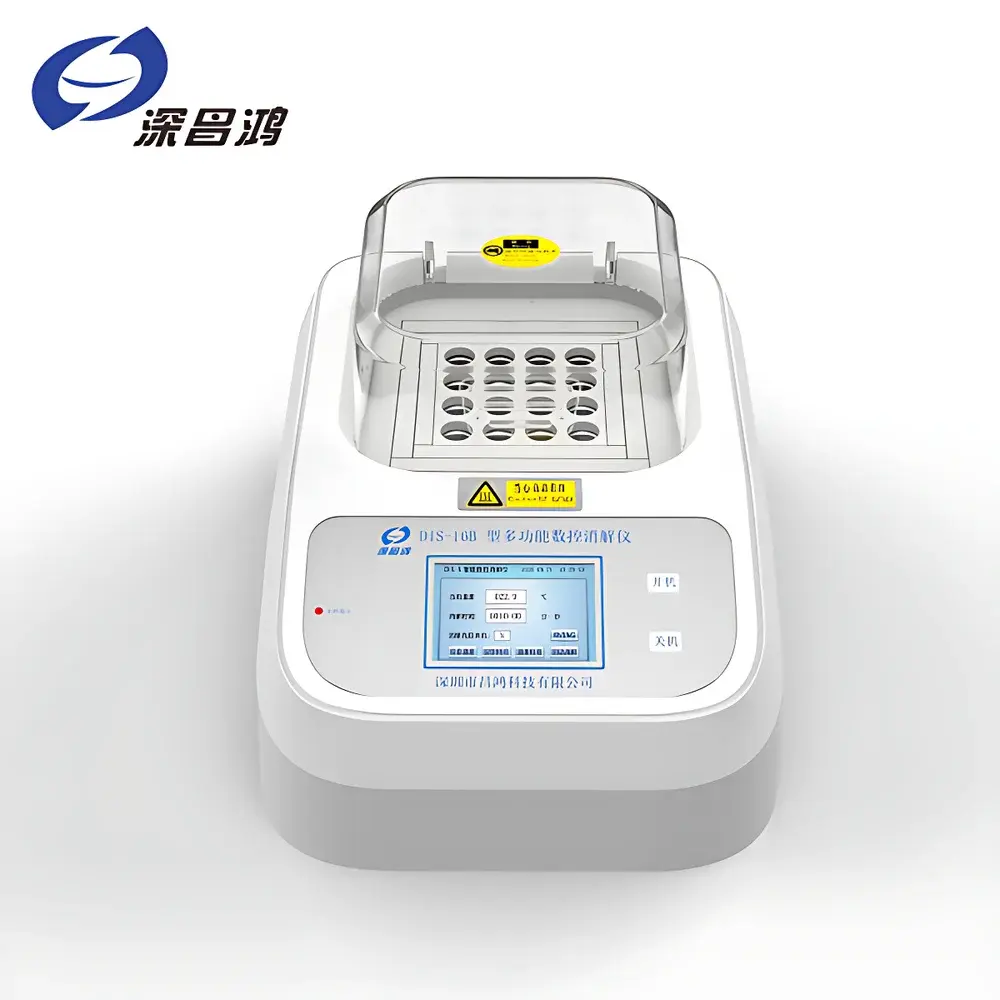
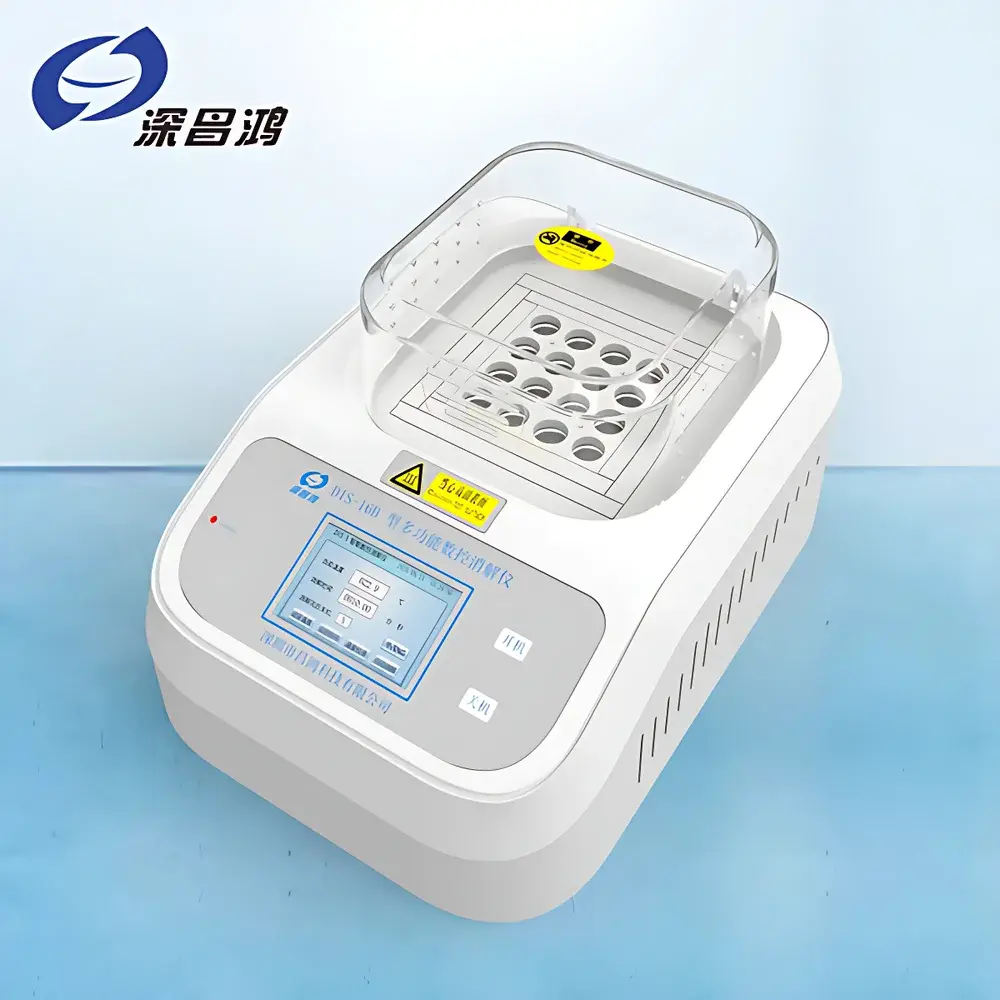
Shenchanghong DIS-16B/20B/25B/36B Multi-Function Digital COD Digestion System
| Brand | Shenchanghong |
|---|---|
| Origin | Guangdong, China |
| Manufacturer Type | Direct Manufacturer |
| Model | DIS-16B / DIS-20B / DIS-25B / DIS-36B |
| Heating Block | Single aluminum alloy block |
| Batch Capacity | 16 / 20 / 25 / 36 × φ16 mm digestion tubes |
| Temperature Range | Ambient to 200 °C |
| Temperature Accuracy | ±0.5 °C |
| Timing Accuracy | 0.1 s/hour |
| Display | 3.5″ color touchscreen (Chinese/English switchable) |
| Power Supply | AC 220 V ±10%, 50 Hz |
| Rated Power | 500 W |
| Housing | Corrosion-resistant coated metal enclosure |
| Safety Features | Dual-stage thermal cutoff (auto-shutdown at >200 °C), reinforced borosilicate glass tube compatibility |
Overview
The Shenchanghong DIS-16B/20B/25B/36B Multi-Function Digital COD Digestion System is a benchtop thermal digestion platform engineered for standardized chemical oxidation of water and wastewater samples in accordance with internationally recognized methods—including ISO 6060, APHA Standard Methods 5220D (Closed Reflux, Colorimetric), and HJ 828–2017 (China’s standard method for COD determination). It employs precise resistive heating within a single high-thermal-conductivity aluminum alloy block to deliver uniform, reproducible temperature profiles across all digestion positions. Designed for routine compliance testing in environmental laboratories, municipal wastewater treatment plants, and industrial effluent monitoring facilities, the system supports digestion protocols for chemical oxygen demand (COD), total phosphorus (TP), total nitrogen (TN), and hexavalent chromium (Cr(VI))—all requiring controlled thermal activation in acidic, oxidizing media (e.g., K2Cr2O7/H2SO4). Its architecture eliminates manual intervention during the critical heating phase, reducing operator variability and improving inter-laboratory data comparability.
Key Features
- High-precision digital temperature control with ±0.5 °C accuracy across the full 0–200 °C range, verified via multi-point calibration against NIST-traceable reference thermometers
- Single integrated heating block with optimized thermal mass and low thermal inertia—reaches setpoint in ≤15 minutes and maintains stability <±0.3 °C over 2-hour dwell periods
- Dual-layer safety architecture: primary PID-controlled regulation + independent mechanical thermal cutoff at 200 °C to prevent overheating under fault conditions
- Corrosion-resistant housing with powder-coated steel enclosure and sealed electronics compartment, rated for continuous operation in humid, chemically aggressive lab environments
- 3.5-inch capacitive color touchscreen with intuitive icon-driven interface; supports one-touch language toggle between English and Simplified Chinese
- Programmable timer with 0.1 s/hour drift specification and user-defined auto-shutdown—ensures strict adherence to digestion time windows required by regulatory methods
- Compatible with standard φ16 mm borosilicate glass digestion tubes (e.g., ASTM D1252-compliant), including imported tubes certified for rapid thermal cycling without fracture
Sample Compatibility & Compliance
The DIS-series accommodates up to 36 parallel samples using industry-standard 16-mm OD reaction tubes, enabling batch processing aligned with EPA 410.4, ISO 6060, and China’s HJ 828–2017 methodology requirements. Tube geometry ensures consistent heat transfer coefficients and minimizes convective stratification during reflux. All models support digestion volumes from 2.5 to 10 mL, compatible with both open-tube and capped digestion configurations. The system meets general laboratory safety standards per IEC 61010-1 (Electrical Equipment for Measurement, Control, and Laboratory Use) and incorporates design elements supporting GLP/GMP-aligned workflows—including non-volatile parameter logging, user-accessible calibration records, and tamper-evident configuration locks. While not FDA 21 CFR Part 11–certified out-of-the-box, audit trails can be exported in CSV format for integration into validated LIMS environments.
Software & Data Management
No proprietary software installation is required: all configuration, real-time monitoring, and method recall are managed locally via the embedded touchscreen controller. Each unit stores up to 100 user-defined digestion protocols—including temperature ramp rates, hold durations, and post-digestion cooling delays—with timestamped execution logs retained for ≥30 days. Parameter changes are logged with user ID (if enabled via optional network authentication module) and include pre/post-value snapshots. Export functionality supports USB flash drive transfer of log files and calibration certificates in PDF and CSV formats—facilitating traceability during internal audits or regulatory inspections. Firmware updates are delivered via secure HTTPS download and require manual validation before installation to maintain configuration integrity.
Applications
- Routine COD analysis in municipal wastewater influent/effluent and surface water monitoring programs
- Total phosphorus quantification via persulfate digestion (ISO 6878) prior to spectrophotometric detection
- Total nitrogen determination using alkaline potassium persulfate oxidation (ISO 11905-1)
- Hexavalent chromium digestion in electroplating and metal finishing wastewater per EPA Method 7196A
- Method development and validation studies requiring precise thermal profile replication across multiple sample sets
- Educational laboratories conducting APHA-standardized water quality experiments with documented thermal control
FAQ
What digestion tube specifications are supported?
The system is designed exclusively for φ16 mm outer diameter borosilicate glass tubes with standard 100–150 mm length; wall thickness ≥1.0 mm is recommended for repeated thermal cycling.
Can the instrument be integrated into a LIMS environment?
Direct API integration is not available; however, exported CSV logs and PDF calibration reports are structured for manual import into common LIMS platforms.
Is external ventilation required during operation?
No forced exhaust is needed under normal use, but placement in a well-ventilated fume hood is advised when digesting high-chloride or high-organic-content samples to manage acid vapors.
How often does the temperature sensor require recalibration?
Annual verification against a certified reference thermometer is recommended; multi-point calibration can be performed on-site using the built-in service mode.
Does the system comply with ISO/IEC 17025 documentation requirements?
Yes—the instrument supports generation of calibration certificates, operational logs, and method execution records that satisfy Clause 7.7 (Equipment Records) and Clause 7.8.2 (Measurement Traceability) of ISO/IEC 17025:2017.







