
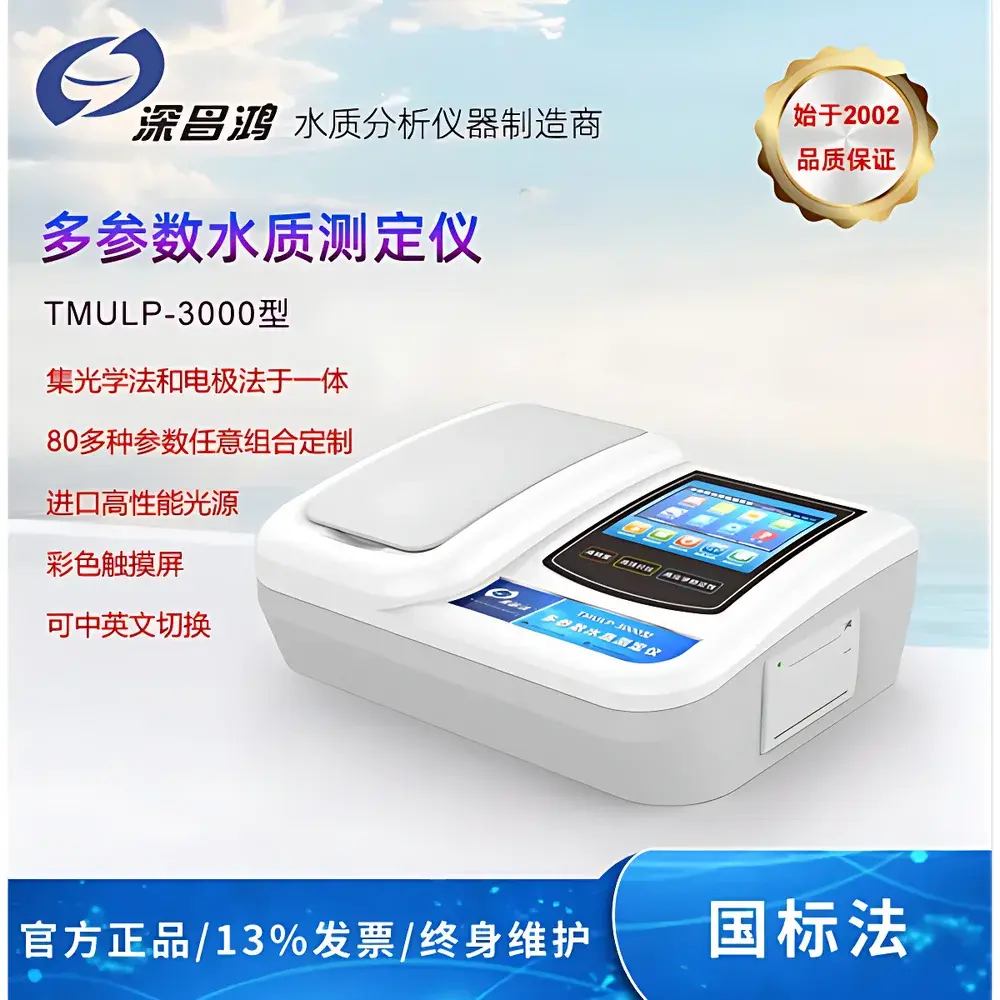
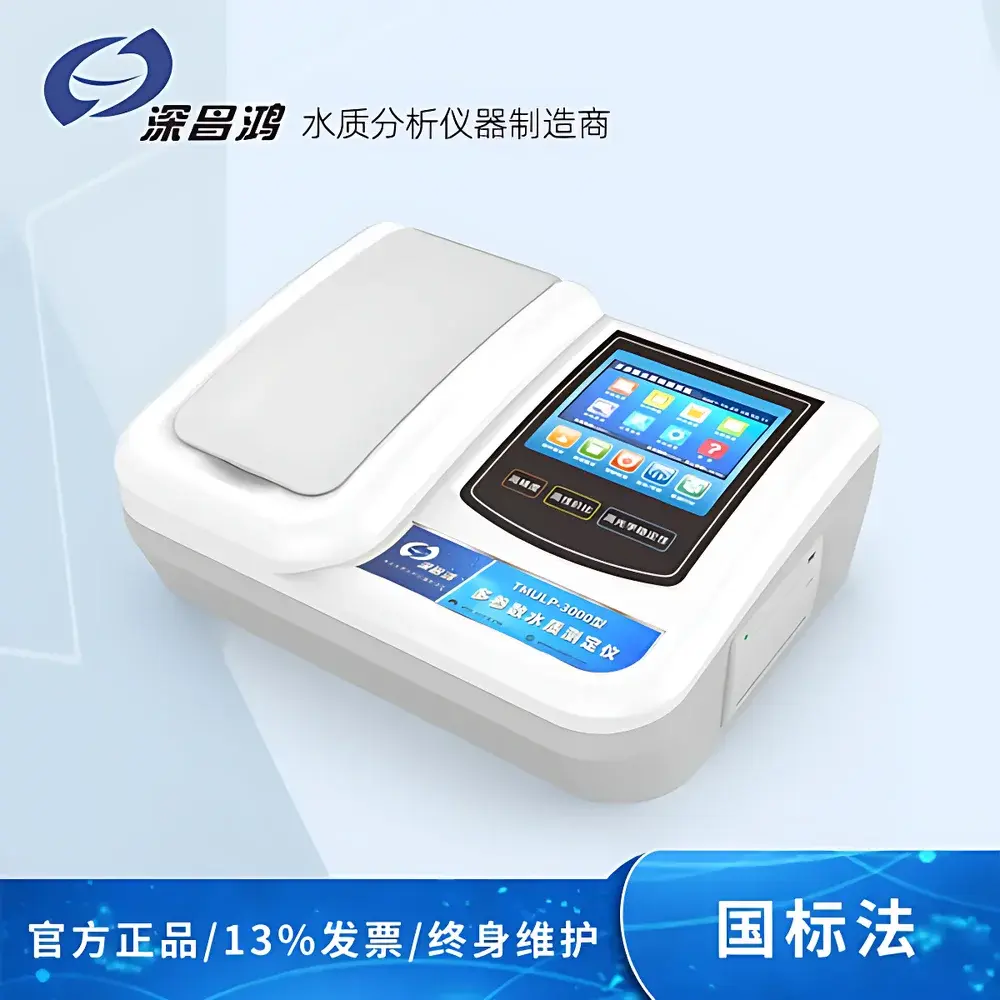
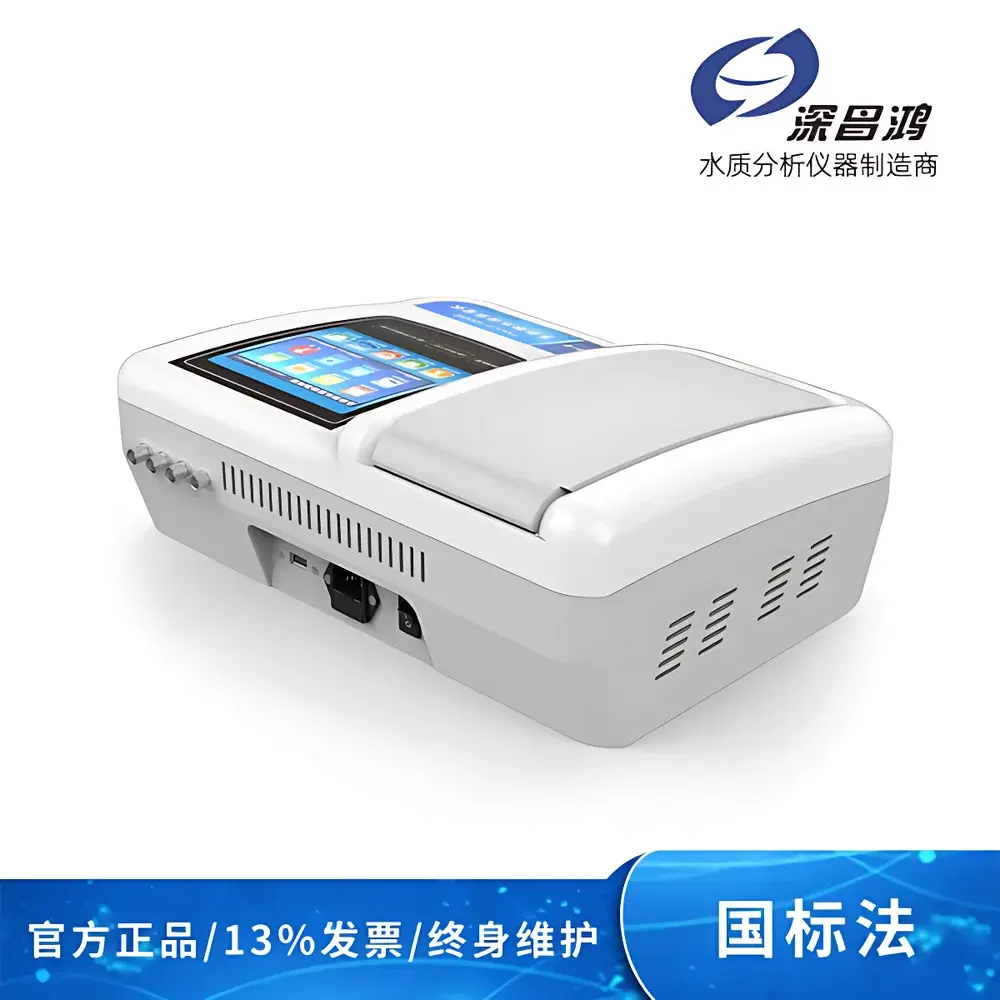
Shenchanghong TMULP-3000 Multi-Parameter Water Quality Analyzer
| Brand | Shenchanghong |
|---|---|
| Origin | Guangdong, China |
| Manufacturer Type | Direct Manufacturer |
| Product Category | Domestic |
| Model | TMULP-3000 |
| Instrument Type | Laboratory Benchtop Analyzer |
| Measurement Principle | Rapid Digestion (for COD) + Spectrophotometry (UV-Vis) + Electrochemical Sensing (pH, EC, DO, Temp) |
| Optical Channels | 4 / 8 / 12 / 16 (customizable 1–16) |
| Available Wavelengths | 340, 420, 440, 470, 520, 540, 560, 610, 630, 660, 680, 700 nm |
| Wavelength Accuracy | ±1 nm (center wavelength) |
| Absorbance Range | −2.000 to +2.000 A |
| Absorbance Linearity | ±0.002 A (0–1 A) |
| Absorbance Precision | ±0.005 A at 1 A |
| Repeatability | ≤±2% (spectrophotometric), ≤±3% (electrochemical) |
| Detection Limit (COD) | 0.1 mg/L |
| Measurement Time (per batch) | 15 min |
| Batch Capacity | 16 samples |
| Photometric Stability | ≤0.002 A / 20 min |
| Light Intensity Adjustment | 16-level programmable |
| Temperature Range (Operation) | 5–40 °C |
| Relative Humidity (Operation) | ≤90% RH |
| Storage Environment | −40 to +60 °C, ≤90% RH |
| Display | Color TFT Touchscreen (bilingual: English/Chinese) |
| Power Supply | AC 220 V (165–240 V), 30 W |
| Dimensions | 400 × 300 × 140 mm |
| Weight | 2.6 kg |
| Host Power Consumption | <10 W |
Overview
The Shenchanghong TMULP-3000 Multi-Parameter Water Quality Analyzer is a laboratory-grade benchtop instrument engineered for simultaneous, high-reproducibility quantification of up to 82 water quality parameters—including chemical oxygen demand (COD), ammonia nitrogen, total phosphorus, total nitrogen, heavy metals, anions, and physicochemical properties such as pH, conductivity, dissolved oxygen (DO), and temperature. It integrates three complementary analytical methodologies: (1) spectrophotometry based on the Beer-Lambert law using discrete-wavelength LED sources (340–700 nm), (2) rapid thermal digestion (in accordance with ISO 6060 and EPA 410.4 for COD determination), and (3) electrochemical sensing via calibrated, replaceable electrodes. The system supports both colorimetric (16-mm and 25-mm tubes, cuvettes) and electrode-based measurement modes within a single platform—eliminating inter-instrument variability and streamlining multi-parameter workflows in environmental testing laboratories, municipal water plants, and academic research facilities.
Key Features
- Modular optical architecture with selectable 4-, 8-, 12-, or 16-channel configurations; custom channel counts (1–16) available upon request.
- Pre-programmed wavelength library (12 fixed wavelengths) with automatic wavelength selection per assay—reducing operator error and method setup time.
- 16-level adjustable LED light intensity to optimize signal-to-noise ratio across low- and high-absorbance ranges, extending dynamic measurement capability without hardware modification.
- Color TFT touchscreen interface with intuitive bilingual (English/Chinese) navigation, embedded contextual help, and guided calibration prompts.
- Comprehensive curve management: 250 factory-loaded calibration curves + capacity for 3,500 user-defined curves; full traceability including standard concentration values, corresponding absorbance readings, calibration date, and operator ID.
- Data storage for up to 100,000 records, each containing parameter name, measured concentration, unit, timestamp, and operator code—fully compliant with GLP documentation requirements.
- Dual calibration algorithms: linear and segmented (multi-point) fitting to accommodate non-linear response profiles—critical for accurate quantification of parameters such as nitrate, phosphate, and heavy metals.
- Built-in security protocols: password-protected system access, configuration lockout, and encrypted backup/restore of calibration data and measurement history.
- Robust environmental tolerance: operational range 5–40 °C, ≤90% RH; storage range −40 to +60 °C—suitable for controlled lab environments and field-deployed mobile labs.
Sample Compatibility & Compliance
The TMULP-3000 accommodates standard 16-mm and 25-mm round glass or plastic colorimetric tubes, as well as rectangular quartz or plastic cuvettes (for turbidity, color, and suspended solids). Electrode-based measurements utilize industry-standard BNC and mini-DIN connectors compatible with interchangeable pH, conductivity, DO, and temperature probes. All spectrophotometric methods align with internationally recognized standards, including ISO 6060 (COD by dichromate), ISO 7888 (conductivity), ISO 5814 (electrochemical DO), and ASTM D1293 (pH). The instrument’s data integrity architecture supports audit-ready operation under GLP and GMP frameworks, with optional timestamped electronic signatures and configurable audit trails meeting FDA 21 CFR Part 11 requirements when integrated with validated LIMS software.
Software & Data Management
Data acquisition, calibration, and reporting are managed via the embedded firmware and optional PC-based software suite (supplied on USB drive). Raw absorbance and electrode output values are stored with metadata (operator ID, method ID, sample ID, ambient conditions). Export formats include CSV and Excel-compatible .xls for seamless integration into laboratory information management systems (LIMS) or statistical analysis tools (e.g., JMP, Minitab). The system supports direct printing of individual results or paginated reports, with customizable templates for regulatory submission. Firmware updates are delivered via USB; all calibration and measurement logs are digitally signed and tamper-evident. Backup files are encrypted and retain full traceability—including original calibration points, curve equations, and uncertainty estimates.
Applications
The TMULP-3000 serves routine and regulatory water quality testing across diverse sectors: municipal drinking water treatment (compliance with WHO Guidelines and GB 5749-2022), wastewater effluent monitoring (per national discharge standards and EU Urban Wastewater Treatment Directive), industrial process water control (e.g., power plant cooling loops, semiconductor rinse water), environmental impact assessments (surface and groundwater surveys), and academic environmental chemistry research. Its broad parameter coverage—from conventional indicators (COD, NH₃-N, TP) to emerging contaminants (cyanide, formaldehyde, hydrazine, surfactants)—enables comprehensive water matrix profiling without cross-platform method translation. The 15-minute batch processing time for 16 samples enhances throughput in high-volume QA/QC labs.
FAQ
What digestion method does the TMULP-3000 use for COD analysis?
It employs rapid closed-vessel thermal digestion (165 °C, 15 min) compliant with ISO 6060 and EPA Method 410.4, using potassium dichromate under acidic conditions.
Can the instrument perform simultaneous electrochemical and photometric measurements?
No—measurements are sequential per sample but fully automated; electrochemical sensors (pH, EC, DO, Temp) are used independently from spectrophotometric assays.
Is method validation support provided?
Yes—each preloaded method includes reference standard concentrations, recovery expectations, and precision targets aligned with ISO/IEC 17025 guidance for method verification.
How is data integrity ensured during long-term operation?
All measurements are timestamped, operator-tagged, and stored with checksum-verified backups; firmware enforces write-once logging for audit trail compliance.
Are replacement electrodes and consumables available through international distributors?
Yes—Shenchanghong maintains certified distribution partners in North America, EMEA, and APAC regions; electrode models meet IP67 rating and have documented shelf life and recalibration intervals.
Related Products







