
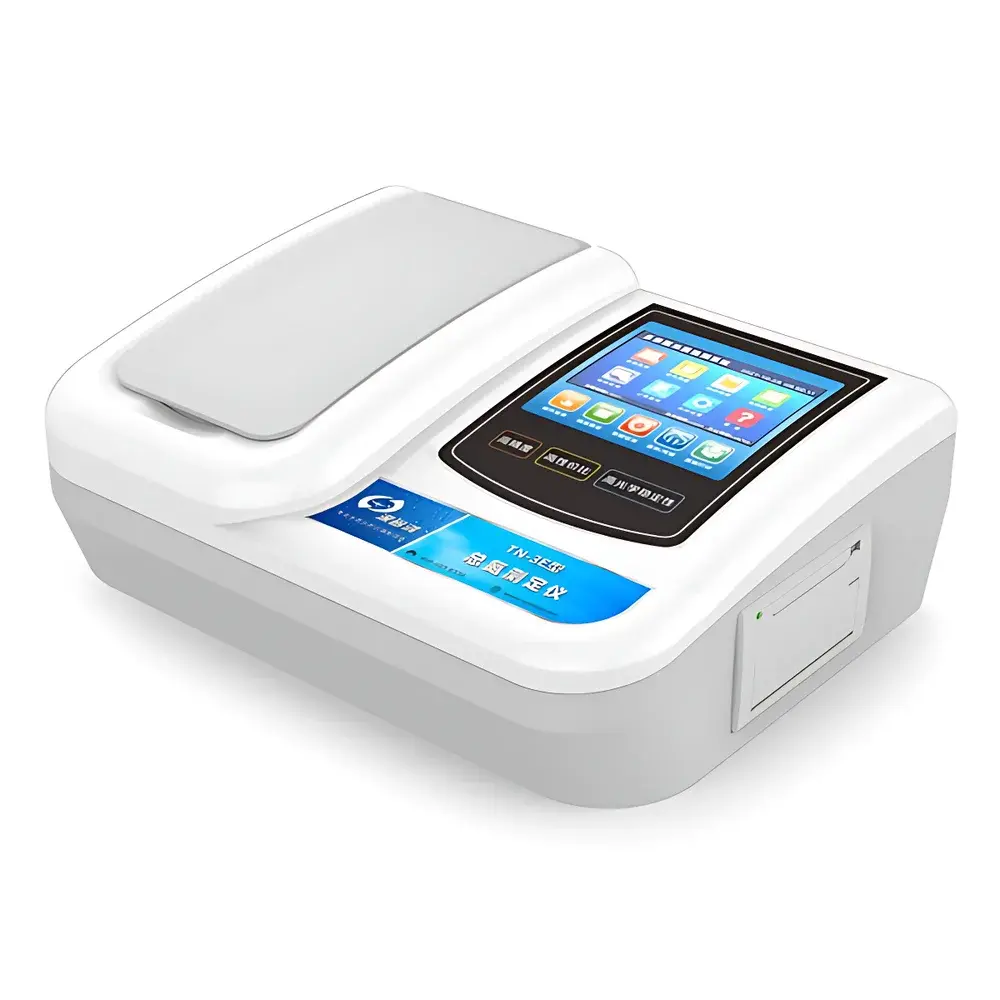
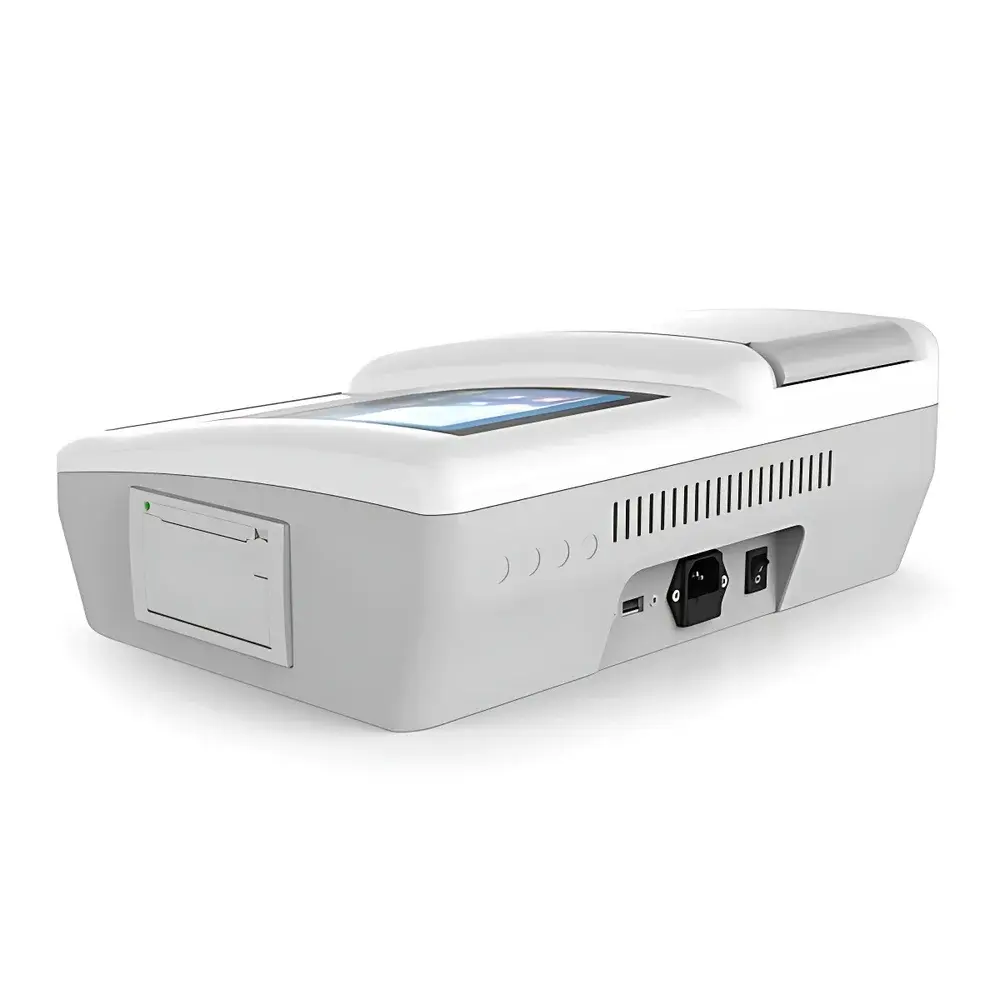
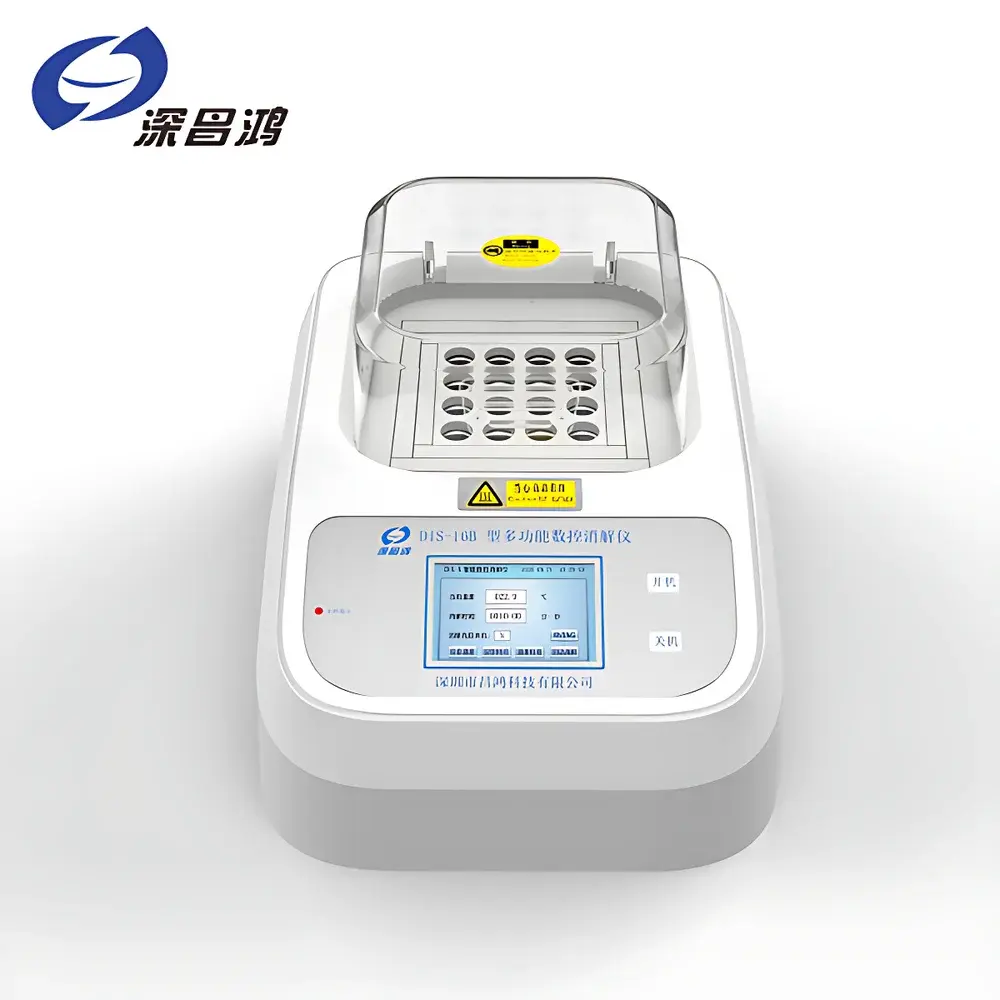
Shenchanghong TN-3E Total Nitrogen Analyzer
| Brand | Shenchanghong |
|---|---|
| Origin | Guangdong, China |
| Manufacturer Type | Manufacturer |
| Product Category | Domestic |
| Model | TN-3E |
| Price | ¥11,800 |
| Measured Parameter | Total Nitrogen |
| Instrument Type | Laboratory Benchtop Analyzer |
| Measurement Principle | Alkaline Potassium Persulfate UV Digestion & Spectrophotometric Detection (220 nm & 275 nm) |
| Measurement Range | 0.05–100 mg/L |
| Accuracy | ≤ ±5% of Full Scale |
| Detection Limit | 0.01 mg/L |
| Resolution | Color Touchscreen Display with English/Chinese Interface |
| Digestion Temperature | 125 °C |
| Digestion Time | 30 min |
| Temperature Control Range | Ambient to 200 °C (adjustable) |
| Optical Stability | ≤ 0.002 A / 20 min |
| Absorbance Error | ≤ ±5% F.S. |
| Repeatability | ≤ 3% RSD |
| Sample Throughput | 16 samples per batch (optional 20/25/36-position blocks) |
| Weight | Analyzer: 2.6 kg |
| Digestion Unit | 5.5 kg |
| Power Consumption | < 500 W |
| Dimensions (Analyzer) | 400 × 300 × 140 mm |
| (Digestor, w/o shield) | 260 × 355 × 135 mm |
| Operating Environment | 5–40 °C, RH ≤ 85%, AC (220 ± 22) V, (50 ± 0.5) Hz |
| Data Storage Capacity | 100,000 records (including parameter name, concentration, unit, timestamp, operator ID) |
| Calibration Curves | Up to 3,500 user-defined curves + 250 factory preloaded |
| Connectivity | USB port for PC data export |
| Output | Built-in thermal printer support |
Overview
The Shenchanghong TN-3E Total Nitrogen Analyzer is a dedicated benchtop laboratory instrument engineered for precise, reliable quantification of total nitrogen (TN) in aqueous environmental matrices. It implements the standardized alkaline potassium persulfate digestion method (in accordance with HJ 636–2012 and ISO 11905-1:1997), followed by dual-wavelength spectrophotometric detection at 220 nm and 275 nm to correct for nitrate interference. This approach ensures high specificity and minimizes matrix effects commonly observed in complex water samples—including surface water, groundwater, municipal wastewater, and industrial effluents. The system separates digestion and optical measurement functions into two independent modules, eliminating thermal cross-talk and enhancing long-term photometric stability. Its cold-light, narrow-band interference optical architecture delivers consistent performance across the full 0.05–100 mg/L measurement range, with an instrumental detection limit of 0.01 mg/L and optical drift ≤ 0.002 A over 20 minutes.
Key Features
- Modular design: Independent digestion unit and analyzer ensure optical stability and extend lamp lifetime.
- Cold-light source with 16-step adjustable intensity calibration—enables dynamic optimization of signal-to-noise ratio for low- and high-concentration samples without hardware modification.
- High-resolution color touchscreen interface with bilingual (English/Chinese) operation menus and context-sensitive on-screen guidance for all workflows.
- Advanced temperature control in the digestion module: multi-point non-linear calibration eliminates sensor-induced offset; programmable ramping and auto-shutdown after completion enhance reproducibility and safety.
- Dual-layer thermal protection: automatic power cutoff at >200 °C prevents overheating and ensures compliance with IEC 61010-1 safety requirements.
- Comprehensive curve management: supports up to 3,500 user-defined calibration curves; each curve stores full metadata—including standard values, corresponding absorbances, calibration date, and operator ID—for full traceability.
- Robust data governance: 100,000-record internal storage with timestamp, concentration, unit, parameter name, and operator ID fields; supports GLP-compliant audit trails.
- USB connectivity enables direct data transfer to LIMS or Excel-compatible spreadsheets; optional thermal printer provides immediate hardcopy output of results and QC reports.
Sample Compatibility & Compliance
The TN-3E is validated for use with raw and pretreated water samples conforming to national and international regulatory frameworks including China’s HJ 636–2012, EPA Method 351.2, and ISO 11905-1:1997. It accommodates standard 16 mm borosilicate glass digestion tubes (10 mm pathlength cuvettes for measurement) and supports optional high-capacity digestion blocks (20/25/36 positions) for increased throughput. All reagents—including proprietary alkaline persulfate digestion solution and catalyst—are supplied as pre-formulated kits to minimize preparation error and ensure lot-to-lot consistency. The instrument meets electromagnetic compatibility (EMC) Class B requirements per GB/T 18268.1–2010 and operates safely within ambient conditions of 5–40 °C and ≤85% RH.
Software & Data Management
The embedded firmware supports full data lifecycle management: from sample ID entry and method selection to automated blank subtraction, dual-wavelength correction, and real-time concentration calculation. Each stored record includes mandatory fields for analyst ID, calibration status flag, digestion parameters, and measurement time—enabling retrospective review in line with ISO/IEC 17025 and FDA 21 CFR Part 11 principles (when used with external audit-trail-enabled LIMS). USB export generates CSV files containing raw absorbance values, corrected concentrations, QC flags, and metadata—compatible with statistical process control (SPC) software and laboratory information management systems. The “one-click restore” function preserves method integrity during unexpected power loss or configuration errors.
Applications
The TN-3E serves routine and regulatory testing laboratories performing compliance monitoring under China’s Surface Water Environmental Quality Standards (GB 3838–2002), Wastewater Discharge Standards (GB 8978–1996), and municipal water treatment plant effluent reporting. It is routinely deployed in environmental monitoring stations, third-party testing labs, university research facilities, and industrial QA/QC departments evaluating nitrogen removal efficiency in biological nutrient removal (BNR) systems. Its robustness and ease of validation make it suitable for method transfer studies, inter-laboratory comparison programs, and proficiency testing schemes requiring documented repeatability (≤3% RSD) and accuracy (≤±5% F.S.).
FAQ
What digestion method does the TN-3E implement?
It uses alkaline potassium persulfate oxidation at 125 °C for 30 minutes, followed by UV spectrophotometric detection at 220 nm and 275 nm.
Is the instrument compliant with international standards?
Yes—it aligns with ISO 11905-1:1997, EPA Method 351.2, and China’s HJ 636–2012 for total nitrogen determination.
Can calibration curves be exported or backed up externally?
Calibration data are stored internally; full curve metadata (standards, absorbances, timestamps) can be exported via USB in CSV format.
Does the system support audit trail functionality?
While the instrument itself does not generate electronic signatures, its structured data export format (including operator ID and timestamps) supports integration into Part 11–compliant LIMS environments.
What maintenance is required for long-term accuracy?
Annual verification of digestion temperature uniformity and photometric linearity using NIST-traceable standards is recommended; optical path cleaning every 3 months ensures sustained absorbance stability.
Related Products







