
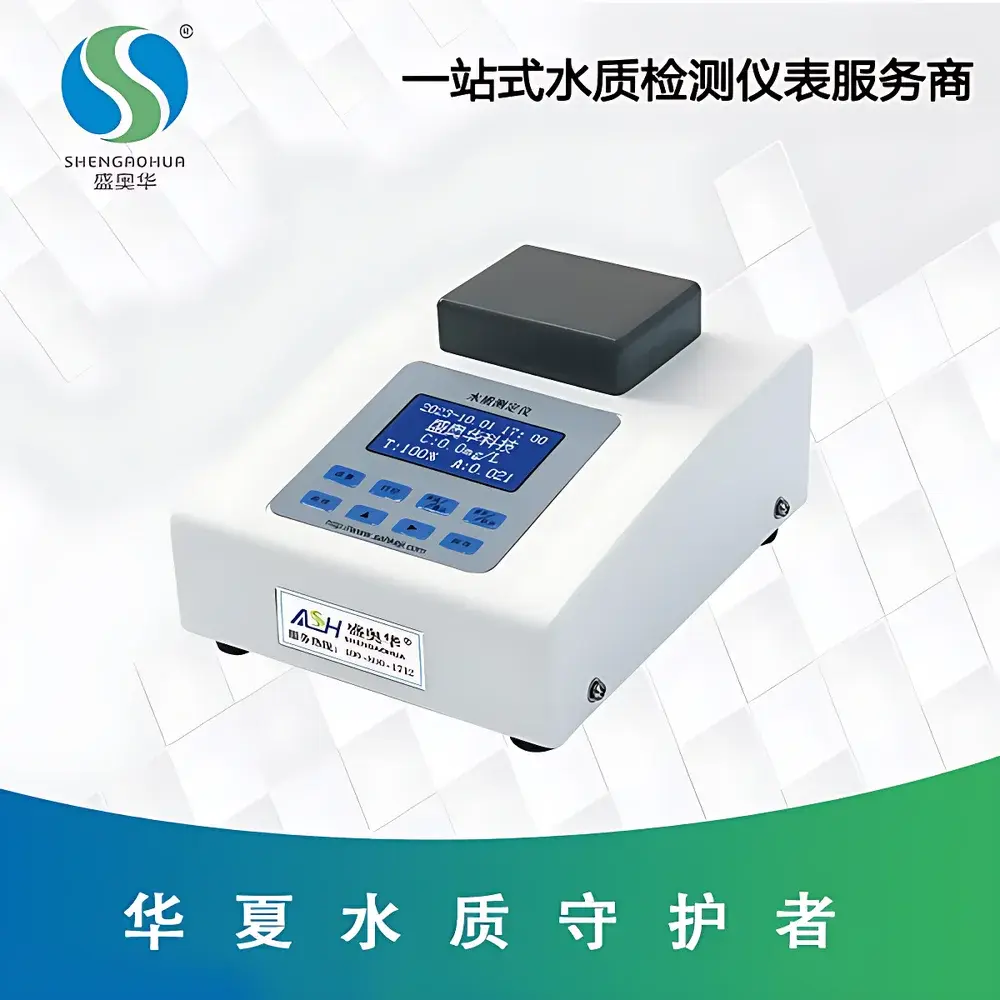
Shengaohua 6B-50H Formaldehyde Water Quality Analyzer
| Brand | Shengaohua |
|---|---|
| Origin | Jiangsu, China |
| Manufacturer Type | Direct Manufacturer |
| Product Category | Domestic |
| Model | 6B-50H |
| Instrument Type | Laboratory Water Quality Analyzer |
| Target Analyte | Formaldehyde |
| Measurement Range | 0–4 mg/L |
| Resolution | 0.0001 mg/L |
| Accuracy | ≤ ±5% FS ±1 digit |
| Repeatability | ≤ 2% |
| Light Source | Cold LED with Narrow-Band Interference Filter (Lifetime: 100,000 hours) |
| Display | Large LCD with Chinese GUI and Guided Menu Navigation |
| Data Handling | Built-in Standard Curve Library (User-Editable, Saveable, Modifiable) |
| Data Output | Direct Readout, Internal Storage, Query Function, Optional Thermal Printer Support |
| Power Supply | AC 220 V ±10%, 50 Hz |
Overview
The Shengaohua 6B-50H Formaldehyde Water Quality Analyzer is a dedicated laboratory-grade photometric instrument engineered for the quantitative determination of free formaldehyde in aqueous environmental samples. It operates on the principle of colorimetric analysis using the acetylacetone (AA) derivatization method—where formaldehyde reacts with acetylacetone under acidic conditions to form a yellow-colored 3,5-diacetyl-1,4-dihydrolutidine (DDL) complex. This complex exhibits strong absorbance at 412 nm, enabling highly selective quantification via narrow-band interference-filtered photometry. Designed for routine compliance monitoring and research applications, the 6B-50H delivers trace-level sensitivity (detection capability down to 0.0001 mg/L) and high measurement reproducibility (≤2% RSD), making it suitable for regulatory screening in municipal wastewater, industrial effluents, and surface water quality assessment.
Key Features
- Cold LED light source with integrated narrow-band interference filter centered at 412 nm—ensuring spectral stability, minimal thermal drift, and extended operational lifetime (>100,000 hours).
- Large backlit LCD display with intuitive Chinese-language guided menu interface—reducing operator training time and minimizing input errors during multi-step calibration or sample analysis.
- Onboard memory supporting multiple user-defined calibration curves—enabling rapid method switching between different sample matrices (e.g., low-turbidity drinking water vs. high-organic wastewater) without recalibration.
- High-resolution digital signal processing architecture achieving 0.0001 mg/L resolution across the full 0–4 mg/L linear dynamic range.
- Robust optical path design with fixed-pathlength cuvette holder (10 mm standard) and automatic zeroing function—enhancing long-term baseline stability and inter-laboratory comparability.
- Integrated data management system with timestamped storage capacity for up to 1,000 test records—including sample ID, date/time stamp, measured concentration, curve ID, and operator code (if enabled).
Sample Compatibility & Compliance
The 6B-50H is validated for use with clarified, non-turbid aqueous samples meeting standard pretreatment requirements per HJ 601–2011 (Chinese Environmental Protection Standard for Formaldehyde Determination in Water by Acetylacetone Spectrophotometry). It accommodates common interferences—including low concentrations of acetaldehyde (<0.5 mg/L), methanol (<50 mg/L), and chloride (<200 mg/L)—through optimized reaction pH control and reagent formulation. While not certified to ISO/IEC 17025 or EPA Method 400.1, its performance characteristics align with routine QA/QC protocols used in GLP-compliant environmental laboratories. The instrument supports audit-ready documentation when paired with optional thermal printer (model TP-200, sold separately), generating hard-copy reports compliant with internal record retention policies.
Software & Data Management
No external PC software is required for core operation; all calibration, measurement, and data review functions are executed onboard. Calibration curves may be constructed using up to 8 standard points, with linear or polynomial regression options. Each stored curve retains metadata including preparation date, analyst ID, and reference standard lot number. Data export is limited to manual printout or visual query via LCD navigation—no USB, Bluetooth, or network connectivity is provided. For laboratories requiring electronic data capture, integration with LIMS systems must be achieved via manual transcription or third-party OCR-based workflows. Firmware updates are performed locally using supplied USB programmer (not included).
Applications
- Regulatory monitoring of formaldehyde discharge limits in textile dyeing, leather tanning, and resin manufacturing effluents.
- Quality control testing of formaldehyde scavengers and preservative formulations in pharmaceutical and cosmetic production.
- Research-scale evaluation of advanced oxidation processes (AOPs) targeting formaldehyde degradation kinetics in pilot-scale wastewater treatment studies.
- Educational use in university environmental chemistry labs for teaching spectrophotometric assay development and analytical validation principles (linearity, LOD/LOQ, recovery, matrix effects).
- Field-deployable verification tool when operated from stable AC power in mobile environmental labs or monitoring stations equipped with uninterruptible power supplies.
FAQ
What is the recommended sample pretreatment for turbid or colored water matrices?
Centrifugation (3,000 rpm, 10 min) followed by membrane filtration (0.45 µm PVDF) is advised to remove suspended solids and humic interference prior to AA derivatization.
Does the instrument support automatic dilution or multi-range measurement?
No—the 6B-50H operates exclusively within the 0–4 mg/L range. Samples exceeding this limit require manual dilution using deionized water and subsequent correction of results.
Is the acetylacetone reagent supplied with the instrument?
Reagents are not included; users must procure certified-grade acetylacetone, ammonium acetate, and glacial acetic acid separately, following the protocol outlined in HJ 601–2011.
Can calibration curves be exported or backed up externally?
Curve parameters are stored internally only and cannot be transferred out. Users are advised to maintain paper or digital logs of curve coefficients and validation data independently.
What maintenance procedures are required to ensure optical accuracy over time?
Monthly cleaning of the cuvette chamber and optical window with lint-free tissue and ethanol; annual verification of LED intensity and filter transmittance using NIST-traceable neutral density filters (user-provided).
Related Products







