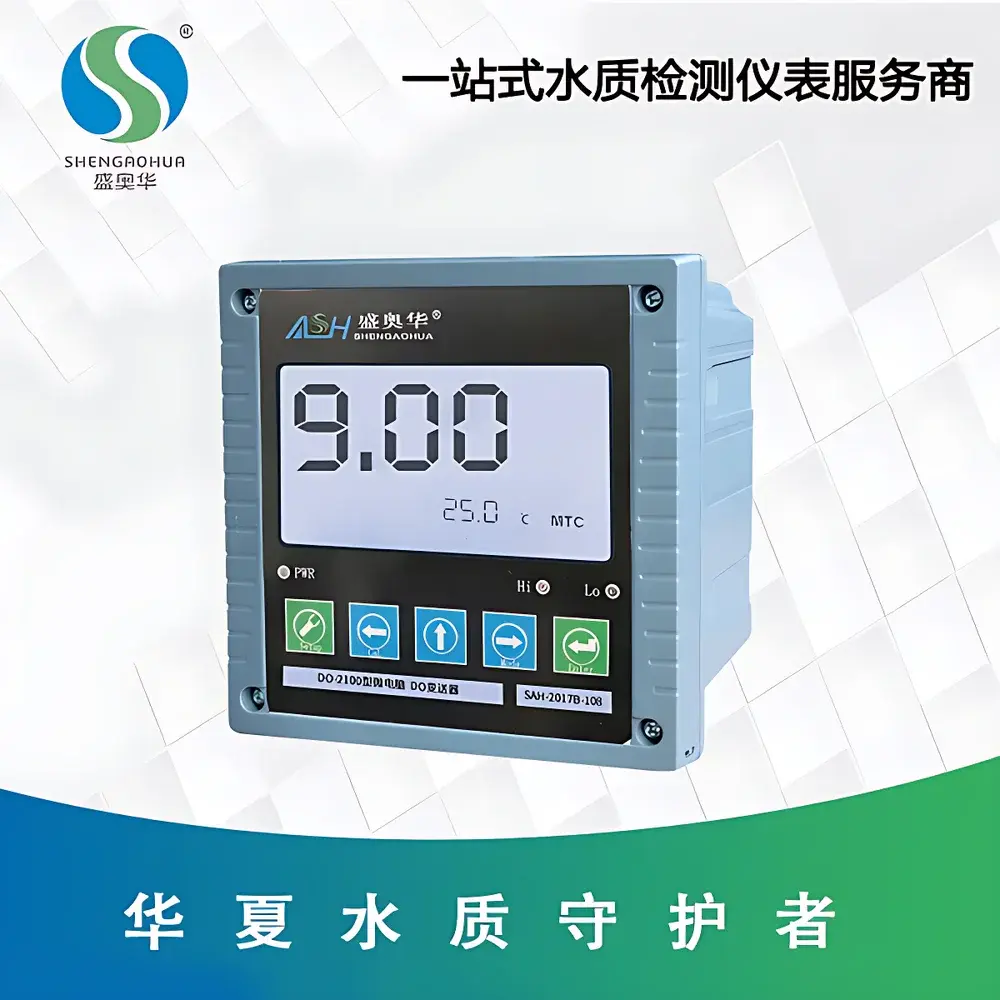
Shengaohua DO-2100 Online Dissolved Oxygen Analyzer
| Brand | Shengaohua |
|---|---|
| Origin | Jiangsu, China |
| Manufacturer Type | Direct Manufacturer |
| Country of Origin | China |
| Model | DO-2100 |
| Price Range | USD 1,400–4,200 (est.) |
| Resolution | 0.01 mg/L |
| Measurement Range | 0–20 mg/L |
| Repeatability | ±1% ±1 digit |
| Stability | ±1% ±1 digit |
| Temperature Compensation | Automatic, −5.0 to 55.0 °C |
| Communication Interface | Isolated 0/4–20 mA output (programmable for DO value) |
| Dimensions | 144 × 144 × 115 mm |
| Operating Ambient Temperature | −5 to 45 °C |
| Power Supply | 88–265 VAC, 50/60 Hz or 24 VDC optional |
| IP Rating | IP65 |
| Mounting Options | Panel mount (cutout 138 × 138 mm), wall mount, pipe clamp |
| Weight | 0.8 kg |
Overview
The Shengaohua DO-2100 Online Dissolved Oxygen Analyzer is an industrial-grade electrochemical sensor system engineered for continuous, real-time monitoring of dissolved oxygen (DO) concentration in aqueous process streams. It employs a polarographic (Clark-type) membrane-covered amperometric sensor principle, where molecular oxygen diffuses through a gas-permeable membrane and undergoes reduction at a cathode surface, generating a current linearly proportional to the partial pressure of O₂ in solution. This signal is digitally conditioned, temperature-compensated, and converted into a calibrated concentration output in mg/L (ppm). Designed for integration into municipal wastewater treatment plants, bioreactors, aquaculture systems, boiler feedwater circuits, and pharmaceutical water-for-injection (WFI) loops, the DO-2100 delivers stable, field-deployable performance under variable hydraulic and thermal conditions. Its robust front-end architecture supports long-term unattended operation with minimal drift, making it suitable for applications requiring compliance with ISO 5814, ASTM D888, and EN 25814 standards for dissolved oxygen measurement.
Key Features
- Polarographic DO sensing technology with replaceable membrane caps and electrolyte fill port for extended service life and on-site maintenance
- Automatic temperature compensation across −5.0 to 55.0 °C using integrated Pt1000 RTD sensor, eliminating manual correction errors
- Dual isolated 4–20 mA analog outputs: Channel 1 configurable for DO value (0–20 mg/L → 4–20 mA), Channel 2 for temperature (0–55 °C → 4–20 mA)
- Programmable relay outputs with adjustable high/low setpoints and hysteresis, supporting alarm signaling or pump control logic
- Manual pressure compensation (0.500–2.500 bar) and salinity compensation (0.0–70.0 ppt) to correct for site-specific environmental variables
- Wide-input power design (88–265 VAC, 50/60 Hz or optional 24 VDC) ensures compatibility with global industrial power infrastructures
- IP65-rated NEMA 4X enclosure with stainless steel front bezel and silicone-sealed display window for dust- and water-resistant operation
- Front-panel navigation via tactile membrane keys and dual-line LCD with backlight for low-visibility environments
Sample Compatibility & Compliance
The DO-2100 is validated for use in clean to moderately fouling aqueous media, including activated sludge effluent, clarified drinking water, recirculated aquaculture water, and purified process water. It is not recommended for highly viscous, abrasive, or strongly oxidizing chemical streams without protective flow cells or sample conditioning systems. Sensor calibration follows two-point protocol (zero-oxygen and air-saturated water), traceable to NIST-certified standards. The analyzer complies with electromagnetic compatibility (EMC) requirements per IEC 61326-1 and safety standards per IEC 61010-1. Its analog output architecture meets foundational requirements for integration into SCADA, DCS, and PLC-based control systems adhering to ISA-88 and ISA-95 frameworks. While not inherently 21 CFR Part 11 compliant, audit-trail-capable data logging can be implemented externally via compatible HMI or historian platforms.
Software & Data Management
The DO-2100 operates as a standalone field instrument with no embedded firmware update capability or USB connectivity. All configuration—including range scaling, relay thresholds, compensation parameters, and output mapping—is performed locally via the front-panel interface. No proprietary software or drivers are required. Process data is transmitted exclusively via analog signals; digital communication (e.g., Modbus RTU, HART) is not supported in standard configuration. For centralized data acquisition, integration with third-party data loggers or distributed control systems is achieved using the isolated 4–20 mA outputs, which maintain galvanic separation to prevent ground-loop interference. Calibration history and event logs (e.g., relay activation, sensor timeout) are retained in non-volatile memory and viewable on-screen but not exportable.
Applications
- Municipal and industrial wastewater treatment: Aeration basin control, denitrification monitoring, and effluent quality assurance
- Drinking water distribution: Residual oxygen verification post-disinfection and corrosion mitigation in storage tanks
- Pharmaceutical water systems: Monitoring of purified water (PW) and water-for-injection (WFI) loops per USP and EU GMP Annex 1 guidelines
- Aquaculture and hatchery operations: Real-time DO feedback for automated oxygen dosing and biomass health assessment
- Food and beverage processing: Fermentation tank supervision, CIP rinse validation, and cold storage water quality tracking
- Power plant boiler feedwater: Detection of ingress oxygen to prevent pitting corrosion in economizers and steam drums
FAQ
What type of sensor technology does the DO-2100 use?
It utilizes a Clark-type polarographic dissolved oxygen sensor with a Teflon-based gas-permeable membrane and aqueous KCl electrolyte.
Is the DO-2100 suitable for seawater applications?
Yes—when configured with salinity compensation (0.0–70.0 ppt) and paired with a marine-grade sensor cap, it supports accurate measurement in brackish and full-strength seawater.
Does the analyzer support automatic zero calibration?
No—it requires manual two-point calibration using nitrogen-purged water (zero) and air-saturated water (span); no built-in solenoid or reagent delivery system is included.
Can the DO-2100 be mounted directly in a wet outdoor environment?
Yes—the IP65 enclosure permits installation in covered outdoor locations or indoor wet-process areas, though direct rain exposure or submersion is not permitted.
What is the expected service life of the DO sensor membrane?
Under typical municipal wastewater conditions, membrane and electrolyte replacement is recommended every 3–6 months; lifespan extends to 12+ months in clean, low-fouling applications.