
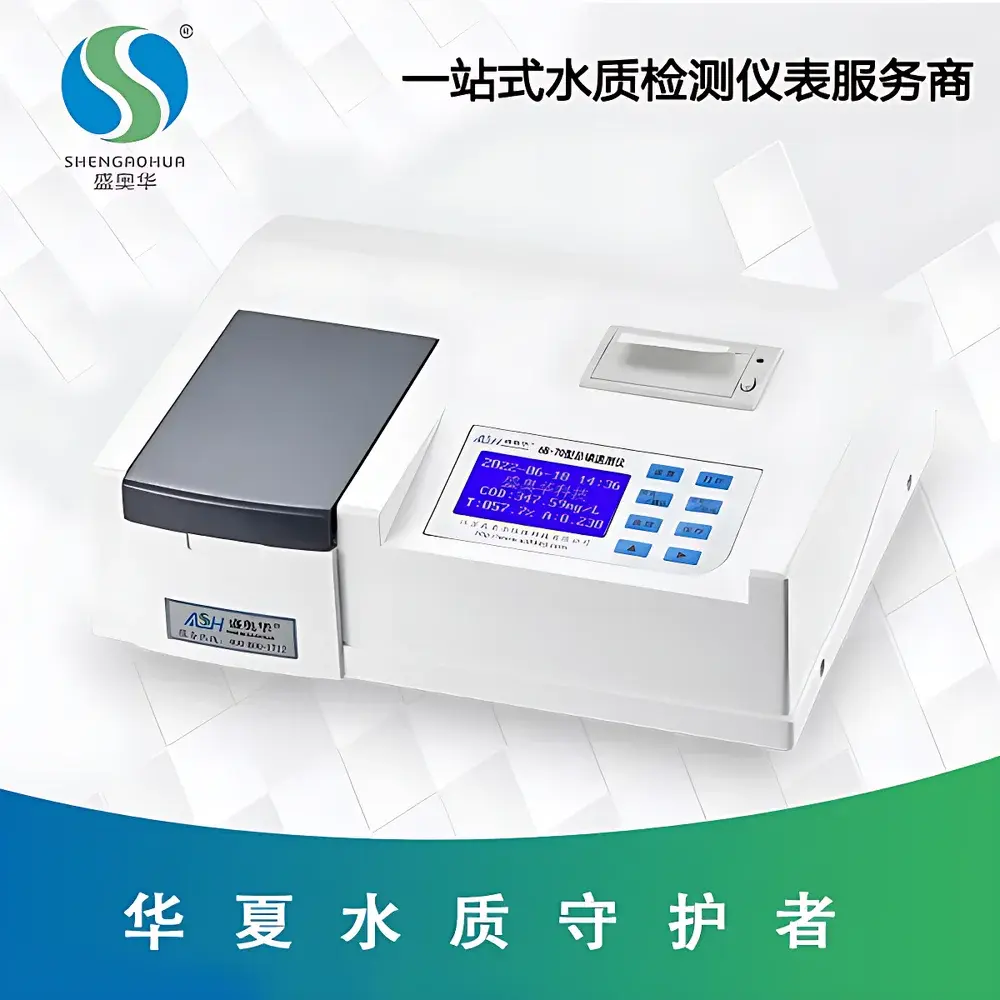
Shengaohua 6B-70 Total Phosphorus Analyzer
| Brand | Shengaohua |
|---|---|
| Origin | Jiangsu, China |
| Manufacturer Type | Direct Manufacturer |
| Product Category | Domestic Instrument |
| Model | 6B-70 |
| Measurement Parameter | Total Phosphorus |
| Instrument Type | Laboratory Benchtop Analyzer |
| Measurement Principle | Spectrophotometry (Molybdenum Blue Method) |
| Measurement Range | 0.01–20 mg/L |
| Accuracy | ≤5% |
| Detection Limit | 0.01 mg/L |
| Resolution | 0.001 mg/L |
| Photometric Stability | ≤0.001 A/10 min |
| Repeatability | ±3% |
| Temperature Control Accuracy | ±0.5 °C at 123 °C |
| Digestion Time Accuracy | ≤±2% |
| Sample Capacity Options | 9 / 12 / 16 / 20 / 25 / 30 positions |
| Preloaded Calibration Curves | 4 factory-standard curves |
| User-Definable Curves | up to 96 |
| Display | Chinese LCD interface |
| Digestion Temperature | 123 °C ±0.5 °C (PID-controlled) |
| Digestion Duration | 30 min (programmable) |
| Power Supply | AC 220 V ±10%, 50 Hz |
| Dimensions | 330 × 260 × 120 mm |
| Operating Ambient | 5–40 °C, RH <85% (non-condensing) |
Overview
The Shengaohua 6B-70 Total Phosphorus Analyzer is a dedicated laboratory-grade spectrophotometric instrument engineered for the quantitative determination of total phosphorus (TP) in aqueous environmental samples—including wastewater, surface water, groundwater, and treated effluents. It implements the standardized molybdenum blue colorimetric method (based on ISO 6878:2004 and GB/T 11893–1989), wherein orthophosphate—liberated after high-temperature acid digestion of all phosphorus species—is reacted with ammonium molybdate and antimony potassium tartrate under acidic conditions, followed by reduction to form a phosphomolybdenum blue complex. Absorbance is measured at 700 nm using a stable tungsten-halogen light source and precision optical path, enabling direct concentration readout in mg/L. The system integrates thermal digestion and photometric analysis into a single compact platform, eliminating inter-instrument variability and reducing manual handling errors common in multi-step benchtop workflows.
Key Features
- Integrated dual-module architecture: Independent PID-controlled digestion block (123 °C ±0.5 °C) and fixed-wavelength photometer (700 nm) ensure consistent reaction kinetics and optical reproducibility.
- Triple independent timing channels allow concurrent digestion of three sample batches—enhancing throughput without cross-contamination risk or operator intervention.
- High-stability optical system with ≤0.001 A/10 min drift meets ISO 17025 traceability requirements for routine environmental testing laboratories.
- Modular sample rack design supports user-selectable capacity configurations (9–30 positions), accommodating standard 16-mm glass digestion tubes or optional quartz cuvettes.
- Corrosion-resistant transparent polycarbonate safety shield provides full visual monitoring while complying with IEC 61010-1 electrical safety standards for laboratory equipment.
- Onboard calibration management: Stores 4 certified reference curve sets (e.g., for low-, mid-, and high-range TP quantification) plus up to 96 user-defined curves with metadata logging (date, operator ID, standard lot number).
Sample Compatibility & Compliance
The 6B-70 is validated for use with municipal wastewater, industrial effluents (e.g., from pulp/paper, textile dyeing, food processing), and natural water matrices following EPA Method 365.4 and ISO 6878 protocols. Sample pretreatment—including filtration (0.45 µm membrane), homogenization, and acid preservation (HNO₃, pH <2)—must adhere to ASTM D5173–19 guidelines to prevent phosphorus speciation shifts. All digestion vials are compatible with standard borosilicate glass or PTFE-lined screw-cap tubes. The instrument’s measurement uncertainty (≤5% RSD at 1 mg/L TP) satisfies QA/QC criteria outlined in ISO/IEC 17025:2017 Annex A.3 for accredited environmental testing labs conducting compliance monitoring under national discharge permits.
Software & Data Management
Data acquisition and reporting are managed via embedded firmware with non-volatile memory retention. Each measurement event logs timestamp, digestion temperature profile, absorbance value, applied calibration curve ID, and operator-assigned sample ID. Stored results (up to 1,000 records) support export via RS-232 serial interface to LIMS or Excel-compatible CSV files. Audit trail functionality includes write-protected firmware logs of all curve modifications and system calibrations—supporting GLP-aligned documentation practices. While no proprietary PC software is bundled, raw output conforms to ASTM E1382–18 data exchange conventions for integration with third-party laboratory informatics systems.
Applications
- Regulatory compliance testing for TP in municipal wastewater treatment plant (WWTP) influent, effluent, and sludge supernatant per China’s GB 18918–2002 and EU Urban Wastewater Treatment Directive (91/271/EEC).
- Process control in phosphorus-limited biological nutrient removal (BNR) systems, including A²/O and SBR configurations.
- Environmental impact assessment (EIA) sampling across rivers, lakes, and reservoirs where eutrophication risk modeling requires sub-0.1 mg/L detection capability.
- Quality assurance in pharmaceutical manufacturing wastewater streams subject to USP and EP 2.2.48 phosphorus limits.
- Method validation studies in academic and research laboratories evaluating novel digestion reagents or alternative catalysts for refractory phosphorus oxidation.
FAQ
What digestion reagents are required for total phosphorus analysis on the 6B-70?
Potassium persulfate (K₂S₂O₈) and sulfuric acid (H₂SO₄) are used for oxidative digestion; reagent purity must meet ACS grade specifications per ISO 6878 Annex B.
Can the instrument be calibrated using NIST-traceable phosphate standards?
Yes—certified reference materials (e.g., NIST SRM 3189) are fully compatible; calibration curves must be generated using ≥5 concentration points spanning the 0.01–20 mg/L range.
Is the 6B-70 compliant with FDA 21 CFR Part 11 for electronic records?
No—the device lacks electronic signature capability and audit trail encryption; it is intended for non-GMP environments where paper-based record retention suffices.
How often should the optical path be cleaned or verified?
Daily visual inspection of the cuvette holder and light path window is recommended; annual verification of photometric linearity using neutral density filters is advised per ISO/IEC 17025 Clause 6.4.10.
Does the instrument support automatic dilution for out-of-range samples?
No—manual dilution prior to analysis is required; users must document dilution factors in the sample ID field for accurate concentration back-calculation.







