
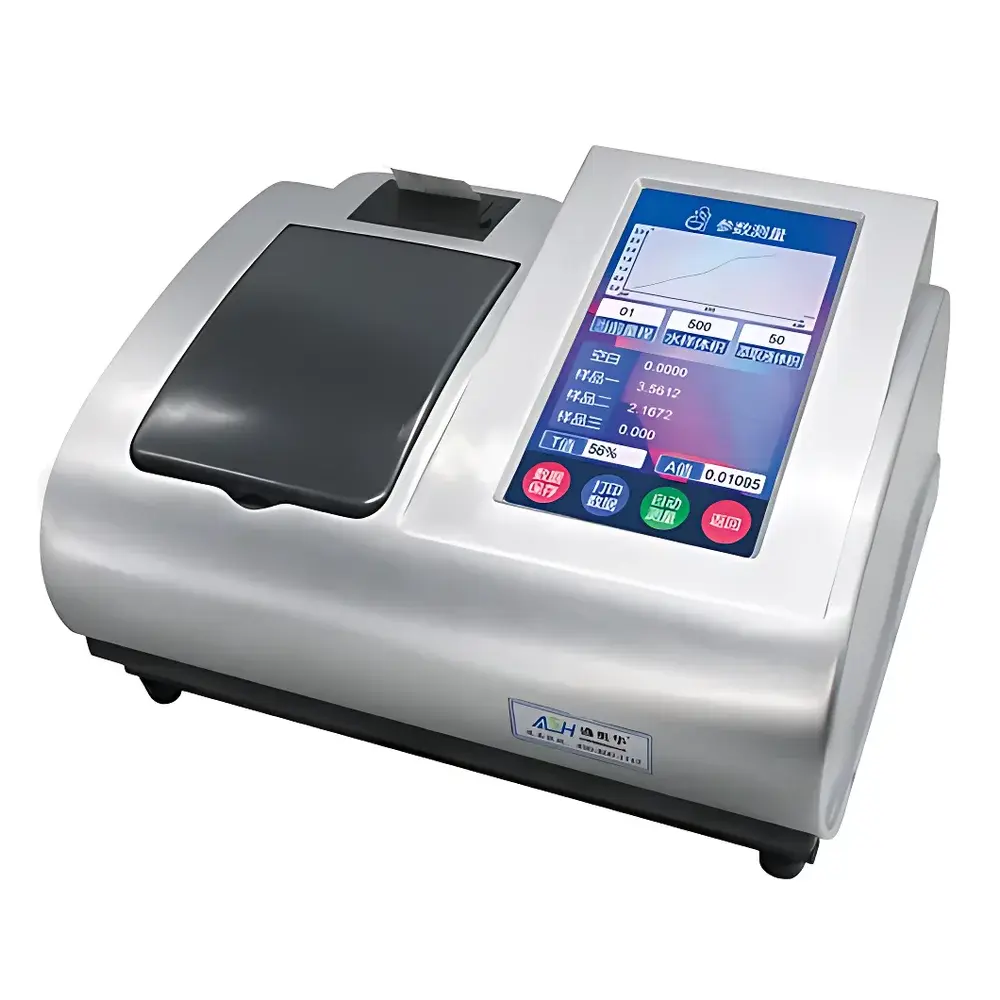
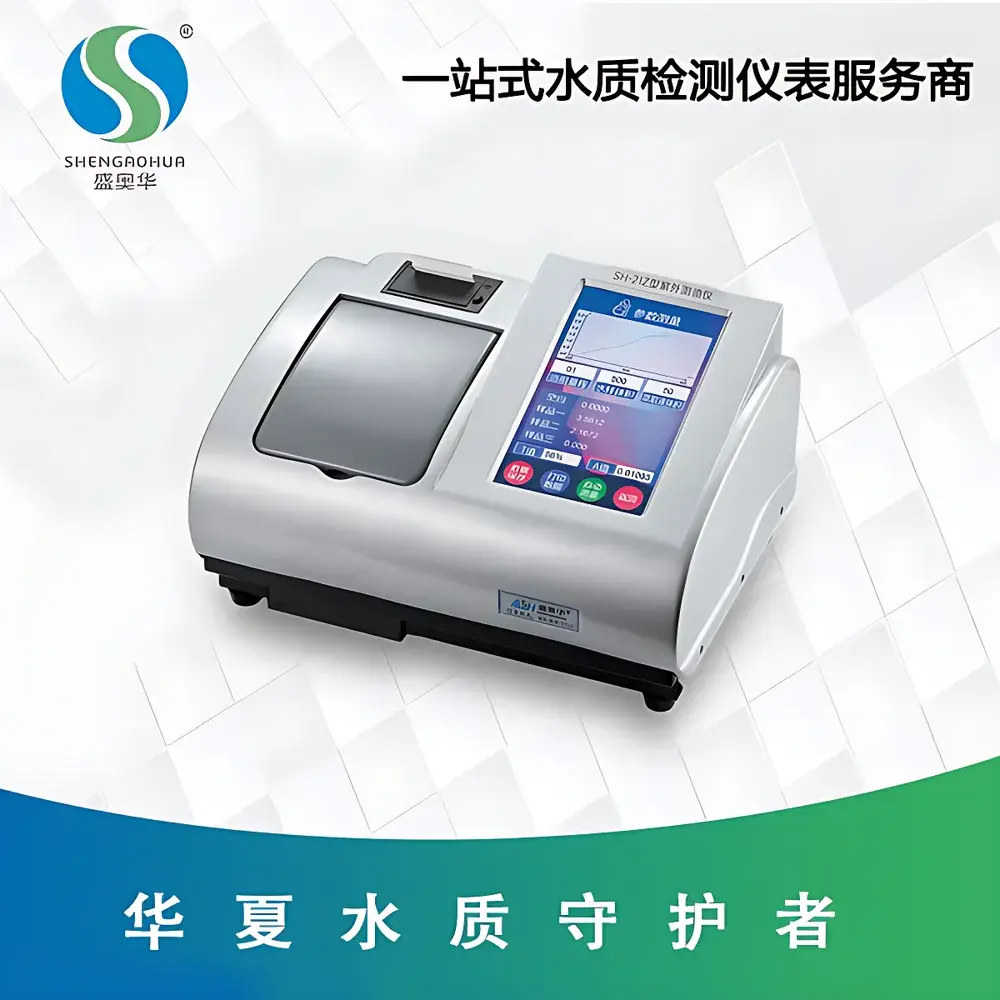
Shengaohua SH-21Z UV-Based Oil Content Analyzer
| Brand | Shengaohua |
|---|---|
| Origin | Jiangsu, China |
| Manufacturer Type | Direct Manufacturer |
| Instrument Category | Domestic |
| Model | SH-21Z |
| Instrument Type | Laboratory |
| Measurement Principle | UV Spectrophotometry |
| Measurement Range | 0.001–1000 mg/L |
| Detection Limit | 0.001 mg/L |
| Accuracy | ≤ ±5% |
| Resolution | 0.001 mg/L |
| Measurement Frequency | 7 measurements/min |
| Wavelength Range | 200–400 nm |
| Photometric Stability | ≤ 0.001 A/10 min |
| Repeatability | ±3% |
| Sample Extraction | Manual with n-Hexane |
| Display | 10.1-inch true-color capacitive touchscreen |
| Data Storage Capacity | 5 million records |
| Dimensions | 220 × 120 × 90 mm |
| Net Weight | 10.3 kg |
Overview
The Shengaohua SH-21Z UV-Based Oil Content Analyzer is a laboratory-grade spectrophotometric instrument engineered for the quantitative determination of petroleum hydrocarbons (petroleum hydrocarbons, animal and vegetable oils, and total oil) in aqueous samples. It operates on the fundamental principle of ultraviolet absorption spectroscopy—specifically, measuring absorbance in the 200–400 nm spectral region following solvent extraction and matrix cleanup. In accordance with HJ 970–2018 (“Determination of Petroleum Hydrocarbons in Water by Ultraviolet Spectrophotometry”), the SH-21Z replaces banned carbon tetrachloride with environmentally safer n-hexane as the extraction solvent. This regulatory alignment ensures full compliance with China’s current national environmental monitoring standards for water quality assessment. The instrument implements Beer–Lambert law-based quantification after acidified (pH ≤ 2) liquid–liquid extraction, dehydration with anhydrous sodium sulfate, and polar interference removal via magnesium silicate adsorption. Its optical architecture delivers high reproducibility and low baseline drift (<0.001 A/10 min), supporting reliable trace-level analysis down to 0.001 mg/L.
Key Features
- Regulatory-compliant workflow aligned with HJ 970–2018, eliminating hazardous CCl₄ use in favor of n-hexane
- Integrated 10.1-inch high-resolution capacitive touchscreen with intuitive icon-driven interface—single-screen display of real-time absorbance, transmittance, concentration, wavelength, calibration curve, and elapsed assay time
- Dual measurement modes: fully automated and semi-automated operation for flexibility across lab protocols
- Preloaded multi-point calibration curves compliant with standard reference materials; user-customizable curve import/export via USB
- Onboard spectral scanning function for blank purity verification and background correction validation
- Built-in thermal printer enabling immediate hardcopy output of current results and historical datasets (up to 5 million records stored internally)
- Self-diagnostic system with automated optical path calibration and hardware status reporting
- USB 2.0 interface for secure data export to external storage or LIMS integration
Sample Compatibility & Compliance
The SH-21Z is validated for use with surface water, groundwater, wastewater, and industrial effluents requiring petroleum hydrocarbon quantification per national environmental monitoring mandates. Sample preparation follows standardized manual liquid–liquid extraction using separatory funnels, followed by silica-magnesium column cleanup—a procedure explicitly described in HJ 970–2018. The analyzer meets ISO/IEC 17025 technical competence requirements for routine environmental testing laboratories when operated within specified environmental conditions (5–40 °C ambient temperature, <85% RH non-condensing). While not certified to FDA 21 CFR Part 11 out-of-the-box, its audit-trail-capable data logging (timestamped, operator-ID-tagged entries) supports GLP/GMP-aligned documentation practices when integrated into validated SOPs.
Software & Data Management
The embedded firmware provides full traceability: each measurement record includes sample ID, date/time stamp, operator code (if enabled), raw absorbance values at selected wavelengths, applied calibration curve identifier, and final calculated concentration. Data are stored in encrypted binary format with cyclic overwrite protection. Export is supported in CSV and PDF formats via USB mass storage mode. No cloud connectivity or remote access functionality is included—ensuring data sovereignty and network isolation required in regulated environmental labs. Firmware updates are performed locally via USB drive with version-controlled release packages distributed directly by Shengaohua.
Applications
The SH-21Z serves as a primary analytical tool in municipal and provincial environmental monitoring stations, wastewater treatment plants, and third-party testing laboratories conducting routine compliance monitoring under China’s “Water Pollution Prevention and Control Action Plan.” It is routinely deployed in industries including petrochemical refining, pulp and paper manufacturing, food and beverage processing (e.g., dairy, brewing), textile dyeing, leather tanning, pharmaceutical production, and electronics fabrication—where effluent discharge permits mandate petroleum hydrocarbon reporting. Academic and research institutions utilize the platform for method development, inter-laboratory comparison studies, and student training in environmental analytical chemistry.
FAQ
Does the SH-21Z support automatic extraction?
No—the instrument requires manual sample preparation using standard separatory funnels and silica-magnesium columns per HJ 970–2018. Automated extraction modules are not integrated.
Can the SH-21Z measure both petroleum hydrocarbons and animal/vegetable oils independently?
Yes—by applying differential adsorption protocols and dual-wavelength evaluation (as defined in HJ 970–2018), it enables selective quantification of petroleum hydrocarbons, animal/vegetable oils, and total oil.
Is the instrument suitable for field deployment?
No—it is designed exclusively for controlled laboratory environments. Its specifications assume stable AC power supply, temperature-regulated space, and benchtop installation.
What is the recommended maintenance schedule?
Optical path cleaning every 3 months; annual verification of wavelength accuracy and photometric linearity using NIST-traceable standards; replacement of desiccant and adsorbent consumables prior to each batch analysis.
Does the SH-21Z comply with international standards such as ISO 9377-2?
It is optimized for HJ 970–2018. While UV-based petroleum analysis principles overlap with ISO 9377-2, method equivalence must be established through in-house validation per ISO/IEC 17025 clause 7.2.2.
Related Products







