
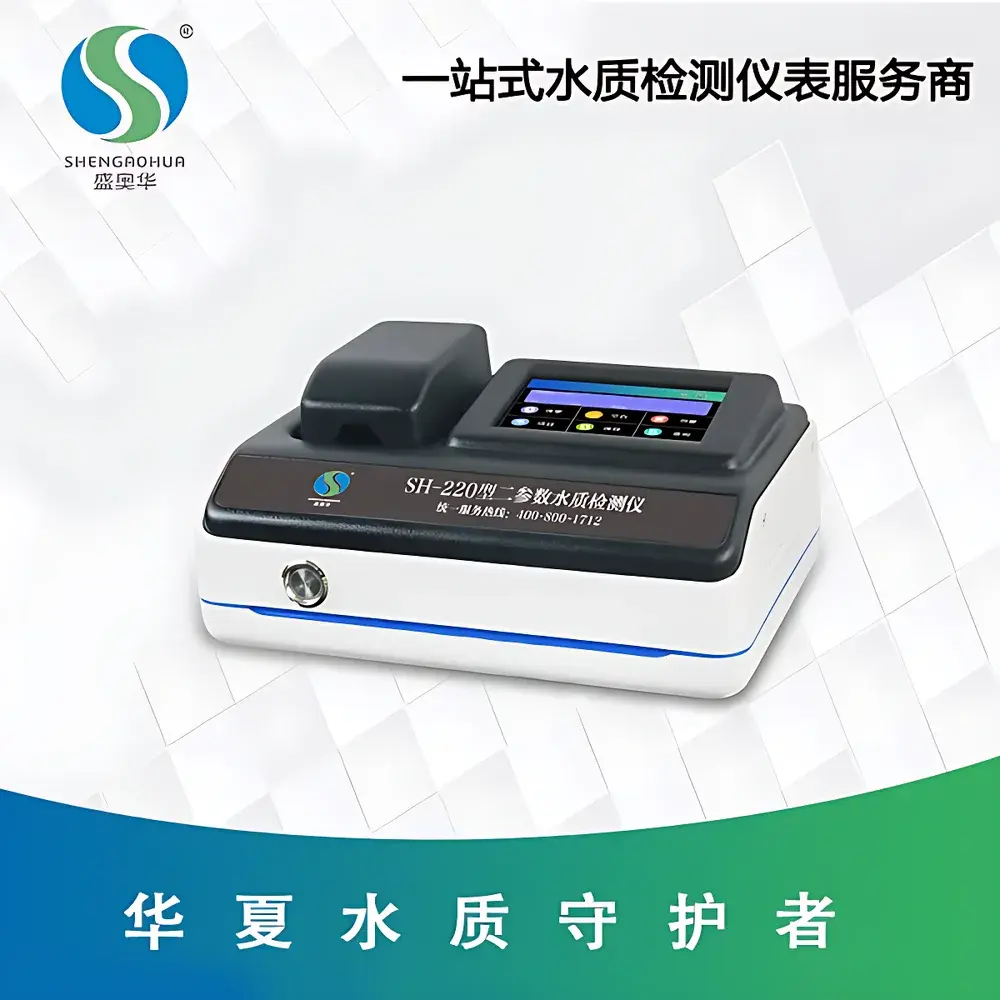
Shengaohua SH-220 Ammonia Nitrogen Analyzer
| Brand | Shengaohua |
|---|---|
| Origin | Jiangsu, China |
| Manufacturer Type | Direct Manufacturer |
| Country of Origin | China |
| Model | SH-220 |
| Instrument Type | Benchtop Laboratory Analyzer |
| Measurement Principle | Colorimetric Method (Nesslerization or Salicylate-based) |
| Ammonia Nitrogen Range | 0–100 mg/L NH₃-N |
| Detection Limit | 0.01 mg/L NH₃-N |
| Accuracy | ≤ ±5% of reading |
| Measurement Time | 10 minutes per batch |
| Batch Capacity | 16 samples per run |
| Display | 5-inch IPS capacitive touchscreen |
| Wavelength Accuracy | ±1 nm |
| Optical System | Rear-mounted optical path with narrow-band interference filters and cold light source (100,000 h lifetime) |
| Data Storage | Internal memory + TF card support (up to 5 million records) |
| Preloaded Calibration Curves | 100 built-in curves (including NH₃-N, COD, total phosphorus — user-selectable 2 of 3) |
| Custom Curve Support | Yes, via intuitive interface |
| Connectivity | Optional wireless thermal printer interface |
| Dimensions | 270 × 190 × 130 mm |
| Net Weight | 1.5 kg |
| Power Supply | AC 220 V, 50 Hz |
Overview
The Shengaohua SH-220 Ammonia Nitrogen Analyzer is a benchtop laboratory instrument engineered for rapid, reliable quantification of ammonia nitrogen (NH₃-N) in aqueous environmental and industrial samples. It operates on the colorimetric principle—specifically optimized for either Nesslerization or salicylate-based reaction chemistry—where ammonia reacts with reagents to form a colored complex proportional to concentration. Absorbance is measured at a precisely controlled wavelength (typically 420 nm or 640 nm, depending on method selection), with automatic wavelength switching ensuring optimal spectral resolution. Designed for compliance with standard methods including ISO 7150-1, ASTM D1426, and HJ 535–2009 (Chinese EPA equivalent), the SH-220 delivers trace-level sensitivity down to 0.01 mg/L NH₃-N and maintains measurement repeatability within ±5% across its full 0–100 mg/L range. Its compact footprint and integrated optical architecture—featuring rear-mounted optics and narrow-band interference filters—minimize ambient light interference, supporting consistent performance in variable lighting conditions typical of municipal labs, field-deployed mobile units, and third-party testing facilities.
Key Features
- 5-inch high-resolution IPS capacitive touchscreen with intuitive Chinese-language GUI and responsive navigation
- Rear-mounted optical path design reduces stray light influence and improves photometric stability
- Cold LED light source with >100,000-hour operational lifetime ensures long-term spectral consistency and eliminates warm-up drift
- Preloaded library of 100 calibration curves—including dedicated protocols for NH₃-N, COD (5–6000 mg/L), and total phosphorus (0.02–40 mg/L)—with user-selectable 2-method configuration
- On-device curve customization capability enables method adaptation for non-standard matrices (e.g., saline wastewater, digested sludge extracts)
- Batch processing for up to 16 samples in ≤10 minutes, using standardized 16-mm glass or quartz cuvettes
- Internal memory plus expandable TF card slot (supports ≥5 million data points) with timestamp, operator ID, and method metadata tagging
- Optional Bluetooth-enabled thermal printer integration for GLP-compliant hardcopy reporting
Sample Compatibility & Compliance
The SH-220 accommodates clarified, filtered, or centrifuged liquid samples from surface water, groundwater, wastewater effluents, aquaculture systems, and industrial process streams. Turbidity interference is mitigated through built-in compensation algorithms and optional pre-filtration guidance in the operating manual. The analyzer meets functional requirements aligned with ISO/IEC 17025:2017 for testing laboratories, supports audit-ready data logging suitable for GLP and GMP environments, and facilitates traceability under China’s HJ series standards (HJ 535–2009, HJ 536–2009). While not inherently 21 CFR Part 11 compliant out-of-the-box, its secure data storage architecture and immutable record timestamps provide a foundational framework for regulated QA/QC workflows when deployed with validated SOPs.
Software & Data Management
Data acquisition, storage, and export are managed via embedded firmware with no external PC dependency. Each measurement record includes sample ID, date/time stamp, selected method, calibration status, raw absorbance values, and calculated concentration. Export options include CSV via TF card for downstream analysis in Excel, LIMS, or statistical software (e.g., Minitab, JMP). Firmware updates are delivered via USB or TF card, with version control and change logs retained in system history. Audit trail functionality—while not full electronic signature implementation—records all parameter modifications, curve edits, and calibration events with user attribution and timestamps.
Applications
The SH-220 serves as a primary analytical tool in municipal water quality monitoring stations, environmental consulting laboratories, wastewater treatment plant QC labs, aquaculture health management programs, and industrial pretreatment verification (e.g., semiconductor rinse water, electroplating effluent). Its dual-measurement flexibility (NH₃-N + one additional parameter) supports cross-parameter correlation studies—for example, evaluating nitrification efficiency via concurrent NH₃-N and NO₂⁻/NO₃⁻ trend analysis (when paired with compatible test kits). Field-deployable design also enables emergency response applications during chemical spills or algal bloom events requiring rapid nutrient load assessment.
FAQ
What sample preparation steps are required prior to analysis?
Samples must be free of particulates (via 0.45-µm filtration or centrifugation) and adjusted to neutral pH if highly acidic or alkaline. Chlorine interference is removed by sodium thiosulfate addition; heavy metal masking may be required for samples containing Cu²⁺ or Fe³⁺ above 0.5 mg/L.
Can the SH-220 be used for seawater or brackish water analysis?
Yes—with method validation and matrix-matched calibration. High chloride concentrations may require dilution or use of chloride-tolerant reagent formulations; recovery testing is recommended per ISO 8466-1 guidelines.
Is method validation documentation provided with the instrument?
Shengaohua supplies a basic validation protocol template covering linearity, LOD/LOQ, precision, and spike recovery—intended for lab-specific adaptation and internal QA review.
How frequently must the optical system be calibrated?
Zero-point calibration is performed automatically at startup; span calibration using certified reference standards is recommended before each analytical session or every 8 hours of continuous use.
Does the instrument support remote data transmission or cloud integration?
No native Ethernet/Wi-Fi module is included; however, exported CSV files can be ingested into cloud-based LIMS or SCADA platforms via manual upload or automated scripts running on connected host PCs.







