
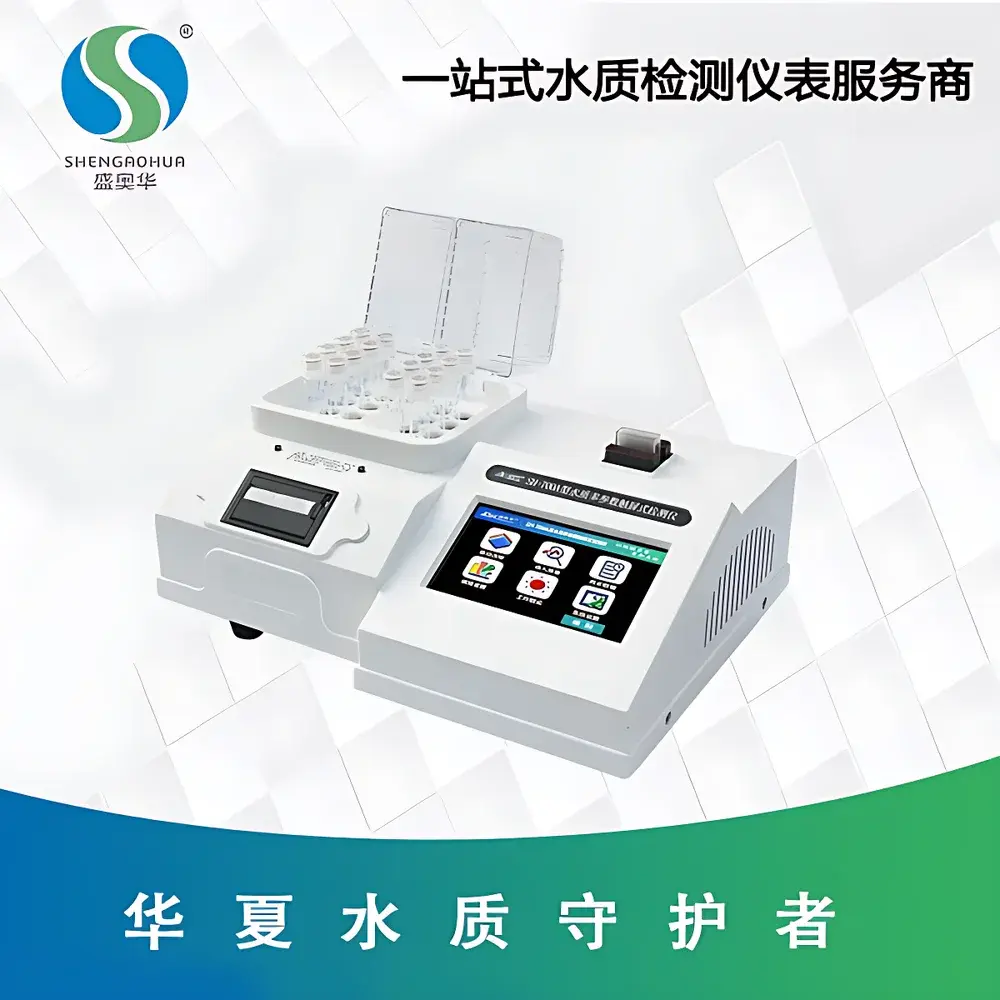
Shengaohua SH-700A Integrated Multi-Parameter Water Quality Analyzer
| Brand | Shengaohua |
|---|---|
| Origin | Jiangsu, China |
| Manufacturer Type | Direct Manufacturer |
| Instrument Type | Laboratory Water Quality Analyzer |
| Model | SH-700A |
| Detection Parameters | COD, Ammonia Nitrogen, Total Phosphorus, Total Nitrogen, Heavy Metals (Cu, Ni, Cr⁶⁺, Fe, Zn, Total Cr), Residual Chlorine, Turbidity, Color, Formaldehyde, Sulfide, Sulfate, Nitrite Nitrogen, Total Chlorine, Aniline, Fluoride, Permanganate Index |
| Wavelength Range | 400–750 nm |
| Measurement Accuracy | ≤ ±5% |
| Calibration Curves | 100 total (15 standard + 85 extended) |
| Sample Throughput | 8×2 or 16 samples per batch |
| Temperature Control Range | Ambient to 200 °C |
| Digestion Temperatures | 165 °C / 123 °C ±0.5 °C |
| Digestion Times | 10 min / 30 min |
| Chloride Interference Tolerance | ≤1200 mg/L (standard), ≤4000 mg/L (high-chloride mode) |
| Dimensions | 400 × 280 × 180 mm |
| Power Supply | AC 220 V ±10%, 50 Hz |
| Weight | 5 kg |
| Light Source | Long-life cold LED (≥100,000 h) |
| Optical Design | Rear-mounted spectrophotometric system with narrow-band interference filters |
| Data Output | Built-in thermal printer |
| Connectivity | Cloud-enabled IoT module for remote data upload, retrieval, and audit-ready logging |
Overview
The Shengaohua SH-700A Integrated Multi-Parameter Water Quality Analyzer is a laboratory-grade spectrophotometric platform engineered for precise, standardized quantification of key water quality indicators in compliance with national and international analytical protocols—including HJ/T 399–2007 (COD), HJ 535–2009 (ammonia nitrogen), HJ 671–2013 (total phosphorus), and HJ 636–2012 (total nitrogen). It operates on the principle of colorimetric analysis using narrow-band interference-filtered LED light sources (400–750 nm), coupled with post-optical-path detection architecture to eliminate ambient light interference and ensure measurement stability. The instrument integrates digestion and photometric measurement into a single compact chassis, eliminating inter-unit calibration drift and enabling simultaneous thermal control and optical readout under programmable conditions. Its dual-digestion temperature capability (123 °C and 165 °C) supports both standard and high-sensitivity oxidation protocols, while intelligent load-sensing power modulation ensures consistent thermal uniformity across variable sample batches.
Key Features
- 7-inch full-touch color LCD interface with intuitive icon-driven navigation—designed for glove-compatible operation in laboratory environments
- Integrated digestion block with PID-controlled heating (ambient to 200 °C), ±0.5 °C temperature accuracy, and automatic power scaling based on rack occupancy
- Rear-mounted optical path design minimizes stray light exposure and enhances signal-to-noise ratio during absorbance measurement
- 100 preloaded calibration curves (15 factory-validated standard curves + 85 user-expandable curves) support method adaptation across diverse wastewater matrices and regulatory requirements
- Onboard thermal printer enables immediate hardcopy output of current results and historical datasets with timestamp and operator ID
- Cloud-connected IoT architecture provides encrypted HTTP/HTTPS data transmission to secure cloud servers; supports role-based access, versioned data backups, and export in CSV/Excel formats
- Dual digestion modes (10-min rapid and 30-min complete) with memory retention for custom time–temperature profiles
- Chloride tolerance up to 4000 mg/L (Cl⁻) via optimized reagent chemistry and algorithmic correction—critical for industrial effluent and saline wastewater analysis
Sample Compatibility & Compliance
The SH-700A accommodates standard 16-mm round glass reaction tubes and 10-mm square cuvettes, supporting both liquid and solid-phase reagent formats. Its modular design permits flexible configuration for EPA-compliant methods (e.g., Method 410.4 for COD, Method 350.1 for ammonia), as well as ISO 6060 (COD), ISO 7150-1 (ammonia), and ISO 11908 (total phosphorus). All curve generation and validation procedures align with GLP documentation standards, including electronic audit trails for calibration updates, user logins, and result modifications. The system meets electromagnetic compatibility (EMC) requirements per IEC 61326-1 and safety specifications per IEC 61010-1. While not FDA 21 CFR Part 11-certified out-of-the-box, its cloud logging infrastructure supports implementation of electronic signature workflows and data integrity controls required for regulated QA/QC laboratories.
Software & Data Management
Firmware includes embedded data management firmware supporting local storage of ≥10,000 test records with full metadata (date/time, parameter, concentration, curve ID, digestion settings, operator code). USB host port enables direct export to external drives; optional Ethernet/Wi-Fi modules enable integration into LIMS via RESTful API endpoints. Cloud portal provides real-time dashboard visualization, multi-site comparative reporting, automated alerting for out-of-spec results, and configurable export templates compliant with ISO/IEC 17025 documentation requirements. All data transfers use TLS 1.2+ encryption; server-side backups are performed daily with 90-day retention and point-in-time recovery.
Applications
The SH-700A serves as a primary analytical tool in municipal wastewater treatment plants (influent/effluent monitoring), environmental monitoring stations (surface water, groundwater, and discharge compliance), and industrial R&D labs across pulp & paper, pharmaceutical manufacturing, food & beverage (dairy, brewing), textile dyeing, electroplating, and petrochemical sectors. Its heavy metal quantification capability (Cu, Ni, Cr⁶⁺, Zn, Fe) supports NPDES permit reporting and RCRA waste characterization. The formaldehyde, aniline, and sulfide modules address specialty chemical process stream verification, while turbidity and color measurements fulfill APHA Standard Methods 2130 B and 2120 B requirements.
FAQ
Does the SH-700A support ASTM or ISO standard methods?
Yes—its optical and thermal specifications comply with core requirements of ISO 6060, ISO 7150-1, ISO 11908, and ASTM D1253 (residual chlorine), D3223 (total organic carbon proxy via COD), and D512 (chloride interference mitigation). Method-specific validation reports are available upon request.
Can users import custom calibration curves?
Yes—up to 85 extended curves can be uploaded via USB or cloud interface in CSV format, provided they conform to the instrument’s absorbance-concentration polynomial structure (linear, quadratic, or logarithmic fit).
Is remote firmware update supported?
Yes—over-the-air (OTA) updates are delivered through the cloud portal with SHA-256 signature verification and rollback capability.
What maintenance is required for long-term accuracy?
Annual optical alignment verification and digestion block temperature calibration are recommended; LED source lifetime exceeds 100,000 hours with no scheduled replacement needed under normal operation.
How is data integrity ensured during cloud transmission?
All uploads use mutual TLS authentication; each dataset is hashed and timestamped at acquisition, with immutable audit logs retained for ≥180 days per ISO/IEC 27001 guidelines.







