
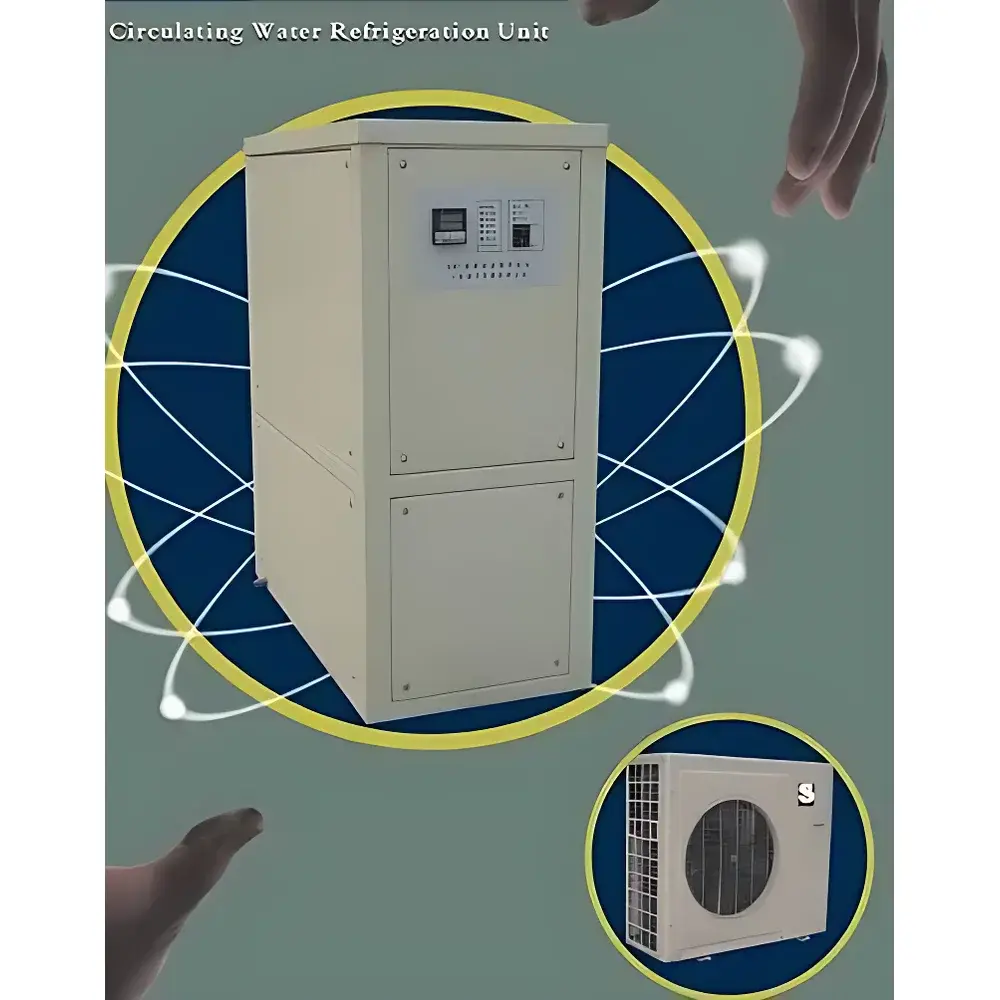
Shengli SL401 Circulating Chiller
| Brand | Shengli |
|---|---|
| Origin | Shanghai, China |
| Model | SL401 |
| Maximum Refrigeration Capacity | 8 kW |
| Temperature Control Range | 10–30 °C |
| Temperature Stability | ±1 °C |
| Circulating Flow Rate | 60 L/min |
| Maximum Outlet Pressure | 3 kg/cm² (≈294 kPa) |
| Refrigerant | R22 |
| Ambient Operating Temperature | 5–40 °C |
| Input Power | 2 kW |
| Power Supply | 380–415 V, 50–60 Hz, 3-Phase |
| Water Reservoir Volume | 60 L |
| Indoor Unit Noise Level | Low (optimized via outdoor condensing unit separation) |
| Compliance | Designed for laboratory-grade thermal stability in analytical instrument support applications |
Overview
The Shengli SL401 Circulating Chiller is an engineered thermal management solution designed specifically to deliver stable, controllable cooling water to high-precision analytical and materials characterization instruments. It operates on a vapor-compression refrigeration cycle using R22 refrigerant, integrated with dynamic cold accumulation technology to maintain consistent temperature output under variable thermal loads. Unlike conventional chillers relying solely on real-time compressor modulation, the SL401 employs a buffered thermal mass strategy—leveraging its 60 L insulated reservoir in conjunction with intelligent PID-based temperature regulation—to minimize overshoot and undershoot during transient load changes. This architecture ensures isothermal delivery critical for instruments sensitive to thermal drift, including X-ray diffractometers (XRD), fluorescence spectrometers (XRF), scanning electron microscopes (SEM), laser-based systems, and metalorganic chemical vapor deposition (MOCVD) reactors. Its split-system configuration separates heat-generating components—including the compressor, axial fans, and air-cooled condenser—into an outdoor module, significantly reducing indoor acoustic emissions and heat dissipation within controlled laboratory environments.
Key Features
- Split-System Architecture: Outdoor-mounted condensing unit isolates noise and waste heat, enabling ultra-low-noise operation (<55 dB(A) at 1 m) from the compact indoor chiller module.
- Dynamic Cold Accumulation: Integrated thermal buffer stabilizes outlet temperature during rapid load fluctuations, achieving ±1 °C setpoint accuracy across the full 10–30 °C control range without requiring oversized reservoirs.
- High-Efficiency Circulation System: Industrial-grade, low-NPSH centrifugal pump delivers 60 L/min at up to 294 kPa (3 kg/cm²) head pressure—sufficient to overcome pressure drops in multi-instrument manifolds or extended coolant loops.
- Intelligent PID Temperature Control: Microprocessor-based controller with adaptive tuning algorithms minimizes thermal oscillation; supports both manual setpoint adjustment and analog/digital interface options for system integration.
- Frost Protection & Winter Operation: Built-in thermostatically actuated auxiliary heating element prevents freezing of the reservoir and internal plumbing during sub-ambient ambient conditions—enabling year-round deployment in northern climate zones.
- Robust Heat Exchanger Design: Brazed plate or shell-and-tube evaporator (configuration dependent on production batch) optimized for high fouling resistance, corrosion resilience, and long-term thermal transfer efficiency with deionized or inhibited glycol-water mixtures.
Sample Compatibility & Compliance
The SL401 is intended for closed-loop cooling of non-corrosive, low-conductivity fluids—typically deionized water or 20–30% ethylene glycol/water solutions—compatible with standard laboratory tubing (e.g., EPDM, silicone, or fluoropolymer-lined). It meets mechanical safety requirements per IEC 61000-6-2 (immunity) and IEC 61000-6-4 (emissions), and conforms to CE marking directives applicable to electrical equipment for laboratory use. While not certified to UL 61010-1 or FDA 21 CFR Part 11 out-of-the-box, its operational log data (temperature, runtime, fault codes) can be exported via RS-485 or optional Ethernet module for integration into GLP/GMP-compliant environmental monitoring systems. The unit supports ASTM E2912 (Standard Guide for Validation of Laboratory Chillers) protocols when paired with external calibrated thermistors and data loggers.
Software & Data Management
The SL401 operates via an embedded LCD interface with push-button navigation—no proprietary software installation required for basic operation. For advanced monitoring, optional communication modules enable Modbus RTU (RS-485) or TCP/IP connectivity, allowing remote readout of real-time parameters—including inlet/outlet temperatures, compressor status, flow detection, and alarm history—into SCADA platforms, LabVIEW, or custom Python-based instrument control suites. All operational events are timestamped and stored in non-volatile memory for audit trail generation. Firmware updates are performed via USB flash drive, supporting version-controlled maintenance in regulated environments.
Applications
- Cooling of high-power X-ray sources in XRD and XRF systems where thermal lensing must be minimized to preserve beam collimation and detector resolution.
- Thermal stabilization of solid-state lasers (e.g., Nd:YAG, Ti:Sapphire) requiring <±0.5 °C short-term stability over 8-hour acquisition windows.
- Heat extraction from vacuum chamber jackets and RF induction coils in MOCVD and plasma-enhanced CVD tools.
- Continuous-duty cooling of high-frequency generators and induction heating units used in materials processing labs.
- Support for cryo-stage pre-cooling circuits where the chiller serves as a primary heat sink upstream of mechanical or Peltier-based secondary cooling stages.
FAQ
What types of coolant are compatible with the SL401?
Deionized water is recommended for maximum heat transfer efficiency; inhibited ethylene glycol/water mixtures (up to 30% v/v) may be used for freeze protection—though thermal conductivity decreases by ~15% at 30% concentration.
Can the SL401 be integrated into a building management system (BMS)?
Yes—via optional Modbus RTU or BACnet/IP gateway modules, enabling status reporting, setpoint adjustment, and alarm forwarding to centralized HVAC control networks.
Is R22 refrigerant still serviceable given global phaseout schedules?
R22 is classified as an HCFC under the Montreal Protocol; while existing units may be maintained using reclaimed or stockpiled R22, Shengli offers R404A or R410A retrofit kits for new installations upon request.
Does the unit include flow monitoring or dry-run protection?
Standard configuration includes mechanical flow switch feedback; electronic flow metering and pump run-dry lockout are available as factory-installed options.
What is the expected service interval for compressor maintenance?
Under continuous operation at rated load, scheduled inspection—including oil analysis, refrigerant charge verification, and condenser coil cleaning—is recommended every 12 months or 8,000 operating hours, whichever occurs first.



