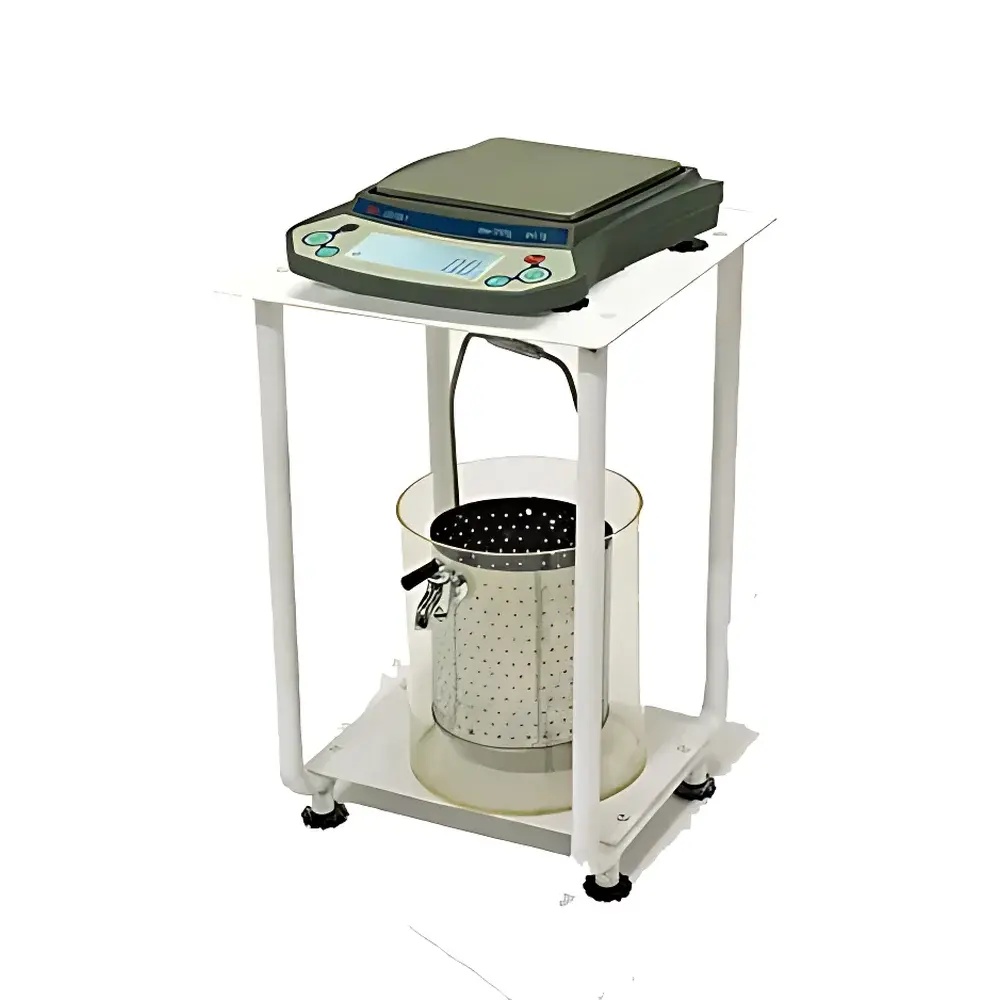
Shenyang Longteng ESK Series Density & Hydrostatic Weighing Balance
| Brand | Shenyang Longteng (Longteng) |
|---|---|
| Origin | Liaoning, China |
| Manufacturer Type | Authorized Distributor |
| Regional Category | Domestic (PRC) |
| Model Series | ESK Series (Density & Hydrostatic Weighing) |
| Instrument Type | Precision Laboratory Balance |
| Maximum Capacity | Up to 60 kg |
| Readability | 0.01 g to 1 g (model-dependent) |
| Repeatability | ±0.01 g |
| Calibration | Internal Automatic Calibration |
| Pan Size | Up to 340 × 300 mm |
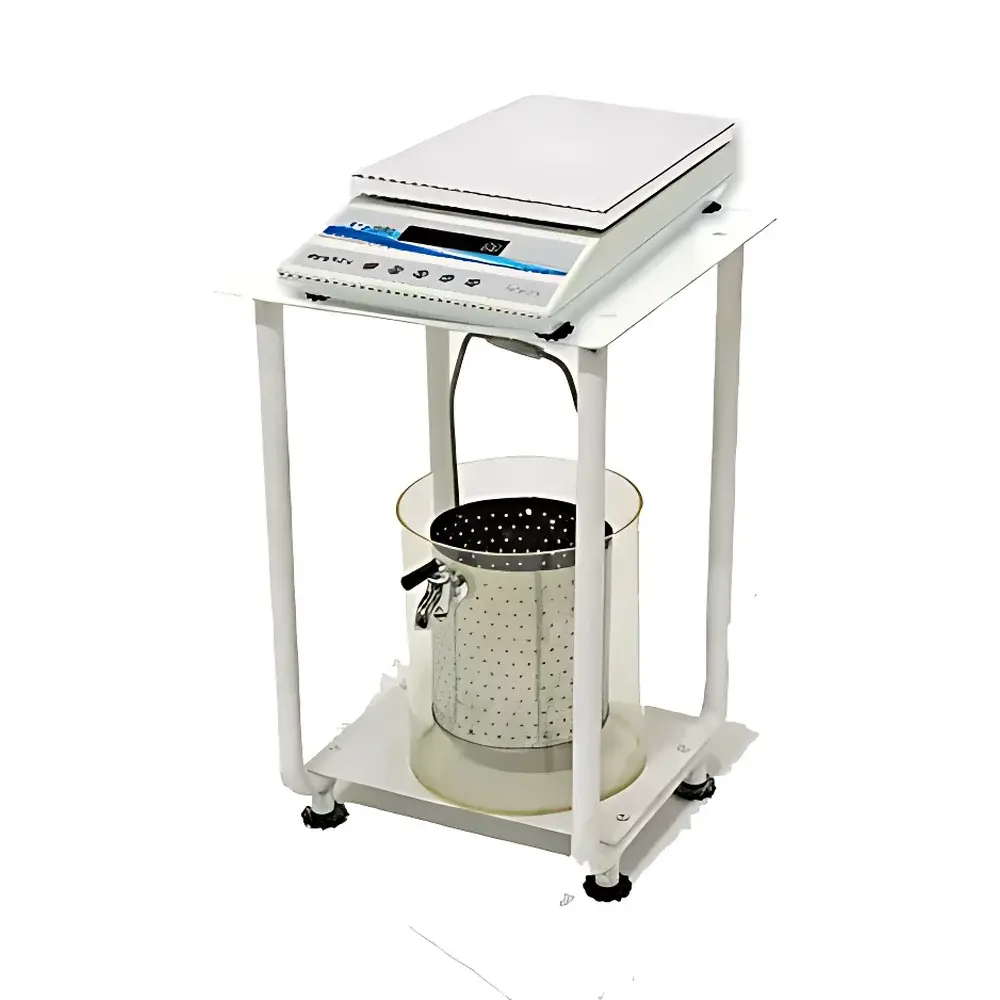
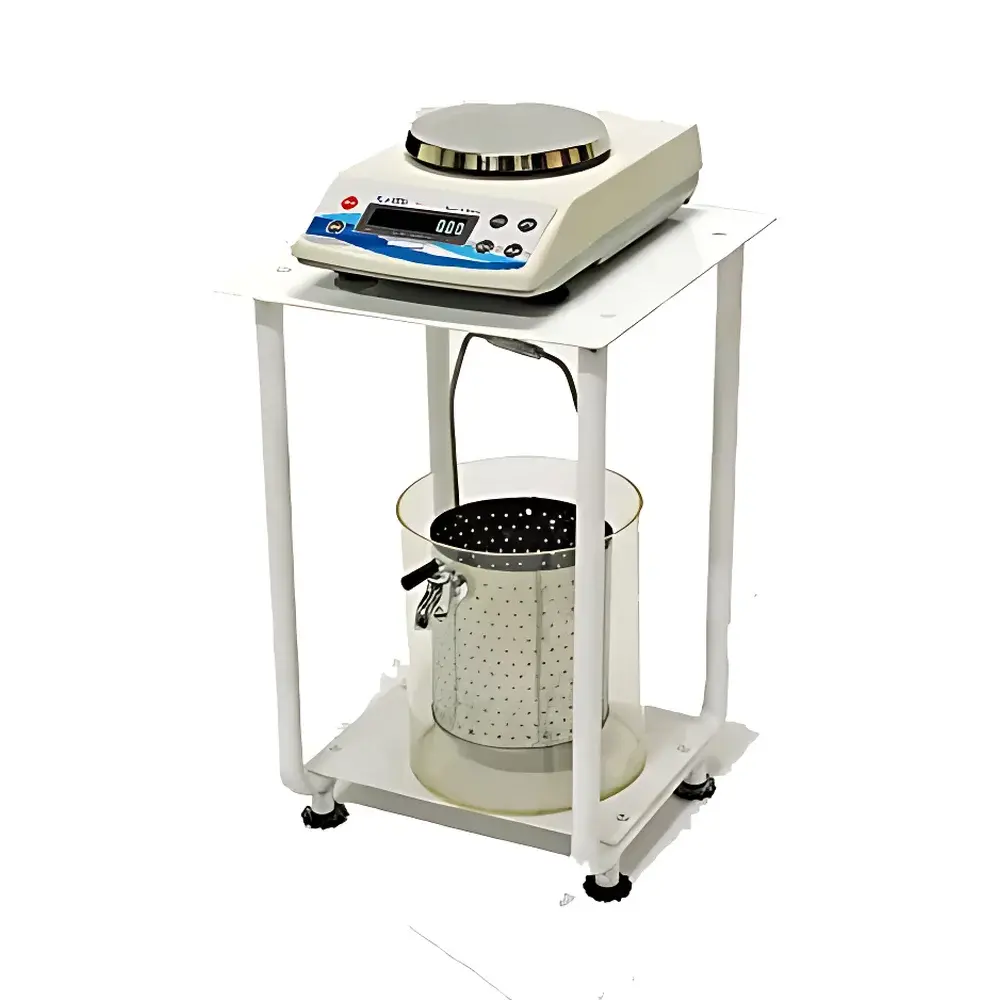
| Hydrostatic Accessories | Suspended Basket (Φ250 × 220 mm), Water Tank (Φ300 × 280 mm), Support Frame (520 × 450 × 400 mm) |
| Compliance | Designed for ASTM D792, ISO 1183, and GB/T 1033 density determination protocols |
Overview
The Shenyang Longteng ESK Series Density & Hydrostatic Weighing Balance is an engineered precision instrument designed specifically for gravimetric density determination of solid materials in geotechnical, civil engineering, and construction materials laboratories. It operates on the principle of hydrostatic weighing—applying Archimedes’ law—to calculate material density by measuring the difference between a sample’s weight in air and its apparent weight when fully submerged in a reference fluid (typically distilled water at controlled temperature). This dual-weighing methodology enables high-reproducibility density measurements without requiring volumetric displacement calibrations or complex geometric assumptions. The ESK series integrates a high-stability load cell architecture, internal automatic calibration, and zero-tracking functionality to ensure long-term measurement integrity under variable environmental conditions typical in field-deployable or semi-permanent lab setups.
Key Features
- Multi-range configuration: Models span from 10 kg to 60 kg maximum capacity, with readability options of 0.1 g (e.g., ESK-10K–1J, ESK-20K–1J, ESK-30K–1J) and 1 g (e.g., ESK-20K×1J, ESK-30K×1J, ESK-60K×1J), supporting both high-precision small-sample analysis and bulk aggregate testing.
- Dedicated hydrostatic hardware suite: Includes corrosion-resistant stainless-steel suspended basket (Φ250 × 220 mm), calibrated water tank (Φ300 × 280 mm), and rigid support frame (520 × 450 × 400 mm) optimized for stable immersion geometry and minimal buoyancy interference.
- Robust mechanical design: Reinforced base structure and vibration-dampening feet mitigate floor-borne disturbances common in construction site labs or shared facility environments.
- Intuitive operational interface: Features tare, auto-zero tracking, piece counting, and unit conversion functions—enabling rapid transition between density, mass, and volume workflows without software dependency.
- Internal automatic calibration: Built-in reference mass and motorized calibration routine ensures traceable accuracy across ambient temperature fluctuations (10–35 °C operating range).
Sample Compatibility & Compliance
The ESK series accommodates heterogeneous solid specimens—including soil aggregates, asphalt cores, concrete cylinders, ceramic tiles, polymer composites, and metallic alloys—provided they are non-porous or sealed against water ingress prior to immersion. Sample dimensions must fit within the specified basket and tank envelope to avoid contact-induced measurement error. All models comply with the procedural requirements of ASTM D792 (Standard Test Methods for Density and Specific Gravity of Plastics by Displacement), ISO 1183-1 (Plastics — Methods of Determination of Density), and China’s national standard GB/T 1033.1–2008. While not certified to ISO/IEC 17025, the balance’s repeatability (±0.01 g) and linearity performance meet GLP-aligned documentation thresholds for routine QC/QA reporting in accredited materials testing labs.
Software & Data Management
The ESK series operates as a standalone instrument with no proprietary software requirement; all density calculations are performed internally using user-input parameters (e.g., water temperature, fluid density, air buoyancy correction factor). Raw mass data (air weight and submerged weight) can be exported via RS-232 serial interface to external PCs running Excel, LabVIEW, or LIMS platforms. Optional ASCII protocol support enables integration into automated test sequences compliant with FDA 21 CFR Part 11 when paired with validated third-party data acquisition systems that provide electronic signature, audit trail, and user access control layers.
Applications
- Density grading of compacted soils and subgrade materials per AASHTO T 180 and ASTM D698.
- Specific gravity determination of coarse and fine aggregates used in asphalt and concrete mix design (ASTM C127, ASTM C128).
- Quality assurance of precast concrete elements, including void content estimation via apparent vs. bulk density comparison.
- Routine verification of polymer density in recycling facilities to support resin identification (e.g., HDPE vs. PP sorting).
- Educational use in university civil engineering labs for hands-on instruction in fluid mechanics and material property characterization.
FAQ
What standards does the ESK series support for density testing?
ASTM D792, ISO 1183-1, GB/T 1033.1–2008, and AASHTO T 180 for soil compaction density.
Is temperature compensation included for water density variation?
Yes—the operator inputs measured water temperature (°C), and the internal algorithm applies the IAPWS-95 reference density table for accurate buoyancy correction.
Can the balance be used for porous materials?
Only if impregnated or sealed to prevent water absorption; otherwise, surface tension and trapped air will compromise measurement validity.
Does the system require external PC software for basic operation?
No—density calculation and display are fully autonomous; PC connectivity is optional for data logging and traceability.
What maintenance is required to sustain calibration integrity?
Annual verification with NIST-traceable weights is recommended; internal auto-calibration should be executed daily before first use or after significant ambient temperature shifts.