
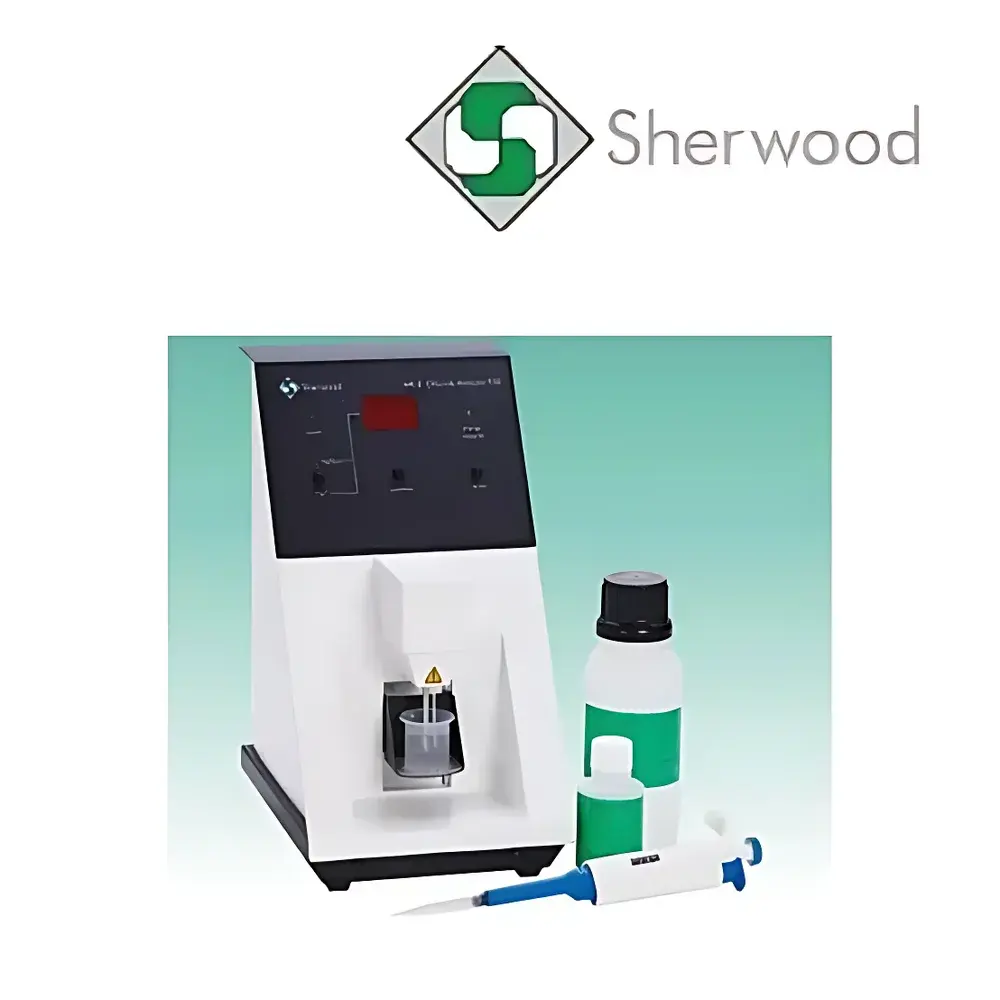
Sherwood M926 & M926S Chloride Analyzers
| Brand | Sherwood |
|---|---|
| Origin | United Kingdom |
| Model | M926, M926S |
| Instrument Type | Benchtop Chloride Analyzer |
| Detection Principle | Coulometric Titration (Silver Nitrate Electrolytic Generation) |
| Sample Volume | M926: 500 µL |
| M926S | 20 µL |
| Measurement Range | M926: 10–999 mg/L Cl⁻ (equivalent to 2–165 mg% NaCl) |
| M926S | 10–299 mmol/L Cl⁻ |
| Detection Limit | 10 mg/L Cl⁻ (M926) |
| Response Time | ≤36 s (typical endpoint detection) |
| Accuracy | M926: ±3 mg/L or <1% RSD at 0.1% Cl⁻ |
| M926S | ±2% at 100 mmol/L Cl⁻ |
| Linearity | ≤1% deviation across full range |
| Repeatability (CV, n=20) | <1.5% at mid-range concentration |
| Temperature Control | Integrated ambient-temperature-stabilized cell compartment |
| Compliance | Designed for GLP/GMP environments |
Overview
The Sherwood M926 and M926S Chloride Analyzers are benchtop instruments engineered for high-precision, trace-level chloride quantification in diverse aqueous matrices. Both models operate on the principle of coulometric titration — a controlled electrochemical process in which silver ions (Ag⁺) are generated *in situ* via constant-current electrolysis of a silver anode. The generated Ag⁺ reacts stoichiometrically with chloride ions (Cl⁻) to form insoluble AgCl precipitate. Endpoint detection is achieved through real-time monitoring of solution conductivity: as free Cl⁻ is depleted, a sharp inflection in conductance signals the completion of the reaction. This method eliminates reagent standardization, minimizes consumable dependency, and delivers inherent accuracy traceable to fundamental electrochemical constants. Unlike potentiometric or colorimetric alternatives, coulometric titration provides direct mass-based quantification without calibration curves — a critical advantage for regulatory-compliant laboratories performing routine water, biological, or industrial sample analysis.
Key Features
- True coulometric titration architecture with digitally regulated constant-current source (±0.1% stability), ensuring reproducible Ag⁺ generation independent of electrode surface condition or electrolyte aging.
- Dual-platform design: M926 optimized for environmental, industrial, and food-grade samples (e.g., boiler feedwater, dairy effluent, soil extracts); M926S configured for low-volume clinical specimens (plasma, serum, urine, sweat) with 20 µL minimum sample requirement.
- Integrated temperature-stabilized measurement cell maintains thermal equilibrium during titration, reducing drift and improving inter-day precision.
- Automated endpoint recognition algorithm compensates for background conductivity shifts caused by matrix ions, enabling robust performance in high-TDS or variable-pH samples.
- Pre-formulated Sherwood Chloride Buffer (sold separately) selectively complexes interfering cations (e.g., Fe³⁺, Cu²⁺, Pb²⁺), suppresses hydrolysis artifacts, and enhances endpoint sharpness — essential for accurate analysis in complex matrices such as mine drainage or digested sludge.
- Self-diagnostic system monitors electrode integrity, current efficiency, and cell cleanliness; alerts users prior to performance degradation.
Sample Compatibility & Compliance
The M926 accepts clarified liquid samples up to 500 µL volume, accommodating turbid or particulate-laden waters following standard filtration (0.45 µm). The M926S utilizes micro-sampling probes compatible with capillary tubes or automated pipettors, supporting integration into clinical lab workflows. Both analyzers comply with ISO 9297 (water quality — determination of chloride — coulometric method) and ASTM D512-20 (Standard Test Method for Chloride Ion in Water). When operated with validated LIMS-integrated software and electronic signature protocols, the system meets data integrity requirements under FDA 21 CFR Part 11, EU Annex 11, and WHO TRS 992 for GLP and GMP environments. Routine verification includes daily system suitability testing using NIST-traceable chloride standards (e.g., KCl solutions certified to ±0.05% uncertainty).
Software & Data Management
Instrument control and data acquisition are managed via Sherwood Chloride Manager v3.x — a Windows-based application supporting method storage, multi-user access levels, and configurable report templates (PDF/CSV). All analytical events — including titration curves, endpoint timestamps, current profiles, and manual interventions — are logged with immutable timestamps and operator IDs. Audit trail functionality records parameter changes, calibration history, and maintenance logs in accordance with ALCOA+ principles. Raw data files retain full waveform resolution (100 Hz sampling), enabling retrospective reprocessing and forensic review. Export modules support seamless transfer to ELN systems and third-party statistical packages (e.g., JMP, Minitab) for SPC charting and trend analysis.
Applications
- Environmental Monitoring: Quantification of chloride in surface water, groundwater, wastewater effluents, and leachates per EPA Method 325B and ISO 9297.
- Industrial Process Control: Boiler feedwater purity assurance (ASTM D1066), cooling tower chemistry management, and desalination plant brine monitoring.
- Food & Beverage Quality: Salt content verification in dairy products, cured meats, sauces, and infant formula — aligned with Codex Alimentarius STAN 206-1999.
- Clinical Diagnostics: Sweat chloride testing for cystic fibrosis diagnosis (CF Foundation Guidelines), serum/plasma chloride in electrolyte panels, and urinary chloride for acid-base assessment.
- Geotechnical & Mining: Chloride profiling in soil pore water, tailings pond monitoring, and ore processing liquor analysis.
FAQ
What distinguishes coulometric titration from traditional argentometric titration?
Unlike manual or auto-titrator-based AgNO₃ addition, coulometric titration generates Ag⁺ electrochemically — eliminating volumetric errors, reagent instability, and pipetting variability. It offers absolute quantification without primary standards.
Can the M926 analyze seawater or hypersaline brines?
The M926 is calibrated for 10–999 mg/L Cl⁻. For samples exceeding 1000 mg/L (e.g., seawater ~19,000 mg/L), dilution with deionized water and matrix-matched blank correction is required. The M926S is not intended for such applications.
Is routine electrode polishing necessary?
No. The silver anode is designed for long-term stability. Performance verification via standard recovery tests (e.g., 100 mg/L KCl spike) every 20 analyses is recommended instead of mechanical maintenance.
How is compliance with 21 CFR Part 11 ensured?
When used with Sherwood Chloride Manager v3.x in “validated mode”, the system enforces electronic signatures, role-based access, and tamper-evident audit trails — all independently verifiable through IQ/OQ/PQ documentation packages available upon request.
Related Products







