
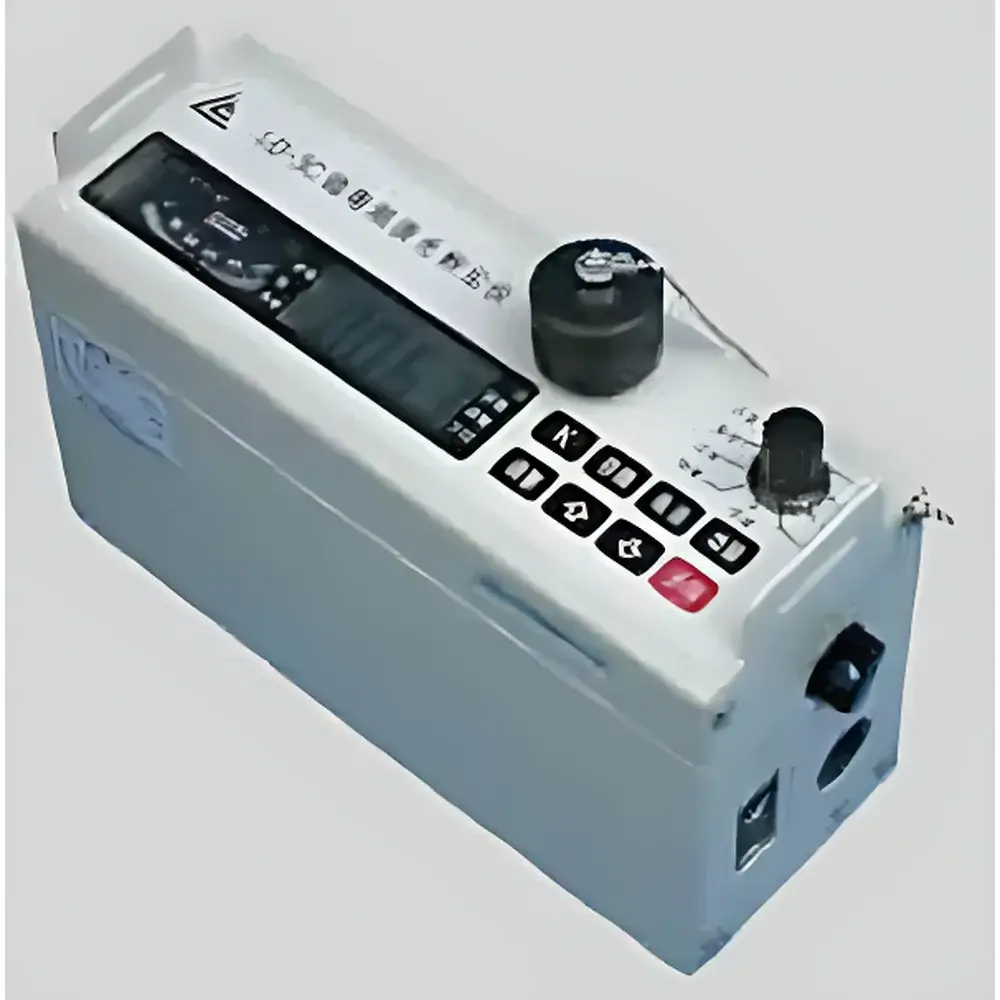
Shibata LD-3C Portable Laser Dust Monitor
| Key | Origin: Imported |
|---|---|
| Manufacturer Type | Distributor |
| Model | LD-3C |
| Measurement Principle | Light Scattering (Laser Nephelometry) |
| Safety Rating | Non-explosion-proof |
| Range (Low) | 0.01–100 mg/m³ |
| Range (High) | 0.001–10 mg/m³ |
| Sensitivity (L) | 1 CPM = 0.01 mg/m³ |
| Sensitivity (H) | 1 CPM = 0.001 mg/m³ |
| Sampling Time Options | 0.1, 1, 2, 5, 10 min + manual mode |
| Accuracy | ±10% |
| Dimensions | 192 × 69 × 140 mm |
| Weight | 1.4 kg |
| Compliance | WS/T 206–2001, LD 98–1996, TB/T 2323–92 |
Overview
The Shibata LD-3C Portable Laser Dust Monitor is a compact, field-deployable optical particulate monitor engineered for real-time measurement of inhalable suspended particulate matter (PM10) mass concentration in ambient and occupational environments. It operates on the principle of laser nephelometry—where a collimated 650 nm semiconductor laser beam interacts with airborne particles, generating scattered light intensity proportional to particle surface area and concentration. This signal is converted to mass concentration (mg/m³) using factory-calibrated transfer functions traceable to gravimetric reference standards. Designed for rapid, on-site assessment—not laboratory-grade speciation—the LD-3C delivers quantitative PM10 data without filter collection or post-processing, making it suitable for routine industrial hygiene surveys, indoor air quality (IAQ) audits, environmental compliance spot-checks, and performance validation of local exhaust ventilation (LEV) or air purification systems.
Key Features
- Direct digital readout of PM10 mass concentration in mg/m³—no manual calculation or conversion required.
- Dual-range detection architecture: High-sensitivity mode (0.001–10 mg/m³) for low-concentration environments (e.g., offices, cleanrooms, post-filtration ducts); standard mode (0.01–100 mg/m³) for higher-exposure zones (e.g., construction sites, foundries, grain handling).
- Integrated self-calibration system utilizing internal reference scattering targets, enabling periodic verification of optical path integrity and detector linearity without external equipment.
- Purged optical chamber design: Continuously flows filtered air across the laser and photodetector surfaces during operation, minimizing contamination buildup and sustaining long-term signal stability.
- Programmable sampling durations (0.1, 1, 2, 5, 10 minutes) plus user-defined manual mode—supporting both short-term exposure assessments (STEL) and time-weighted average (TWA) estimations per OSHA and ACGIH guidelines.
- Acoustic and visual concentration threshold alarm: Configurable upper-limit trigger with LED flash and audible beep for immediate operator notification during exceedance events.
Sample Compatibility & Compliance
The LD-3C is optimized for ambient and workplace air containing non-volatile, solid-phase aerosols typical of mineral dusts (e.g., silica, coal, limestone), metal fumes, wood flour, and general urban PM10. It is not intended for oil mists, sticky organics, or high-humidity condensable vapors that may coat optics or distort scattering geometry. The instrument conforms to three Chinese occupational and public health standards: WS/T 206–2001 (PM10 determination in public spaces), LD 98–1996 (industrial dust monitoring via light scattering), and TB/T 2323–92 (railway-specific dust concentration correlation methodology). While not certified to ISO 12103-1 or EN 481, its optical design and calibration protocol align with the functional requirements of ISO 7708 for respirable fraction definition and ASTM D6245 for indoor air particulate measurement practices.
Software & Data Management
Data logging is performed internally with timestamped concentration records stored in non-volatile memory (capacity: ≥2,000 entries). No proprietary software is required for basic operation; however, optional USB interface enables export of CSV-formatted datasets for integration into LIMS or Excel-based exposure trend analysis. All stored records include sampling duration, range mode, and averaged concentration value. Audit-ready functionality includes immutable timestamps and absence of editable metadata—supporting GLP-aligned documentation workflows where electronic records are subject to review under internal QA protocols. Though not compliant with FDA 21 CFR Part 11 (lacking electronic signature and full audit trail), its deterministic output and fixed calibration parameters satisfy Tier-1 industrial hygiene recordkeeping requirements per OSHA 1910.1200 and EU Directive 2004/37/EC.
Applications
- Occupational health monitoring: Real-time evaluation of worker exposure during sandblasting, welding, grinding, bagging, and demolition operations.
- Environmental site assessment: Baseline and post-abatement PM10 screening at brownfield developments, landfill perimeters, and road construction zones.
- Indoor air quality verification: Pre- and post-remediation measurements in schools, hospitals, and commercial buildings following ASHRAE 62.1 guidance.
- Air cleaner efficacy testing: Quantitative comparison of inlet vs. outlet concentrations across HEPA and electrostatic precipitator units (per AHAM AC-1 test methodology principles).
- Educational and training use: Demonstrating aerosol generation, dispersion dynamics, and engineering control effectiveness in occupational safety curricula.
FAQ
What particle size fraction does the LD-3C measure?
It is calibrated and validated for PM10—particles with an aerodynamic diameter ≤10 µm—as defined by ISO/CIE standard conventions for inhalable mass fraction.
Can the LD-3C distinguish between dust types (e.g., silica vs. gypsum)?
No. It provides total mass concentration only; elemental or crystalline phase identification requires complementary techniques such as XRD or SEM-EDS.
Is routine recalibration required?
Annual verification against a NIST-traceable aerosol generator or gravimetric reference sampler is recommended for regulatory reporting; field checks using the built-in self-calibration function should be performed before each daily use.
Does the instrument require consumables?
No filters, reagents, or gas cylinders are needed. Only periodic cleaning of the inlet nozzle and external optical window with lint-free tissue and isopropyl alcohol is advised.
How is humidity handled during measurement?
Relative humidity >80% may cause hygroscopic growth of particles and overestimation; operation is specified for RH <80%. For high-moisture environments, use with a Nafion™ dryer or heated inlet is strongly advised.







