
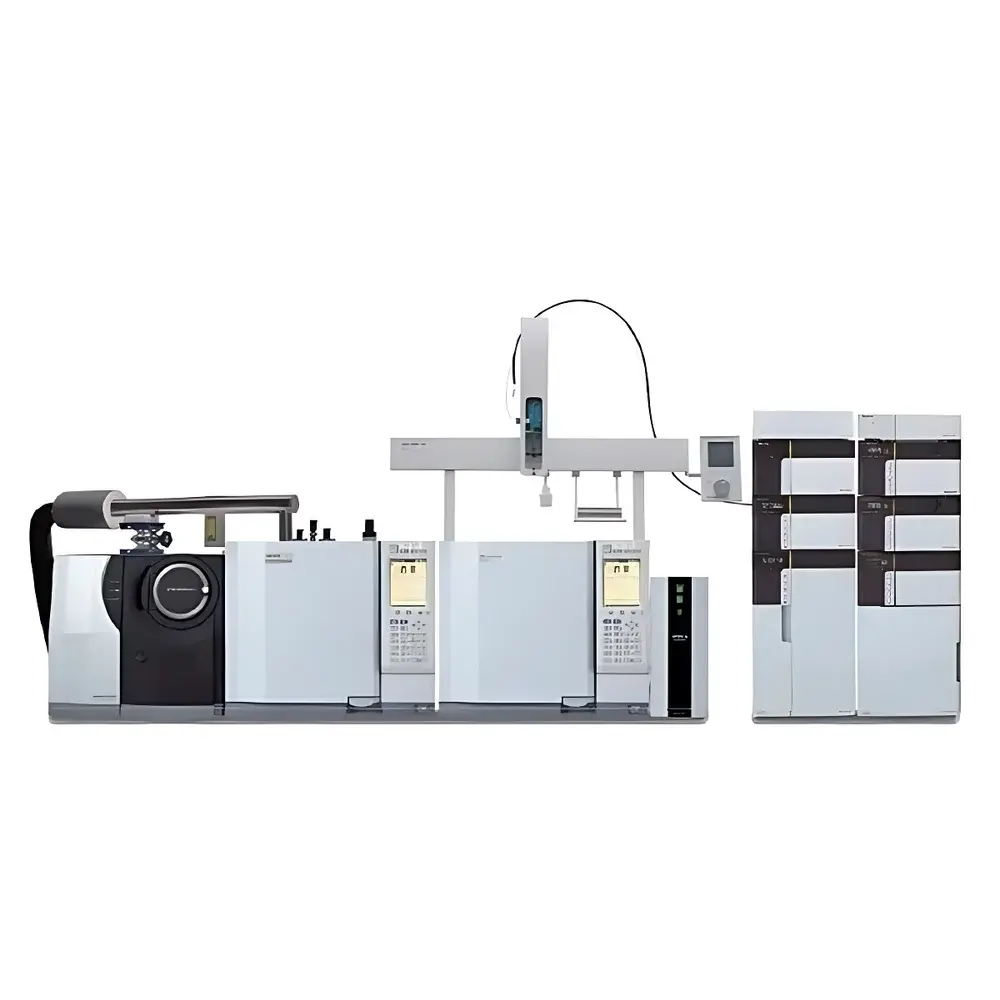
Shimadzu 5D Ultra-e Five-Dimensional Comprehensive Separation Mass Spectrometry System
| Brand | Shimadzu |
|---|---|
| Origin | Japan |
| Manufacturer Type | Original Equipment Manufacturer (OEM) |
| Import Status | Imported |
| Model | 5D Ultra-e |
| Instrument Type | Triple Quadrupole Mass Spectrometer |
| Chromatography Configuration | Comprehensive Two-Dimensional Gas Chromatography (GC×GC) Coupled with Online Liquid Chromatography (LC) |
| Mass Range | m/z 2–1090 |
| Resolution | Unit Mass Resolution |
| Sensitivity | >15,000:1 (S/N, peak-to-peak, at 1 pg OFN) |
| Scan Speed | 20,000 u/s |
Overview
The Shimadzu 5D Ultra-e Five-Dimensional Comprehensive Separation Mass Spectrometry System represents a paradigm shift in high-resolution chemical analysis of ultra-complex matrices. Engineered for maximum orthogonality and peak capacity, the system integrates four physically distinct separation dimensions—liquid chromatography (LC), first-dimension gas chromatography (¹GC), second-dimension gas chromatography (²GC), and two-stage mass spectrometric detection (MS/MS)—into a single, synchronized analytical platform. This architecture leverages the principle of comprehensive multidimensional chromatography (MDGC), where each stage contributes independent selectivity based on physicochemical properties: polarity (HPLC), volatility (¹GC), polarity or polarity reversal (²GC), and mass-to-charge ratio with fragmentation specificity (triple quadrupole MS/MS). The system is built around the GCMS-TQ8040 triple quadrupole mass spectrometer, known for its high-speed scanning, low-noise electronics, and robust collision-induced dissociation (CID) performance—enabling both quantitative precision and structural confirmation in a single run.
Key Features
- Integrated LC-GC×GC-MS/MS architecture with fully automated, software-synchronized operation across all four separation modules
- Dual-oven GC configuration (GC-2010Plus) equipped with the ZX-2 thermal modulator for precise, cryogen-free modulation between ¹GC and ²GC columns
- Online LC-to-GC transfer via OPTIC-4 PTV inlet coupled with AOC-5000 Plus autosampler, enabling selective heart-cutting or comprehensive transfer of LC fractions into GC×GC
- Triple quadrupole mass spectrometer (GCMS-TQ8040) delivering unit mass resolution, scan speeds up to 20,000 u/s, and quantitative sensitivity exceeding 15,000:1 (S/N) at sub-picogram levels
- Modular hardware design supporting method development flexibility—users may operate individual modules (e.g., standalone LC-MS or GC×GC-MS) or engage full 5D workflows
- Rugged, temperature-stable column ovens and pressure-controlled pneumatic systems compliant with ISO/IEC 17025 traceability requirements for calibration and performance verification
Sample Compatibility & Compliance
The 5D Ultra-e system accommodates liquid samples compatible with reversed-phase HPLC (e.g., crude extracts, solvent partitions, digested biological matrices) and volatile/semi-volatile analytes amenable to GC injection after derivatization or direct transfer. It supports regulatory-grade analysis per ASTM D7213 (petroleum hydrocarbon speciation), EU Commission Regulation (EC) No 1881/2006 (MOSH in edible oils), and USP guidelines for multidimensional chromatographic validation. All data acquisition, processing, and reporting functions comply with FDA 21 CFR Part 11 requirements when deployed with validated 5D Solution software configurations—including electronic signatures, audit trails, and role-based access control. System suitability testing (SST) protocols are embedded within the workflow for daily verification of modulation fidelity, peak capacity, and MS/MS transition reproducibility.
Software & Data Management
Control and data handling are unified under Shimadzu’s 5D Solution software suite, which orchestrates instrument sequencing, real-time modulation timing, and event-driven fraction transfer from LC to GC×GC. Raw spectral and chromatographic data are stored in vendor-neutral .cdf format and processed using ChromSquare 2D for contour plot generation, peak deconvolution, and retention time alignment across dimensions. The software includes built-in libraries for MOSH/MOAH identification, petrochemical compound classes (e.g., n-alkanes, iso-alkanes, cycloalkanes, aromatics), and targeted pesticide screening. All processing steps—including background subtraction, baseline correction, and integration—support GLP/GMP-compliant documentation with timestamped metadata and version-controlled method files.
Applications
The 5D Ultra-e excels in applications demanding simultaneous resolution, identification, and quantification of co-eluting isomers and structurally related compounds. Key use cases include: mineral oil saturated hydrocarbons (MOSH) and aromatic hydrocarbons (MOAH) profiling in vegetable oils and food contact materials; detailed hydrocarbon analysis (DHA) of refinery streams and lubricants; non-targeted screening of persistent organic pollutants (POPs) in sediment and biota; and forensic analysis of complex pyrolysis products in coal tar and creosote. Its ability to resolve >10,000 peaks per run enables statistically robust chemometric modeling—supporting principal component analysis (PCA) and partial least squares discriminant analysis (PLS-DA) directly from native 5D data cubes.
FAQ
What does “5D” refer to in this context?
The term “5D” denotes five orthogonal analytical dimensions: (1) LC separation by polarity, (2) ¹GC separation by volatility, (3) ²GC separation by polarity reversal or secondary volatility, (4) precursor ion selection in Q1, and (5) product ion detection in Q3—collectively providing unparalleled peak capacity and selectivity.
Is the system suitable for regulated environmental testing?
Yes—the platform meets ISO 17025 method validation criteria and supports compliance with EPA Methods 8270/8272 when configured with appropriate calibration standards and QC protocols.
Can existing Shimadzu GC or LC instruments be upgraded to 5D Ultra-e?
Hardware integration requires factory-certified coupling modules and firmware upgrades; retrofits are possible only for GC-2010Plus, GCMS-TQ8040, and Prominence HPLC systems manufactured after 2019 with compatible communication interfaces.
What sample preparation is recommended prior to 5D analysis?
Solid-phase extraction (SPE) or gel permeation chromatography (GPC) cleanup is strongly advised for complex matrices to minimize column fouling and matrix-induced ion suppression in MS/MS detection.
Does the system support untargeted analysis?
While optimized for targeted quantitation, the high-resolution 2D chromatograms and full-scan MS/MS capability enable retrospective data mining and library-independent feature detection when combined with ChromSquare 2D’s peak alignment algorithms.





