
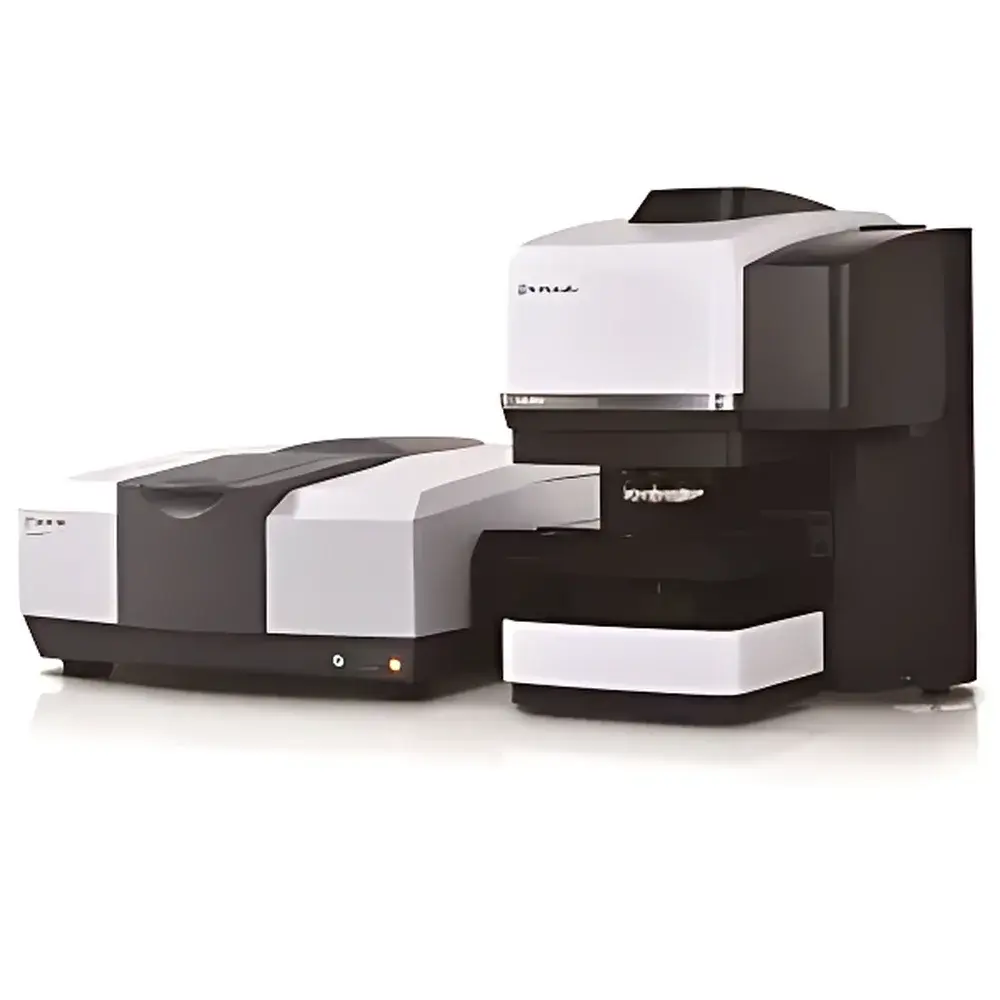
Shimadzu AIM-9000 Infrared Microscope
| Brand | Shimadzu |
|---|---|
| Origin | Japan |
| Model | AIM-9000 |
| Detection Principle | Fourier Transform Infrared (FTIR) Spectroscopy with Reflectance/Transmission Microscopy |
| Optical Magnification Range | 330× continuous (macro to micro, 10 mm × 13 mm to 30 μm × 40 μm) |
| Automated Stage | Motorized XYZ stage with sub-micron positioning repeatability |
| Detector | Liquid Nitrogen-Cooled MCT (Mercury Cadmium Telluride) |
| Spectral Resolution | ≤ 4 cm⁻¹ (user-selectable down to 1 cm⁻¹) |
| Spectral Range | 7800–600 cm⁻¹ (mid-IR) |
| Imaging Mode | Point Mapping, Linear Mapping, Area Mapping (chemical imaging) |
| Software Platform | IRsolution with AI-assisted particle identification and multivariate spectral analysis |
Overview
The Shimadzu AIM-9000 Infrared Microscope is a fully integrated FTIR-based microanalysis platform engineered for high-fidelity chemical identification and spatially resolved spectroscopic imaging of microscopic contaminants, particles, and heterogeneous materials. Designed to commemorate Shimadzu’s six decades of leadership in infrared spectroscopy, the AIM-9000 implements a closed-loop analytical workflow—from optical observation and automated region-of-interest (ROI) definition to spectral acquisition, multivariate processing, and compositional inference—without manual intervention. Its core architecture combines a high-throughput FTIR spectrometer (e.g., IRTracer-100 or similar Shimadzu host), a precision motorized XYZ stage with <1 µm positional reproducibility, and a liquid nitrogen-cooled MCT detector optimized for signal-to-noise ratio in low-light microsampling conditions. Unlike conventional IR microscopes requiring iterative manual focusing and point selection, the AIM-9000 leverages synchronized digital imaging and real-time spectral validation to execute measurement protocols compliant with ISO 17025–accredited laboratories and GLP/GMP environments.
Key Features
- Seamless macro-to-micro observation: Integrated wide-field camera (10 mm × 13 mm FOV) and high-magnification objectives enable continuous 330× optical zoom—eliminating mechanical lens swapping and reducing parallax-induced targeting errors.
- AI-accelerated ROI detection: Proprietary image recognition algorithms identify morphologically distinct particles (>30 µm) in under 1 second, assigning priority scores based on contrast, edge sharpness, and size distribution—enabling novice users to replicate expert-level sampling decisions.
- High-speed chemical imaging: Supports point mapping (up to 1,024 × 1,024 pixels), linear scanning, and area mapping with dwell times as low as 10 ms per spectrum; full spectral cubes (e.g., 200 × 200 × 2,000 data points) acquired in <30 minutes.
- Automated spectral interpretation: The embedded contaminant analysis module performs unsupervised component extraction using hierarchical cluster analysis (HCA) and spectral correlation matching against built-in libraries (e.g., Polymer, Pharmaceutical, Contaminant databases), reporting primary and secondary constituents without prior knowledge of mixture complexity.
- Robust optical path design: Optimized off-axis parabolic mirrors and anti-vibration optical bench minimize alignment drift; all IR optics are purged with dry air or nitrogen to suppress atmospheric CO₂/H₂O absorption artifacts.
Sample Compatibility & Compliance
The AIM-9000 accommodates solid, thin-film, and particulate samples ranging from bulk tablets and coated wafers to airborne residues on silicon substrates or filter membranes. Transmission, reflectance, and attenuated total reflection (ATR) micro-accessories are supported via modular interface design. All hardware and software modules comply with ISO/IEC 17025 requirements for testing laboratories, including audit-trail logging, electronic signature support, and user-access controls aligned with FDA 21 CFR Part 11. Data integrity is ensured through SHA-256 hashing of raw interferograms and spectral metadata, with version-controlled method templates traceable to ISO 9001 quality management systems.
Software & Data Management
IRsolution software serves as the unified control and analysis environment, featuring dual-mode operation: guided wizard workflows for routine QA/QC and advanced scripting (Python API) for custom algorithm integration. Spectral libraries adhere to ASTM E1252 and ISO 18383 standards for reference material certification. Chemical imaging datasets are stored in HDF5 format with embedded metadata (sample ID, instrument parameters, environmental conditions), enabling interoperability with third-party chemometric tools (e.g., MATLAB, Unscrambler X). Audit trails record every user action—including ROI edits, baseline corrections, and library match thresholds—with immutable timestamps and operator IDs.
Applications
- Pharmaceutical: Identification of extraneous particles in injectables per USP <788> and <1788>, coating uniformity assessment, and polymorph mapping in tablet cross-sections.
- Electronics: Failure analysis of solder flux residues, delamination interfaces in PCB laminates, and contamination tracing in semiconductor cleanrooms.
- Materials Science: Phase distribution in polymer blends, filler dispersion in composites, and oxidation state mapping in battery electrode cross-sections.
- Forensics & Environmental: Microplastic identification in water filters, pigment analysis in paint chips, and fiber characterization in trace evidence.
FAQ
Does the AIM-9000 support ATR microanalysis?
Yes—optional ATR objective modules with diamond or germanium crystals are available for surface-sensitive analysis of non-transparent or hydrated samples.
Can spectral libraries be customized or extended?
Absolutely—users may import proprietary spectra in JCAMP-DX format, assign custom metadata fields, and validate new entries against NIST SRM-certified references.
Is remote operation supported for unattended overnight mapping?
Yes—the system supports secure SSH-enabled remote desktop access and scheduled batch execution with email/SNMP alerts upon completion or error.
What maintenance is required for the MCT detector?
The detector requires periodic refilling of liquid nitrogen (LN₂); auto-fill dewars and level monitoring are optional accessories for extended unattended operation.
How does the system ensure measurement traceability?
Each spectrum includes embedded calibration metadata (wavenumber accuracy ±0.02 cm⁻¹, photometric linearity per NIST SRM 1921b), with optional annual verification using Shimadzu-certified calibration standards.




